











Wrapping Up Efficiency
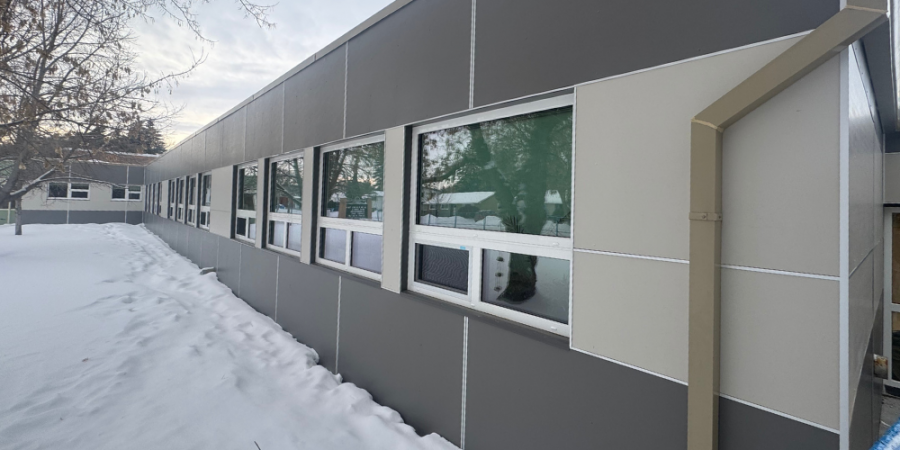

Spray Foam Magazine – Winter 2025 – Upgrading a 65-year-old school to improve its energy efficiency is essential not only for the building itself but also for the success of its students.
When two wall assemblies already feature a vapor barrier on the interior side, introducing a second vapor barrier raises critical building science questions. Spray Foam Magazine chats with a knowledgeable contractor to explore the possible implications of this scenario.
Going back to school is a pivotal time that elicits various emotions. Some children eagerly anticipate returning, while others wish to remain at home or be elsewhere entirely. However, one crucial factor that can and must be controlled is maintaining safe temperatures in schools, which is increasingly vital.
Classroom temperatures that are too hot or too cold significantly hinder students' attention, efficiency, and overall performance. A pivotal study from Cornell University clearly demonstrates the impact of temperature on an environment. It reveals that the optimal range for studying is between 21°C (69.8°F) and 25°C (77°F). These steady temperatures have a dramatic 44% reduction in errors and a staggering 150% increase in output. This indicates that students who feel "too cold" perform substantially worse than those in a comfortable setting.
Moreover, research unequivocally shows that excessively high, or low, temperatures can also detrimentally affect schoolchildren. Numerous studies confirm that student test scores decline on hot days compared to moderate conditions. In summary, classrooms that are either too cold or too hot directly impair students’ ability to learn, stay engaged, and retain information. On the other hand, maintaining an optimal temperature is crucial for enhancing concentration, memory, and problem-solving capabilities among students.
Conrad Correa, President of MAGNUS Construction Services Inc., alongside his cousin Eduardo Chavez, the company's CEO, has established a company dedicated to transforming the insulation landscape. They specialize in spray polyurethane foam and traditional insulation products, including fiberglass, mineral wool, and loose fill for residential applications. As demand surged, they strategically expanded to include super-insulated envelope systems such as Spider Insulation and BIBs (Blown-In Blanket Insulation), along with open-cell foams equipped with vapor barrier solutions.
One project that had them engaged was to enhance the energy efficiency of Prince Philip School in Saskatoon, SK, Canada. This school, over 65 years old, ranks among the least energy-efficient buildings in the city. The team at MAGNUS, along with the architect, were determined to change that. The structure features two distinct wall assemblies:

Applying Elastochem Wrapsulate to the exterior of the building will effectively wrap the school in a protective "blanket" that minimizes thermal bridging.
Older Assembly (Rigid Insulation + Vapor Barrier): - Exterior face brick - Air gap - Rigid insulation - Vapor barrier - Interior face brick
Newer/Common Assembly (Fiberglass Batt Insulation + Vapor Barrier): - Exterior face brick - Air gap - Fiberglass batt insulation - Vapor barrier on the warm side and interior finish
Both assemblies already include a vapor barrier on the interior side of the wall, which presents a critical challenge. Adding conventional rigid insulation or closed-cell spray foam to the exterior would create a second vapor barrier. During extreme Prairie winters, this results in vapor lock, trapping moisture between the two barriers and causing serious issues like condensation, mold growth, and long-term deterioration of the brick and mortar.
Conrad, the owner of MAGNUS Construction Services, points out, “This mistake is unfortunately common in exterior retrofits. Contractors often focus solely on improving R-value and reducing thermal bridging, neglecting essential building-science principles such as dew point management. In both wall assemblies, without a safe path for drying, moisture accumulation leads to dampness and mold indoors, freeze-thaw cracking of the brick facade and mortar joints, efflorescence, spalling, crumbling mortar, and even hidden timber rot in adjoining materials.”
In this project, the architect, Concept Plus Architecture & Engineering, recognized the urgency of keeping both types of wall assemblies dry, safe, and durable. They specified Wrapsulate, a 1lb water-blown spray foam insulation innovation that is uniquely designed for the exterior of buildings made by Canadian manufacturer Elastochem. It creates a seamless barrier that improves energy efficiency, prevents moisture buildup, and protects against water intrusion. This reduces the need for multiple materials in the building enclosure, effectively wrapping the school in a protective "jacket" that minimizes thermal bridging and dramatically improves energy efficiency across both wall assemblies.
Furthermore, the foam tackles moisture management head-on. Its permeable design allows for controlled outward drying, preventing moisture entrapment behind the existing vapor barrier, regardless of whether the interior insulation is rigid or fiberglass. This process is non-invasive; neither assembly requires demolition or modification. By integrating Wrapsulate SPF directly over the brick facade, the MAGNUS crew will ensure a simpler, less disruptive construction process.

The brick school building is designed to breathe, and Wrapsulate will enable the exterior brick wall to continue releasing moisture, shielding it from freeze-thaw damage, efflorescence, surface spalling, and structural deterioration. The architect selected this SPF because it effectively upgrades both wall assemblies. The older rigid and vapor barrier system, as well as the newer batt and vapor barrier system, without creating a double vapor barrier.
It enhances R-value, manages moisture, protects the brick facade, and guarantees long-term durability, comfort, and energy efficiency for the school. The MAGNUS crew divided the project into two phases, with phase one involving a spray area of 1,600 sq ft and phase two covering 3,500 sq ft. The crew, consisting of one sprayer and two support helpers, arrived early in the morning, fully prepared to work safely and efficiently.
Despite less-than-ideal wind conditions, the building itself provided adequate protection across much of the work area. The process commenced with a thorough system flush to eliminate any residual product from the hoses, pumps, and reactor. After ensuring the equipment was clean, the crew introduced the new chemical set, balanced temperatures, and performed several test sprays over poly to confirm the correct foam density and consistency. Showing again that MAGNUS is committed to excellence in every aspect of this project.
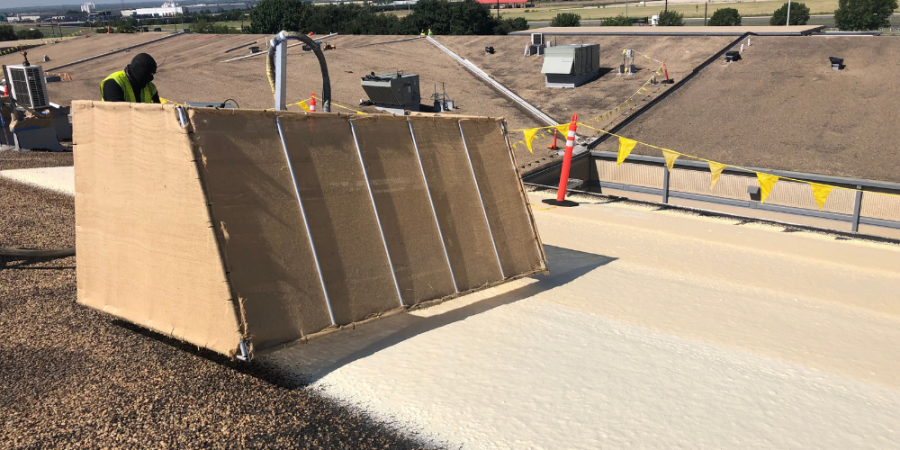
Meanwhile, the support crew masked all windows and surrounding surfaces to protect them from overspray. Special attention was given to areas exposed to wind and any property located downwind. To safely access higher elevations, scaffolding was set up, and MAGNUS’ custom-built wind protection screen, developed for spray foam roofing, was installed to further safeguard the site.
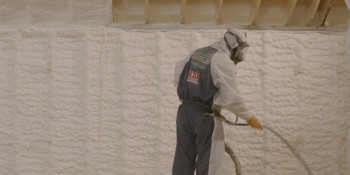
The crew utilized the regular personal protective equipment (PPE) required for any spray foam application. Since the school building was relatively low, the crew was able to reach most areas with one set of scaffolds. For higher sections, safety harnesses were required. Spraying was carried out with precision, ensuring a uniform application.
The crew used an H40 proportioner, 300 ft. of hose, and a Fusion Air Purge Gun to apply four inches of Wrapsulate SPF over the south side of the building's exterior brick walls. They accomplished this using three sets of foam. Once completed, all studs were carefully cleaned to allow for the immediate installation of exterior panels. Only minimal trimming was needed, as the foam was applied evenly without exceeding the wall's surface. This was critical for preserving the foam's natural “skin,” a protective top layer that enhances Wrapsulate’s performance.
Achieving this level of accuracy is only possible through the skill of an experienced applicator, capable of applying the foam smoothly to the exact desired thickness. One challenge for the crew was controlling the foam's expansion. In this application, it was essential to prevent the foam from growing proud of the Z-girts, which would necessitate trimming. Excess trimming would compromise the foam's natural “skin” layer, which serves to protect the open-cell structure from moisture absorption. “Our experienced applicators applied the foam with precision, raising it evenly to the desired thickness while preserving the topcoat to ensure the system performs as designed,” confirmed MAGNUS’s Conrad.
According to the team at MAGNUS, the lead sprayer, Corey Deptuch, expertly handled this project. Corey, who joined Team MAGNUS with an already impressive background in the spray foam roofing industry, brings a wealth of practical knowledge and skill. Over the past ten years with MAGNUS, he has expanded his expertise, adding hundreds of commercial and industrial spray foam, waterproofing, and coating applications to his experience.
Following Phase One, which took four days to complete, MAGNUS Construction Services revisited the school. It was an extremely cold winter day, and the team saw this as an ideal opportunity to compare the performance of the renovated and non-renovated portions of the south wall. Conrad reported, “It was –30°C (–22°F) outside, yet the classrooms behind the newly renovated wall with Wrapsulate installed, maintained a comfortable 21°C (69.8°F). In contrast, the adjacent classrooms with the original, unrenovated south wall registered less than 14°C (57.2°F). That +7°C (+12.6°F) temperature difference illustrates the dramatic impact of spray foam, transforming what would otherwise be an extremely cold, uncomfortable classroom into a warm and livable space for students and staff.”
Today, MAGNUS Construction Services confidently delivers comprehensive building envelope solutions. Their expertise spans from interior wall assemblies, including insulation, drywall, texture, and paint, to advanced exterior insulation and finishing systems, as well as under-slab spray foam insulation for effective radon control and high-performance attic and roof protection systems. They are committed to providing complete, end-to-end services that meet the highest standards.
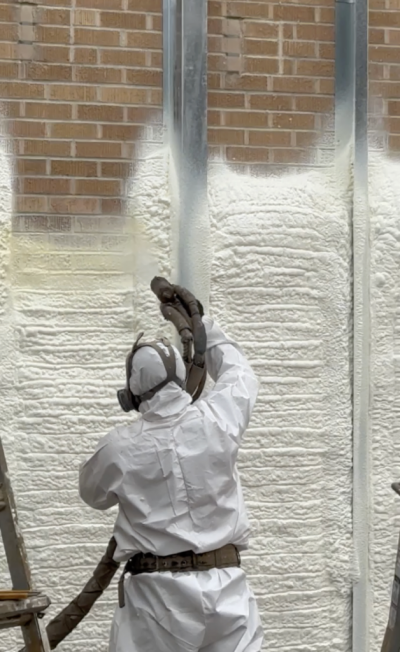
Applying Wrapsulate SPF to the exterior of the building will improve energy efficiency.
At the time of this interview, MAGNUS Construction Services was working on phase two of Prince Philip's School, applying four inches of Wrapsulate to half of the remaining south exterior walls. With their meticulous building science knowledge and research, this second phase will ensure that the building is energy efficient and that students remain comfortable. Well done, MAGNUS! The work you are doing on this project is helping future generations thrive!
Disqus website name not provided.