











Potts on Pot


Spray Foam Magazine – February 2025 – Contrary to his last name, David Potts is not a cannabis connoisseur, but he is an insulation aficionado. In early November of 2025, these two unlikely worlds collided when he and his team at USA Insulation installed two inches of Quadrant HFO closed-cell foam to the ceiling and walls of a commercial-scale grow facility to prevent it from raining rusty water droplets onto the hundreds of thousands worth of plant products below. The problem was condensation and the solution, of course, was foam.
Potts is a franchise owner for USA Insulation. His territories include Toledo, Ohio; Southeast Michigan; Kalamazoo, Michigan; and Northern Indiana. He splits his time between an office in Toledo and another in Kalamazoo, answering customer inquiries and directing foam crews. They primarily do residential retrofits, but every now and again they take on a big commercial job, like this grow-op.
Potts’s reputation precedes him. Since coming onto the insulation scene in 2017, he’s accrued numerous accolades from the community. He’s been the recipient of the BBB Torch Award twice, the Community Involvement Award winner, and the Threshold Key award winner in 2022, and in 2023, made two 40 under 40 lists—the Toledo 20 and Pro-Remodeler. In 2024, he won the IFA Franchisee of the Year Award.
His well-deserved reputation is all the more impressive considering he’s only been with USA Insulation since 2017. Previously, he’d worked as a salesman for a national company hocking windows, siding, and patio doors. He’d joined USA Insulation as a salesman after following one of his former sales managers to the newly-opened Toledo location.
“I figured it would be better to focus on selling one product, insulation, versus trying to sell windows, doors, roofing, and all that. About a year later, corporate decided to franchise out some of the locations. They asked me if I wanted to buy it and I said, ‘hell yes!’ That was 2018, and we’ve been expanding like crazy.”
The franchise’s expansive marketing and advertising efforts caught the eye of the facilities manager in charge of the Sturgis, MI cannabis facility. The building, though fairly new, had been inadequately insulated right from the start. They were battling constant condensation due to the heat and humidity put off by the plants, and cold outdoor weather only made it worse. Something had to be done, with the caveat that any solution needed to happen while the facility remained 100% open and operational. They wondered if SPF could solve a rather expensive and sopping wet problem, and gave Potts a ring.
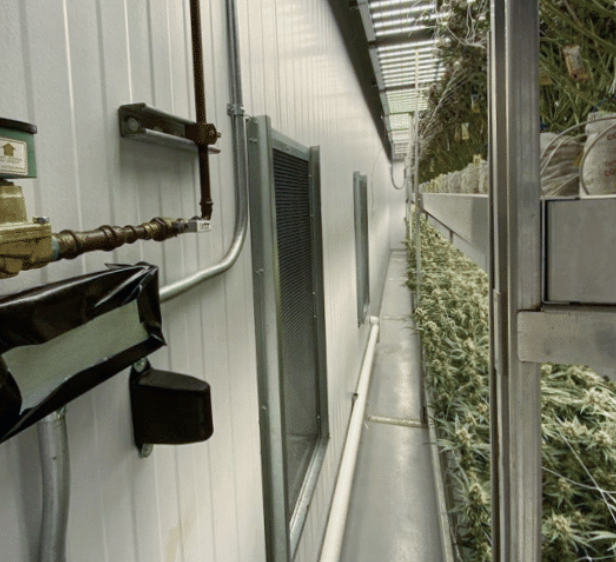
The heat generated by the plant lights was causing condensation to accumulate and cascade down the metal roof and walls of the building.
“We’re primarily a residential retrofit company, but you know with spray foam, sometimes you get into weird things. So, I told them I couldn’t guarantee anything, but I’d at least come look.”
The sprawling cannabis facility is multipurpose and vertically integrated, meaning that they grow, process, and sell their products out of the same building. In the back, they are a bonafide indoor pot farm, with what is essentially a massive greenhouse full of high-quality plants. They do all their own processing on site, which includes drying the plants, extracting the cannabinoids, and manufacturing products like infused edibles, concentrates, and of course, flower buds. Front-of-house is a proper dispensary where products are displayed, and customers are eager to pay. Sometimes money can grow on trees, but rather than profit going up in smoke, it was being contaminated by a deluge of condensation dripping from the metal ceilings.
From his initial visits to the facility and conversations with the managers, it was clear that this oversight wasn’t a result of cutting corners or of trying to cheap out on a decent building envelope. It was a costly mistake, likely due to a communication mishap.
“It’s a nice, well-done building, but from the beginning, I don’t think either the builders or the owners had the conversation of, hey, this is a grow facility, and it’s going to have very different needs from just a regular workshop due to all the plants and lights and heat,” Potts recalls. “When it was cold, all the condensation from the humidity and heat was escaping the grow rooms and collecting on the uninsulated outer ceiling. And it was just raining, almost like one of those walk-in rainforest exhibits at the zoo. There was no HVAC system that could possibly keep up with it, and it was a slip and fall hazard for staff,” he added.
As if having an unintentional indoor rainforest puddling on the floor wasn’t bad enough, it didn’t take long at all for rust to start to form on the metal roof and walls. So, not only is it raining where it shouldn’t be, the raindrops are rusty and orange and probably depositing unknown contaminants onto the plants. They obviously can’t sell contaminated plants, so what do they do? Trash them? Burn them? With each room capable of producing around $200,000 of cannabis products each week, this problem needed fixing yesterday.
While touring the site and assessing feasibility, Potts gained a sprout of confidence after remembering some previous work they’d done for an indoor facility that grew organic strawberries. It wasn’t quite the same situation, but after consulting with others in his spray foam network, Potts decided his team would take on the job after all.
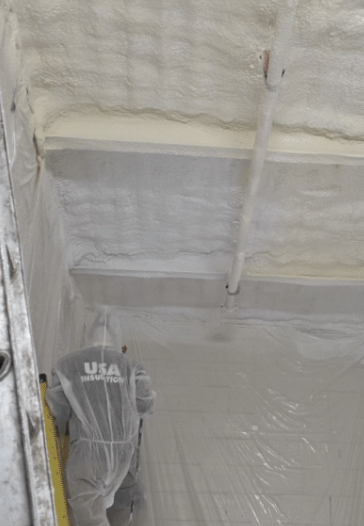
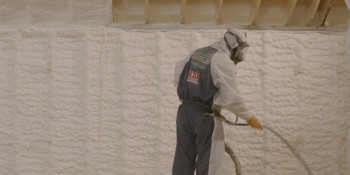
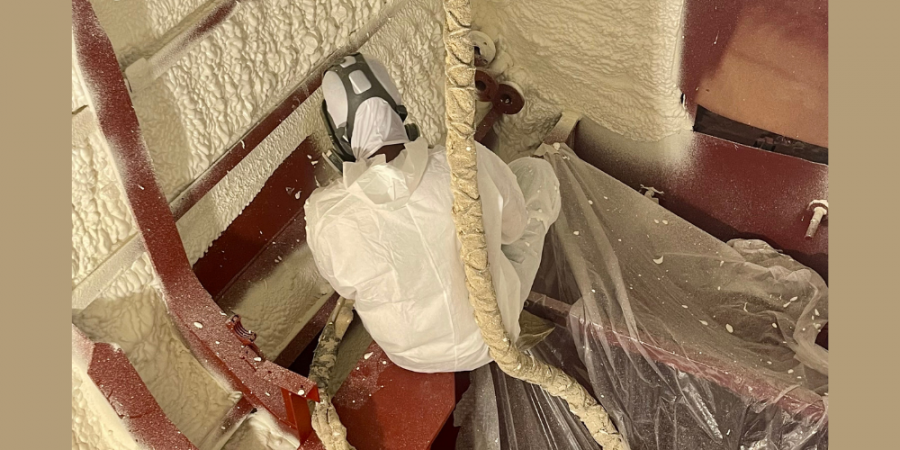
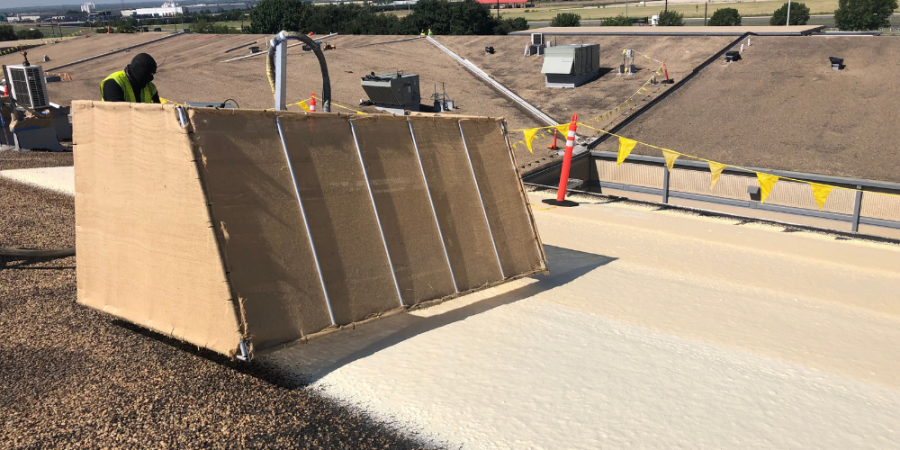
A sprayer works inside the containment tent to install two inches of Quadrant HFO closed-cell foam to the walls and ceiling without affecting any of the cannabis workers going about their daily routines.
Over the course of two weekends, Potts sent out a rotating team of nine to insulate the facility’s metal ceiling and walls with a two-inch layer of Quadrant HFO closed-cell foam, complete with FIRESHELL F10E and FIRESHELL F1 coatings. The winning team was made up of about four sprayers handling the foam, two painters for the coatings, and the rest were helpers.
Because the facility still had to be operational 24/7, the spray foam team’s strategy had to be air-tight. The work began in the grow rooms, since that’s where the majority of the problem was occurring.
First, the team used six-mil poly to create a containment tent with close to zero air penetration around where they’d be working– roughly 16 feet above the floor. The containment tent enabled the sprayers to safely foam the walls and ceiling while allowing the cannabis cultivars to tend to the plants below without any risk of further contamination from overspray. Inside the containment tent, they also masked all the ceiling fixtures, such as sprinklers, pipes, and HVAC systems. They reached the ceiling and tops of the walls using a combination of tall ladders and rolling scaffolding.
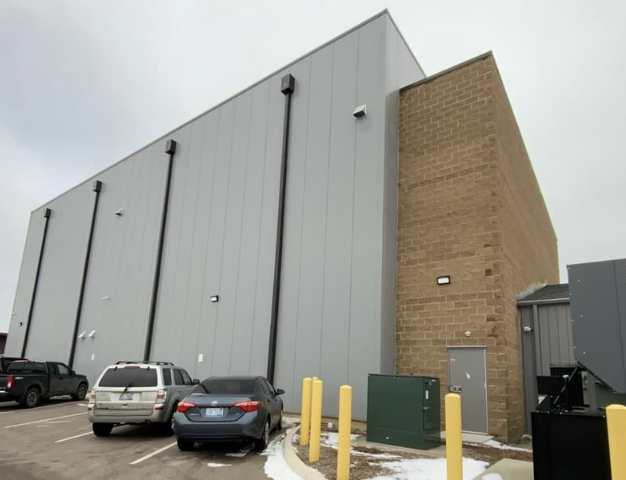
An exterior shot of the cannabis grow facility in Sturgis, Michigan.
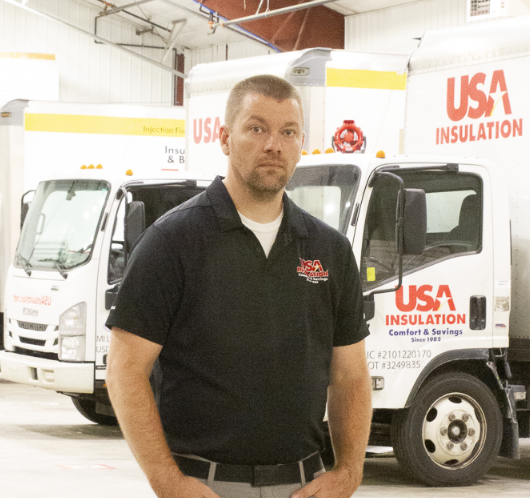
David Potts, owner of several USA Insulation franchises, poses beside his rigs.
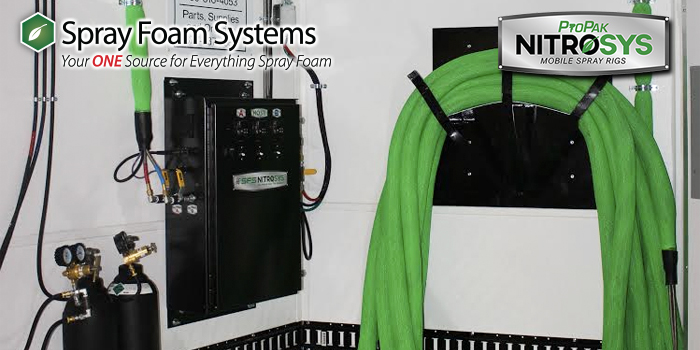
After containing their work area with six-mil poly, they installed two inches of Quadrant HFO closed-cell foam, topping off the cured foam with a coating of double whammy FIRESHELL F10E and FIRESHELL F1 coatings. They installed both the foam and the coatings using a Nitrosys HFO Plus system and an N-Plus Metal spray gun, also by Nitrosys.
“The F10E was the intumescent coating and the F1 was a topcoat for the humidity, to protect everything from moisture,” explained Potts.
Potts credited the Nitrosys reactor for making the job even safer for the cannabis workers who still needed to be in and out of the work area while spraying was in process. He explained that using this low-pressure rig means residential customers don’t have to completely vacate their homes for a full 24-hours, as is common with higher pressure rigs. It gave them a leg up on this grow facility job because it allowed the cannabis workers more freedom to complete their job duties while spraying was in process.
“For commercial jobs like this, maybe we’re a little slower than the guy with the high-pressure rig, but we don’t do enough of it that it affects us,” said Potts. He added that the low-pressure Nitrosys also tends to be safer for the employees. A 3M full-face respirator with P100 particulate filters, plus the standard Tyvek suits, gloves, and a couple air exchange fans did the trick for PPE.
It took about six sets of foam and between 15 to 20 cans of each FIRESHELL coating to envelope the entire building, which Potts calculated was about 22,000 board feet in total. The USA Insulation team completed the project over the course of two weekends, finishing up in early November 2025.
With the condensation conundrum finally behind them, the facility hasn’t experienced any more rusty rain showers or perilous puddles. Best of all, it gave Potts and his rockstar team at USA Insulation the chance to rise to a new challenge in the realm of commercial jobs, rather than letting the opportunity go up in smoke.
Disqus website name not provided.