











The Warmth Within


Spray Foam Magazine – Winter 2025 – Hot tubs are universally recognized as a luxurious way to relax. Their designs have undergone significant evolution over the years, with insulation playing a pivotal role in this advancement. The team at Spray Foam Magazine engaged with a leading Canadian hot tub manufacturer that is unwavering in its commitment to excellence and demands the highest standards from the superior materials it utilizes, particularly SPF.
Archaeological evidence confirms that ancient Egyptians had been harnessing the therapeutic benefits of hot baths for around 4,000 years. Known for their impeccable hygiene, they are believed to have bathed in these tubs at least four times a day. The Greeks and Romans also valued hot water for its healing properties, while the Japanese embraced the philosophy of their natural hot springs (Onsen) by crafting wooden tubs for enjoyment. The modern hot tub, as we recognize it today, was introduced by American innovator Roy Jacuzzi in 1968. By perfecting water sanitation and filtration, and utilizing newly developed acrylic and fiberglass shells, he eliminated the common issues of leaks, mold, and toxins that plagued the original all-wooden models.
Founded in 1978 by Keith and Judy Scott in Surrey, British Columbia, Beachcomber Hot Tubs remains a trailblazer in the industry. Their manufacturing facility in Surrey, combined with distribution centers in Vancouver, Toronto, and Montreal, underscores their commitment to Canadian craftsmanship. As a family-owned manufacturer, Beachcomber has produced some of the first hot tubs to include spray foam. They have also earned acclaim for their meticulous manufacturing process, exceptional quality control, integrity, and outstanding customer service.

Sandra Yue has been a driving force at Beachcomber for over 23 years. Starting as a UBC Mechanical Engineering Co-op student in 2002, she has ascended to the role of Director of Manufacturing and Engineering.
“At the Beachcomber factory, we firmly believe that just as you wouldn’t buy a home that isn’t fully insulated, you shouldn’t settle for a hot tub that isn’t fully insulated,” she asserts. “By filling the entire cavity with Elastochem open-cell spray foam insulation (SPF), we craft some of the industry’s most energy-efficient models. The foam also acts as a structural adhesive, providing essential rigidity and support for the hot tub’s plumbing and internal components.”
The SPF applied by the Beachcomber crew provides excellent insulation that retains heat within the tub. It effectively prevents moisture and condensation build-up within the hot tub’s cavity caused by temperature differentials and other factors. Furthermore, the open-cell foam delivers, draft and soundproofing, significantly reducing noise from the jets and pumps, thus enhancing the relaxation experience.

There are 2x3 pressure-treated wooden structural members that are tied into the acrylic shell and the cabinetry to support the weight of the hot tub and the hot tub water. Beachcomber provides a lifetime Guarantee on the shell structure of the hot tub, so these are put in place to ensure structural rigidity for the lifetime of the product.
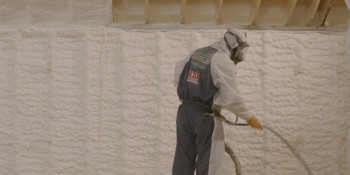
Safety is non-negotiable for the spray foam insulation crew at Beachcomber. They are equipped with full protective gear, including respirators, gloves, suits, and goggles before picking up the spray foam gun. The tub must be upside down for the crew to fill the cavity of the hot tub with the top of the tub being the acrylic shell.
Employing a Graco Reactor H25, and using a Probler P2 spray gun, they expertly install Elastochem’s Insulthane 450 NM open-cell foam into the hot tub’s cavity, ensuring comprehensive coverage from the acrylic shell to the cabinetry and all the way to the bottom of the tub.
The open-cell foam expands rapidly, up to 30–60 times its liquid volume, to fill all gaps and cavities. It sets quickly, within seconds to minutes, though full curing may take up to 24 hours. Any excess foam is meticulously trimmed flush with the bottom of the hot tub’s cavity to accommodate the ABS cap (Acrylonitrile Butadiene Styrene). The team rigorously inspects each tub for voids or missed spots, applying additional foam as needed to maintain their high standards. Once the foam is sprayed and fills the entire cavity, the Beachcomber team covers it with a form-fitted ABS cap to protect the foam and hot tub components from environmental elements and pests.
Beachcomber proudly boasts a 98% customer referral rate and has hot tubs that continue to operate excellently after 25 years. They stand firmly behind their products, offering a lifetime guarantee on the shell structure. The production line includes approximately 300 quality checks and inspections across 30+ work centers, illustrating that quality comes second only to safety in their operational ethos.
Beachcomber sells hot tubs globally, with production levels fluctuating each year based on diverse factors, including economic conditions both domestically and internationally. They have also managed some unique deliveries, including a hot tub that was crane-lifted onto a penthouse suite and installations on houseboats. Beachcomber’s unwavering commitment to utilizing superior materials like Elastochem foam, combined with their dedicated workforce, has positioned them as a dominant force in the hot tub industry.
Disqus website name not provided.