












Class Act
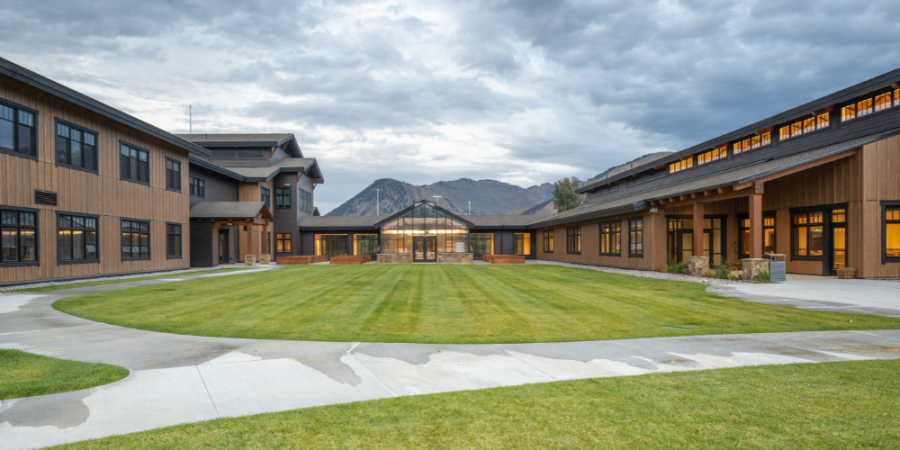
Photo Credit: JHCA

Spray Foam Magazine – February 2025 – High Country Solutions (HCS) are a team of insulation experts operating out of Alpine, Wyoming, led by co-owners Skeeter Aimone and Brad Morrison. Together with their crew of meticulous spray foam pros, they lent their skilled hands and sharp minds to the construction of Jackson Hole Classical Academy’s (JHCA) new campus.
They spent the better part of a year either collaborating with the architects about the project or working on site to set the plan in motion. When all was said and done, they’d used about 70 sets of NCFI InsulStar 1.7 lb closed-cell spray foam across the school’s roof deck, attic ceiling, and exterior walls, plus more than a few dollops of No-Burn Intumescent Coating anywhere the foam was present.
The new campus at JHCA has been a work in progress for several years. Classes were taught on-site out of modular trailer-type structures, while the new, permanent school building came together little by little. The modular buildings worked well as a temporary fix, but students and teachers alike were more than ready to finally move into the completed main campus. JHCA’s main building features a bright, open floor plan complemented by gorgeous wooden accents and pastoral outdoor views from its many windows. Not only that, but the entire school is also outfitted with a cutting-edge insulation system which is guaranteed to save the school a ton on energy costs– and it could even benefit the student’s developing brains.
Several studies have shown that temperatures, especially too-warm temperatures, can have a drastic effect on a student’s academic performance. After all, it’s hard to focus on learning long division when you’re sweating through your uniform or shivering in your seat. Luckily for the students of the new and improved JHCA, the K-12 private school is now outfitted in the top-of-the-line, LEED Certified insulation system designed to keep indoor temps comfortable, no matter the outdoor temperature. It’s a decision that will keep the student’s test scores high, and the school’s power bills low.
Fully Booked: Pre-Construction Proactivity
High Country Solutions was contracted by the project’s general contractor, DPR Construction. HCS was involved in the project months before they even sprayed the first bit of foam. They were welcomed aboard the project in June 2024. The architects and engineers valued having the insulation folks at their beck and call to answer any logistical or technical questions. It allowed them to anticipate and solve problems before the stakes got too high, or the deadline too close.
Morrison and Aimone found the builder’s proactive approach comforting. To them, it signaled that the client was seriously prioritizing getting the insulation Goldilocks-perfect. The open communication conveyed that the HCS team’s opinions were valuable beyond just being the hired hand.
As Morrison explained, the early conversations involved explaining the science of a proper building envelope, then problem-solving any holes they uncovered in the initial blueprints and avoiding costly mistakes.
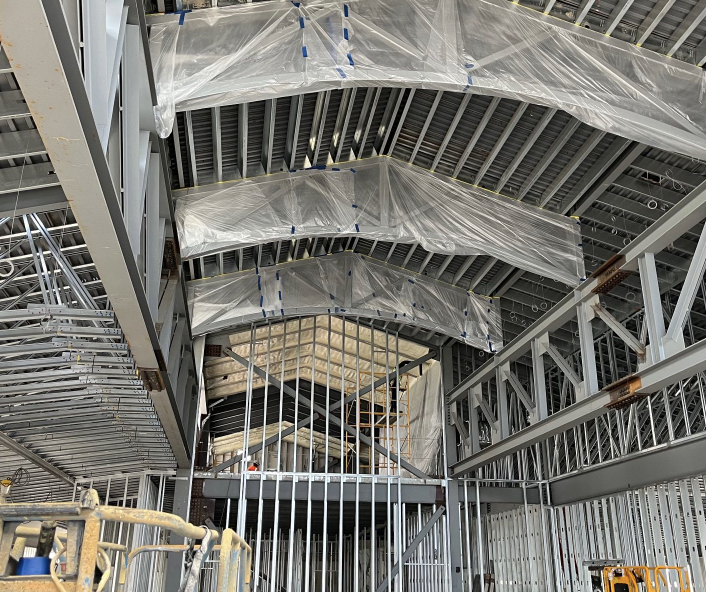
At this point in the process, the building’s interior is coming together, but still skeletal. Still, HCS covered up the structural beams before spraying. Later, these beams will be covered in wood veneer for a polished, classic look.
Morrison describes the team’s presence on the campus as continuous. If they weren’t there in the flesh, they were there in spirit, and always a phone call or text away.
“There was maybe a month or two where we weren’t physically on-site. But everything went pretty seamlessly, because the general contractor really had their ducks in a row,” he recalls.
And ducks in a row is exactly what they needed to keep this massive job on-schedule and on-budget. Before long, it was time to put on their work boots and head out to Jackson Hole to put their plans to action.
Studying Up: Prepwork and PPE Poindexters
Each day, the HCS team began the day with an idea in mind of what they should accomplish. Some days were straightforward and only required two to three guys. Other days were more involved and called for eight or nine crew members to head over to Jackson Hole to get their hands dirty.
Communication was vital, both for professional courtesy as well as safety. Until the foam cured, no one without PPE could be in the areas that were being actively sprayed. HCS had to coordinate with other trades about what everyone was working on, when, and where. This involved daily meetings with DPR Construction to sort out the day’s logistics and agenda before spraying the first drop of foam.
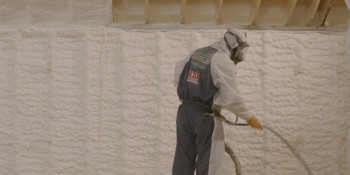
To prevent others from being unnecessarily exposed, part of their daily prep work involved hanging reflective signage around the work area that read “SPRAYING IN PROGRESS.” To protect themselves, the sprayers wore 3M respirators, protective coveralls, and gloves. Because it was an active construction site, hardhats were required for just about everyone. Even the sprayers wore hard hats when not spraying.
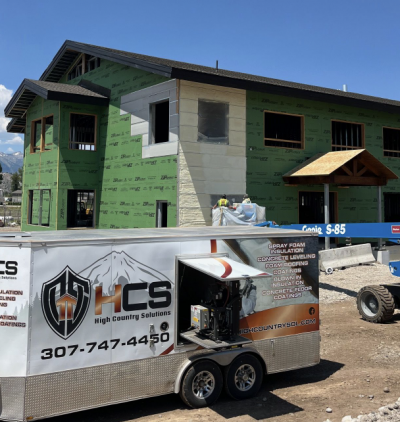
During the foaming process, HCS used a plastic-covered lift to install the foam up and down the school’s exterior.
After their daily briefing with the general contractor, there was a lot of prep work to do before firing up the rig and unraveling the hoses. For example, the finished school features many exposed beams and fixtures that had to be painstakingly covered with plastic. Even the concrete floors, which would soon be covered up by another flooring material also had to be completely shrouded with plastic to prevent even a speck of foam from marring it. They also covered other fixtures as needed such as doors, banisters, and windows—and there were a ton of windows to let natural light in. While the sprayers readied the rig, the helpers scurried around, taping up just about everything with protective plastic except the soon-to-be-foamed substrate.
On busier days that necessitated a bigger turnout, the HCS team divided the labor into three distinct crews, with one sprayer leading each team. The helpers got to work with the extensive prep work—covering everything with plastic and hanging warning signs. Sometimes, helpers would be off in another part of the building to hang fiberglass batt.
Sticking to the Syllabus by Powering Through the Process
When it was time to spray, HCS used their PMC PH-2 reactors and Graco PC guns to install six inches of InsulStar 1.7 lb closed-cell foam to the roof deck, exterior walls, and ceiling. They also installed blown-in insulation in sections of the attic void space. Every foamed area also received No-Burn Intumescent Coating. The helpers also installed fiberglass batting to certain interior areas of the school where sound dampening was a concern.
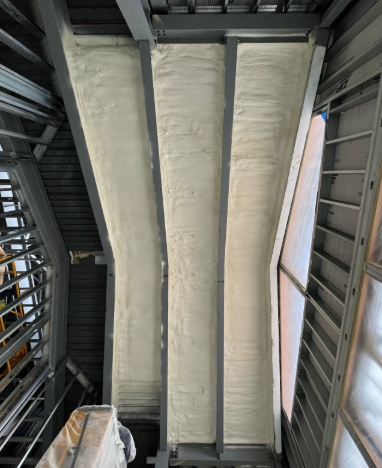
A lofty view of some of the high ceilings inside the school. As pictured, most of the ceilings got six inches of InsulStar 1.7 lb closed-cell foam. Other void spaces, like certain parts of the attic, got one inch of foam and blown-in insulation for the rest–a cost-effective solution given the sheer size of the building.
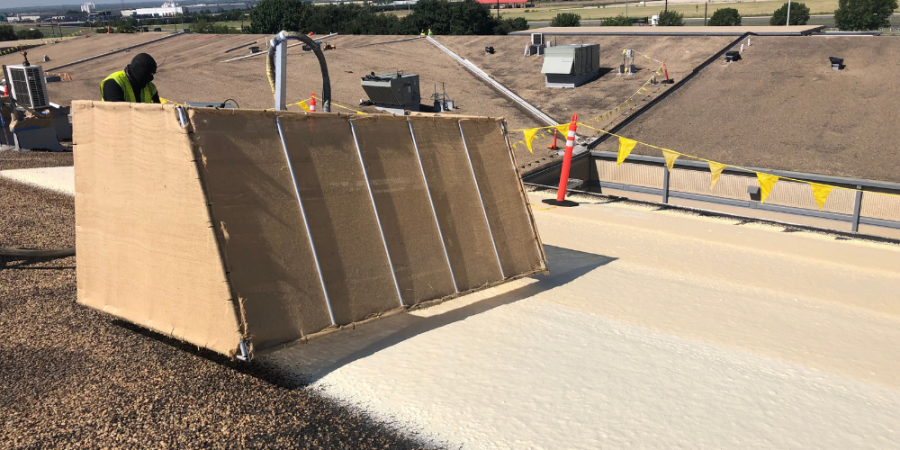
They installed six inches of foam to the roof deck, two inches to the exterior walls, and one inch to certain areas in the attic ceiling. Some sections of the foam they installed on the roof would need to be cut and adjusted when it was time to install some of the mechanical components, such as the air handling units and other parts of the HVAC insulation system. As Morrison explains, this need for flexibility was a core reason to use spray foam. As easily as it goes on, it can be cut and removed in small sections to retrofit any equipment they need. So, the crew would install the smooth layer of foam as normal, wait for it to cure, then add the No-Burn Intumescent Coating over top. At a later date, the foam could be cut and removed without much hassle and touched up as needed once everything was installed.
On the exterior walls, they sprayed two inches of foam between the metal framing, right onto the wall covered in ZIP System sheathing. ZIP System alone has an R-value of about 10, hence why they could get away with a thinner foam layer on the walls while still achieving impressive results.
Morrison explained that the client opted to use and combine different insulation types in certain areas rather than sticking with only foam:
“Parts of the vaulted roof received six inches of closed-cell foam sprayed right onto the rigid exterior. But then there were these big attic access spaces where we only put one inch of foam onto the sheetrock for a vapor barrier, then filled the rest in with blow-in fiberglass.” Combining the two insulation types was the most cost-effective way for the client to get a full vapor barrier and a complete building envelope of around R-60.
Spray Foam Makes the Honor Roll
High Country Solutions put a bow on their part of the project in August 2025. They left the school knowing they’d installed one heck of a building envelope, having gone through about 70 sets of InsulStar 1.7 lb closed-cell foam to do so. Two months later, the school held a grand opening ceremony just as temperatures began to drop and the first hint of wintery weather graced the mountain air. Thanks to High Country Solutions and the architects who prioritized the insulation right from the get-go, the JHCA community can focus on learning without being distracted by temperature fluctuations or unwieldy power bills.

An exterior shot of JHCA’s picturesque main campus. It officially opened in October 2025, just two months after the HCS team finished their part.
See the Business Behind the Story:
Disqus website name not provided.