












Raising the Standard

Spray Foam Magazine – Summer 2026 – Flemingsburg, Kentucky, tucked in the rolling hills of the northeastern part of the Commonwealth, is the hometown of Franklin Runyon Sousley, one of the six U.S. Marines immortalized in Joe Rosenthal’s iconic photograph of the flag raising on Iwo Jima. That same spirit of doing things right, of building something that endures, now shapes a new chapter for the community’s youngest residents.
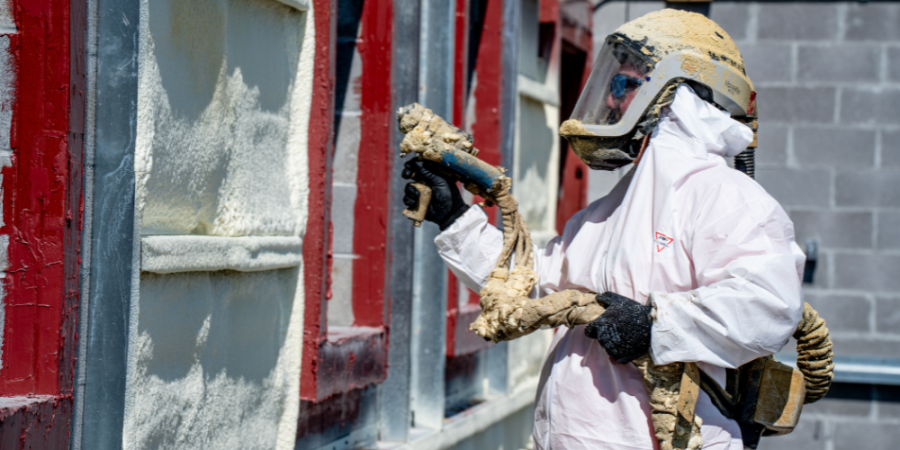
When Fleming County broke ground on a brand-new, 600-student elementary school, Chad Collins already knew what the building would be wrapped in. Collins is the president of Spray Foam Technologies of KY, a commercial insulation contractor based in Stanville, and built his reputation on a simple conviction: for a project like a school that will serve a community for generations, there is no room for second-best.
“Closed-cell SPF is not a single-purpose product,” he says. “It is a high-performance building science system that simultaneously addresses four critical functions of the building envelope — insulation, air barrier, vapor retarder, and water-resistant barrier — in a single application.”
For the new Fleming County Elementary School, Collins specified NCFI’s InsulBloc OPTIMAXX, a commercial-grade, 2-pound closed-cell SPF formulated for exactly this kind of demanding, high-stakes application.
“It’s the finest field-tested, closed-cell insulation for schools,” Collins says flatly.
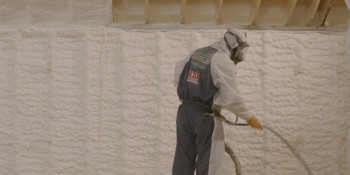
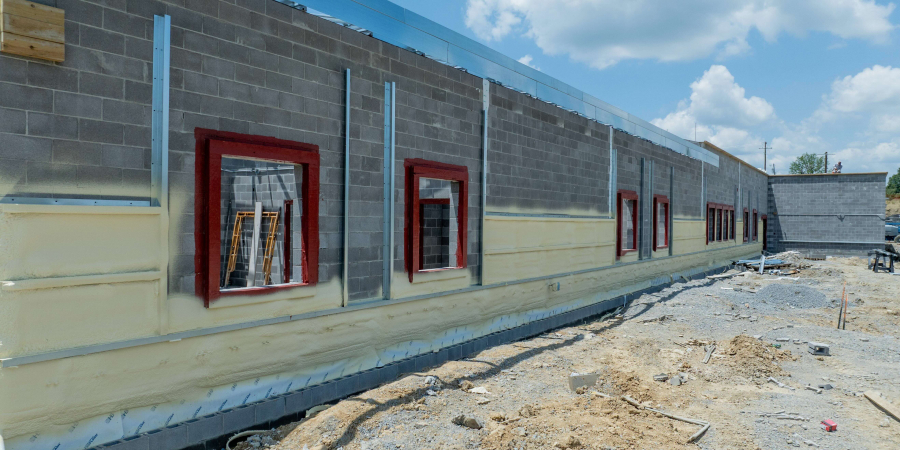
Construction manager Packs + Walker had selected the green-site project — a masonry load-bearing structure with steel columns and beams, chosen by the Fleming County Board of Education to replace aging infrastructure — to be covered with architectural panels. The envelope system underneath those panels would determine how the building performed for the Flemingsburg community for the next half-century. Collins and his crew applied 115,000 board feet of InsulBloc OPTIMAXX across the entire exterior facade.
Four Performance Advantages Schools Can’t Afford to Skip
The case for closed-cell SPF in an institutional building like a school rest on four functions it performs simultaneously — functions that, in any other system, would require multiple products, multiple trades, and multiple opportunities for failure.
- Thermal Performance —Closed-cell SPF achieves the highest R-value per inch of any commercially available insulation — typically R-6 to R-7 per inch. For a masonry school building where wall thickness limits how deep traditional batt or rigid board can be installed, that thermal density is decisive. More R-value in less space means lower heating and cooling loads, reduced utility costs, and a more comfortable learning environment. For a school operating for 50 or more years, the lifetime energy savings can be substantial.
- A True Air Barrier — Air infiltration accounts for 25 to 40 percent of a building’s heating and cooling load. Closed-cell SPF expands to fill every void, gap, and penetration, forming a seamless, monolithic air barrier that conventional insulation cannot replicate. The result is a tighter building envelope, measurably lower air changes per hour, and dramatically improved indoor air quality — a priority in any facility where children spend the majority of their day.
- Waterproofing and Moisture Management — The closed-cell structure is impermeable to liquid. Unlike legacy insulations, closed-cell SPF does not absorb or hold moisture. Applied to the exterior facade of a masonry building, it functions as an integrated water-resistant barrier, protecting the structure from freeze-thaw cycling, wind-driven rain, and bulk water infiltration. Moisture damage inside a wall cavity can compromise structural integrity and occupant health for decades. Closed-cell SPF eliminates that risk at the source.
- Wind and Structural Resistance — Closed-cell SPF bonds tenaciously to the substrate and adds measurable compressive strength and racking resistance to the wall assembly. Independent testing has shown it can significantly increase a wall’s resistance to wind uplift and lateral loads. In Kentucky, where severe storms and occasional tornadoes present real risks to occupied buildings, that structural contribution is a genuine life-safety benefit — particularly for a school sheltering hundreds of children during weather emergencies.
The Product Behind the Performance
Collins is direct about why he chose InsulBloc OPTIMAXX over the alternatives.
“Our relationship with NCFI gives us confidence in every job we take. Their products are consistently the highest quality available, and their team’s depth of building science knowledge and customer care is unmatched. On a project like this — a school that will serve this community for generations — we wouldn’t use anything else.”
NCFI — headquartered in Mount Airy, NC, and Houston, TX — has been manufacturing and innovating polyurethane foam systems for over 60 years. The InsulBloc product line is formulated for commercial and institutional construction. OPTIMAXX means it’s the latest fully optimized formulation — offering the consistent yield, dimensional stability, and adhesion strength that large-scale exterior applications demand.
Mitch Clifton, EVP of NCFI’s Construction Foam Division, puts the track record plainly: “Hundreds of schools, colleges, universities, and hospitals have used InsulBloc over the past 25 years to provide the safest engineered building product, highest air quality, and best energy cost savings of any insulation. Bar none.” Of contractors like Collins, Clifton adds: “Chad and his company lead the way.”
NCFI is an active member of the SPFA, ABAA, Energy Star, and IA, and a recipient of the EPA’s Montreal Protocol Award — recognizing a commitment to environmental stewardship that extends from the chemistry of the product to the standards of its application.
Raising the Standard
For the 600 children who will learn inside its walls — and the generations who will follow — it represents the same thing: a community that believes its future is worth protecting. Thanks to Spray Foam Technologies of KY and NCFI’s InsulBloc OPTIMAXX, the building envelope protecting that future is as tight, resilient, and enduring as the community that built it.
Spray Foam Magazine does not take editorial positions on particular issues; individual contributions to the magazine express the opinions of discrete authors unless explicitly labeled or otherwise stated. The inclusion of a particular piece in the magazine does not mean that individual staff members or editors concur with the editorial positions represented therein.
Published by Spray Foam Magazine
SprayFoam / Spray Foam Insulation
See the Business Behind the Story:
Disqus website name not provided.