












Stormproof by Design
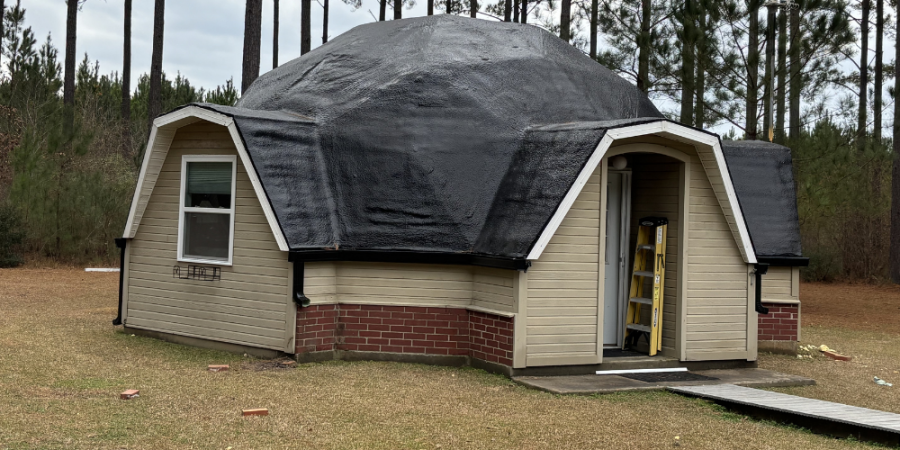
PHOTOS PROVIDED BY DUSTIN CHRISTY

Spray Foam Magazine – Summer 2026 – Monolithic dome home construction has been around since the 1970s. Yet only recently has it been recognized and appreciated for its durable design. Census data indicates that weather-related disasters displaced over 3.3 million American adults in 2022. Spray Foam Magazine was excited to interview Dustin Christy, owner of Spray Foam Worx (formerly Spray Foam Professionals), about a recent dome home project he completed.
Dustin’s enthusiasm for spray foam is evident. He founded his business over 11 years ago in Monroe, Louisiana, and his professional reputation often leads him to projects beyond his hometown. This dome home project was not far for Dustin to travel to and one he looked forward to tackling.
The aerodynamic design of dome homes provides exceptional durability against high winds and storm surges. The curved surface and absence of roof-to-wall corners allow wind to pass over the structure, reducing direct impact and distributing strain. As a result, the shell can withstand winds exceeding 200 mph.
The fact that these monolithic dome designs withstand increasingly volatile weather has FEMA taking notice of their durability, with many domes meeting FEMA’s standards for "near-absolute protection," making them perfect for homes and even storm shelters. The domes have no separate roofs or weak nail connections that cause conformist house and roof designs to fail under uplift forces, blowing the roof off, as FEMA notes as a common failure.
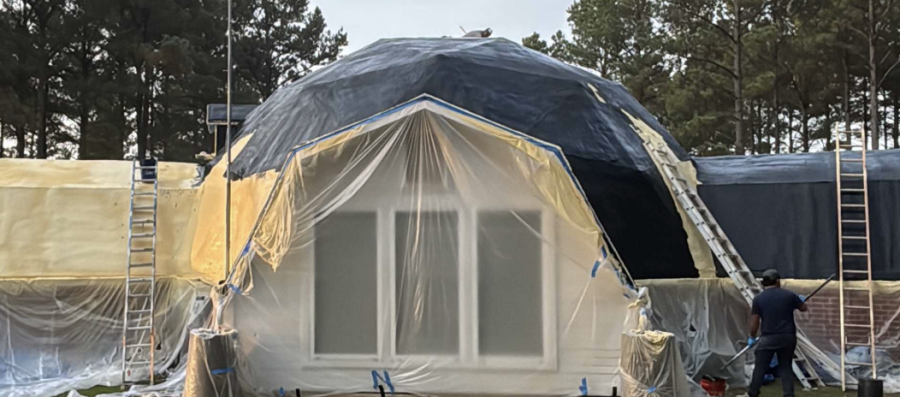
With every edge masked off perfectly on the facia and the foam completed without complications, it was a satisfying feeling to watch the black silicone being applied, knowing the hardest part was behind us.
This dome home is situated in Haynesville, not far from Dustin’s office. Its roof needed a drastic overhaul after several leaks occurred. “A roofing inspector I have known for a long time went to look at it and contacted me. I sent him some photos of other monolithic domes that had been foamed, and he liked what he saw. I told him it was a matter of removing the old shingles and drying out what was underneath after the leaks. We would then spray one and a half inches of Progressive Materials closed-cell roofing foam on the top and then coat it with black silicone,” Dustin explained.
Dustin noted that eliminating shingle cuts would save the client time and money. The project involved 3,709 sq. ft. of roofing; therefore if the client had decided to use the previous method, it would have involved purchasing shingles to cover both the 2,645 sq. ft. main building and a 1,064 sq. ft. guest dome.
SPF is well-suited for dome homes. The monolithic design reduces surface area, enhancing energy efficiency and lowering maintenance and heating or cooling costs. SPF adheres seamlessly to curved surfaces, forming an airtight barrier that prevents energy loss and strengthens the structure against high winds. It also serves as both insulation and a vapor barrier, protecting the building from mold and rot.
Before beginning the project, Dustin used Hover, a tool that generates satellite-like images and precise building dimensions. By processing eight photos taken from various angles, Hover creates accurate 3D measurements and detailed blueprints. This allowed Dustin to calculate the exact amount of foam required.
When presenting monolithic dome buildings to clients, Dustin highlights that the roof offers maximum strength and is fully wrapped and structurally robust once the SPF is applied from eave to eave. Through training and lots of experience, Dustin and his crew know that they had to ensure an even application at a proper thickness to avoid voids and thermal bridging, which can lead to condensation points.
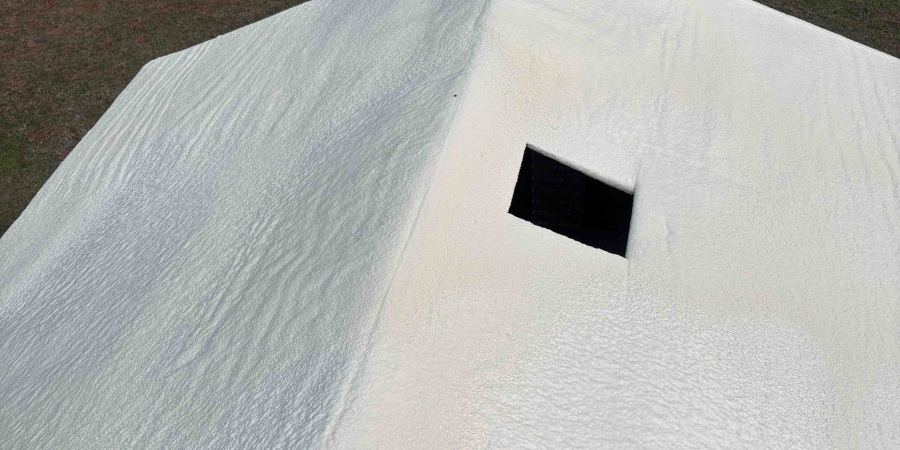
SPF applied to this dome provides a high R-value, filling gaps to prevent thermal bridging and air leakage
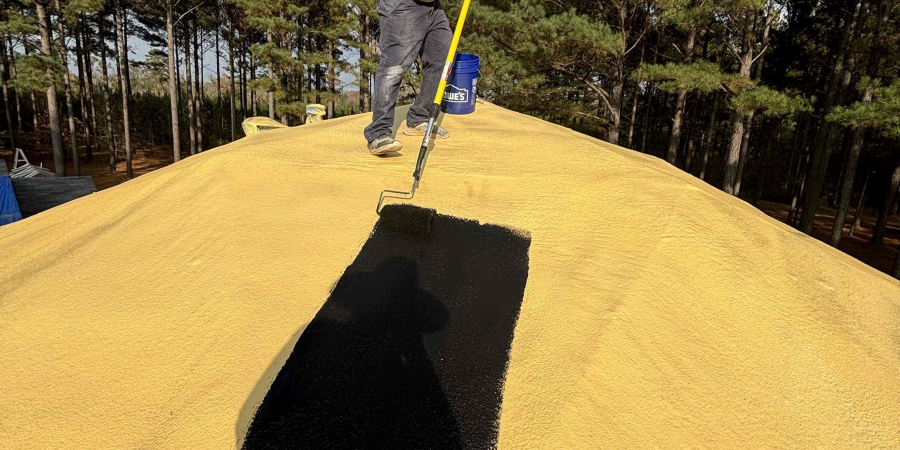
The pure silicone rolled onto the foam with ease, and once dry, its strength and durability were evident to the touch. It was clear the customer would be pleased.
SPF can be an ideal insulation for dome homes because it creates a seamless, gap-free barrier when applied by a qualified installer like Dustin. The silicone coating applied on top ensures long-term durability, even in harsh weather conditions.
Dustin coordinated with his network of tradespeople to remove the old shingle roof off the plywood paneling underneath and handle debris disposal. The crew inspected for leak damage and addressed a few affected areas. One of the biggest risks when spraying directly onto the dome structure is trapping moisture against the plywood, causing wood rot. Therefore, the wood needs to be dry and the exterior completely watertight before spraying. It is also essential not to seal off ridge or soffit vents, particularly in the eaves. If there is trapped, warm, moist air from inside, it will condense on the colder foamed plywood surface, resulting in structural issues.
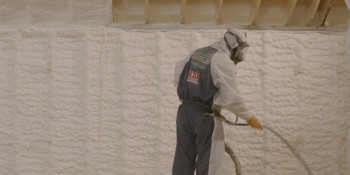
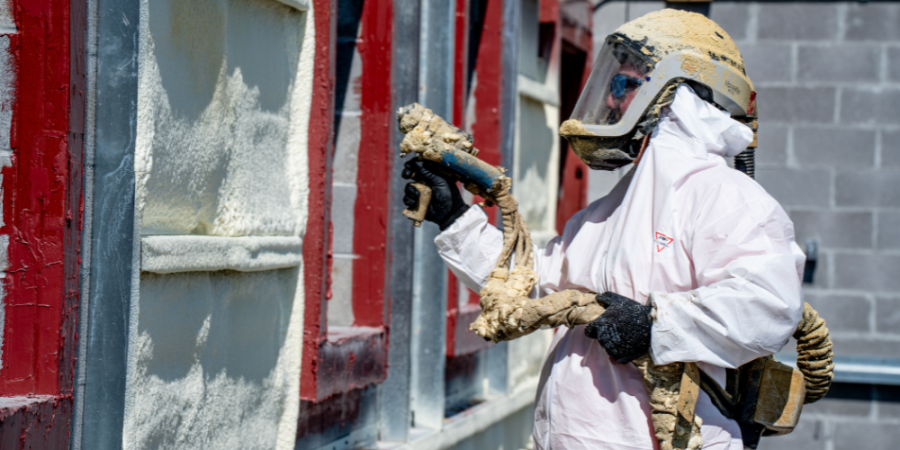
Dustin led the spray application with four crew members. They prepared the site by installing plastic sheeting and tarps over the entire area, including the garage and adjacent building, to prevent overspray. Once the area was cleaned, cleared, and dried, the crew proceeded to spray the plywood panels.
Dustin prepared his BOSS hydraulic sprayer with 250 ft of hose and an AP 02 Fusion gun. He made sure all his crew wore appropriate PPE.
Dustin identified, “There was an area, roughly one foot by one foot with no plywood. The client was worried about the strength in that area. We made a strong layer of SPF over the top of it, about three inches and showed the client that they could literally stomp on it, and it would stay intact. After the rest of the dome roof had one and a half inches of closed-cell foam applied, with a total of two and a half sets used, it needed time to air out.
Next, the Spray Foam Worx crew rolled on a black Progressive silicone coating. The roll-on method helps reduce overspray, eliminates equipment rental costs, and provides thicker coverage on uneven or damaged surfaces. The spray foam application and coating proceeded without issue, except for a challenge with the guttering. The homeowner requested new gutters; however, a brick ledge prevented installation of the six-inch gutters they had recently purchased. As a result, the crew installed new five-inch gutters in the main house, whereas the guest house had six inch gutters installed.
Afterward, they applied black silicone to the flashing between the foam and gutter, finishing with a clean silicone layer at the base. “The monolithic design of this dome puts the guttering at eye level, so we had to ensure it looked good while functioning. In the end, the black silicone made it look clean next to the gutter and foam,” explained Dustin.

“One of the most memorable photos of my career, as I had dreamed of spraying monolithic domes for many years. The satisfaction of that success is forever marked as a win,” Dustin said.
The project was completed in one week—one day for preparation, half a day for removal, two days for spray foam application, and two days for painting. Dustin, who is passionate about monolithic dome homes, described this as a dream job. “Imagine if everyone had access to spray polyurethane foam. It really is a great, affordable way to build a robust, cost-effective structure. Domes are aerodynamic, wind-resistant, and energy-efficient, making them ideal even during hurricanes and with the added SPF they are even stronger.”
Having SPF applied to this dome home gives it a high R-value, filling in all gaps in the curved, irregular surfaces typical of domes to prevent thermal bridging and air leakage. This, in turn, results in higher energy efficiency than conventional insulation. By applying a dense, rigid closed-cell foam, Dustin has helped the structure increase its racking strength, thereby improving wind resistance during storms. Because it acts as a vapor barrier, closed-cell foam will help prevent mold and rot. The rapid application and its ability to totally seal the dome home in a short amount of time will save the client money in the long run due to its energy efficiency, and upfront, will save on additional materials.
Spray Foam Worx successfully completed another notable project, overcoming logistical challenges through innovative solutions. Dustin’s enthusiasm and expertise in monolithic dome homes highlight their unique durability and raise the question of why they are not more commonly used in the U.S. Could they ultimately be the solution to hurricane prone areas?
Published by Spray Foam Magazine
SprayFoam / Spray Foam Insulation
Disqus website name not provided.