










Lincoln Block


Spray Foam Magazine – Winter 2025 – Sometimes the best ideas come when you stop trying so hard. For John Venturo, inventor and President of Lincoln Block Inc, his flash of genius happened on the banks of Washington’s Lake Roosevelt, fishing rod in hand.
Venturo was recovering from an injury and struggling to finish a construction project on his own. A lifelong builder, he was used to tackling jobs himself, but this time, he couldn’t climb ladders or swing tools like before. He had to rely on others to get the work done and had a hard time accepting anything less than his high standards.
“I was getting frustrated,” Venturo admits. “So, I sat down at a lake with a piece of paper and started drawing. I came up with a pattern to turn inexpensive lumber into a small, hollow brick and build a structural wall.”
Crystal Frye, Vice President of Lincoln Block and Venturo’s daughter, is quick to interject, “He leaves out the best part. He couldn’t do it himself this time because he’d broken his back. He was yelling instructions from the ground while my brother and cousin tried to roof the house in 100-degree heat. Finally, he gave up and went fishing. That’s when the idea for Lincoln Block literally came to him.”
“I started doing experiments and calculations, and two or three years later, I was able to prove you can take wood and make a structural wall out of it instead of just a passive one.” said Venturo.
From that fishing trip came Lincoln Block: a patented, glue-laminated wood block system that assembles like bricks but builds like lumber. By the time the patents were secured in 2017, Venturo and Frye had consulted with industry experts, including the North American Lumber Association, to make sure the idea was truly viable. Nearly a decade in business later, and viable seems like an understatement. Venturo’s design is damn near bullet-proof.
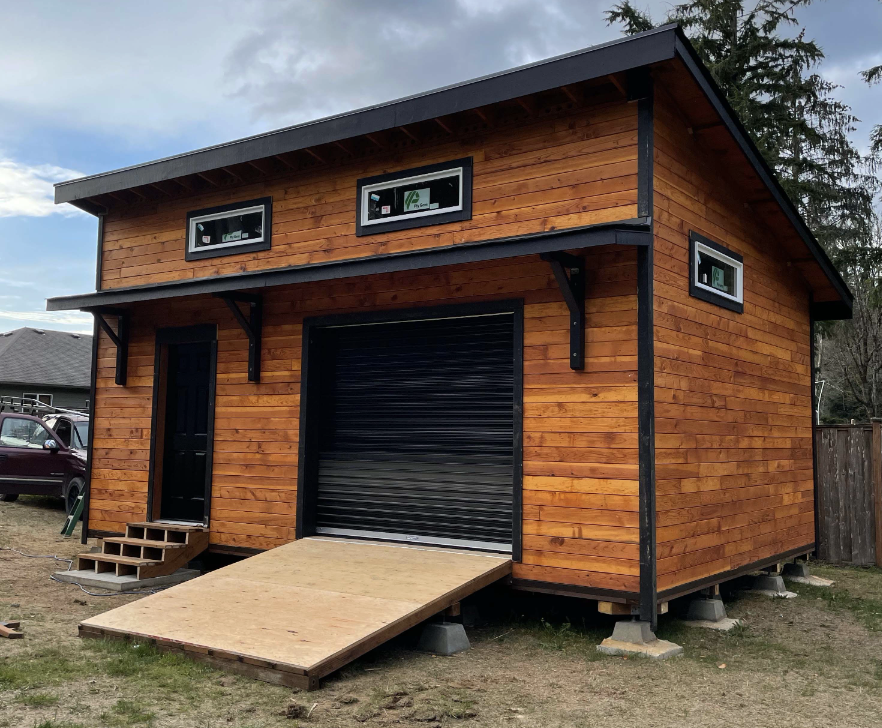
Lincoln Blocks are assembled wooden bricks that are stacked and filled with foam.
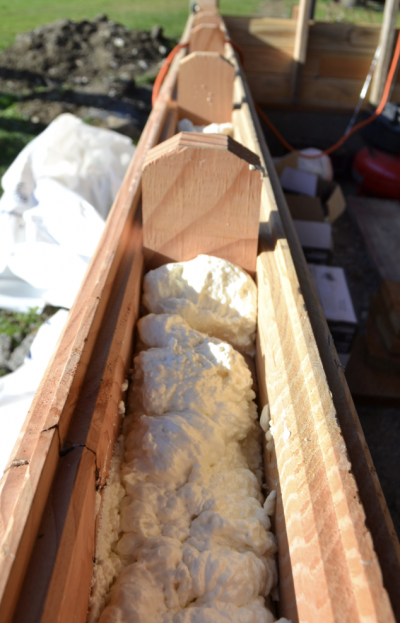
Here’s a course of Lincoln Block being filled with spray foam from a portable kit.
Lincoln Block + Spray Foam = Forever
Lincoln Block is a building material. It’s a structural block system made of real wood. Venturo buys the wood inexpensively from overstocked sawmills, then sends it off to a remanufacturing partner who cuts it into patterns. Once trimmed, the wood gets sent back to Venturo, who assembles it into finished 6-inch Lincoln Blocks at the company’s headquarters in Lake Stevens, Washington. The finished wall system includes Lincoln Blocks, spray foam, acrylic latex elastomeric sealant, stainless steel nails, and hot dip galvanized nails. And what do you get when you combine all those ingredients?
“Imagine you superglued Legos together.” Venturo said. “Once it’s up, it’s not going anywhere.”
Lincoln Block is cross grain laminate reinforced with spray foam. It’s essentially a wooden brick that’s as strong as it is energy efficient. The foam makes each wall “brick-solid” while delivering insulation performance well beyond conventional assemblies.
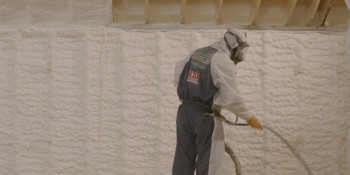
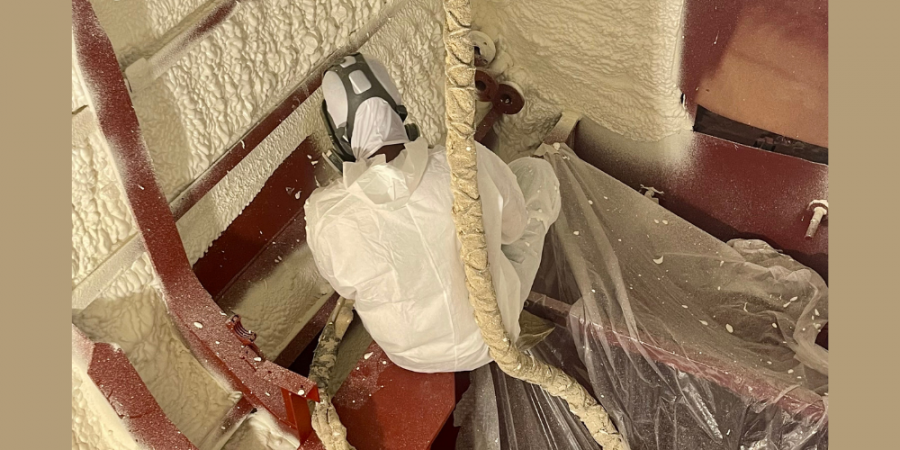
Customers ordering the Lincoln Block systems are provided with a spray foam kit to install the foam themselves. Small jobs receive either DAP Touch-N-Go spray foam kit or another similar DIY kit, since they’re user-friendly and high-density. But for bigger jobs, Venturo says any standard standard spray foam machine and closed-cell, slow-rise foam system will do the trick.
The foam is applied between each course of Lincoln Blocks. But first, DAP sealant is used between courses before foam gets applied, helping contain expansion and allowing for natural wood movement. Once the foam cures, it locks the wall into place, boosting load-bearing capacity, improving wind shear, and sealing the structure into a continuous thermal envelope. What results is a home that’s as cozy and stable as any conventional build, but with fewer materials and much less labor.
But with any spray foam application, technique matters. Crystal and John spend a lot of their time reassuring first-time builders, walking them through the process, and sharing a piece of advice they repeat often: slow down, you’ll go faster.
“Most of the issues people run into are from trying to go too fast,” Crystal says. “Dad always tells people when you get to foam level, stop. Double check your work. Spray. Then go have a cup of coffee. Come back later. If you let it set, you’ll actually go faster in the long run.”
For skeptical contractors, Lincoln Block often clicks once they understand the rhythm. “It’s like laying brick, but easier,” John says. “Follow the steps, slow down, and if you hit a wall, call us.” Whether it’s a phone call, a video chat, or even an in-person visit if they’re nearby, John and Crystal make themselves available. They’re not the ones drawing the blueprints, but they’re committed to making sure builders succeed with their system.
Life-Changing Stuff
The proof might be in the walls, but Lincoln Block’s customers will shout it to the hills. A Montana builder who gave Lincoln Block a try told John he never wanted to build another way again. Another customer, living in the mountains of Washington, had been paying $400 a month to heat his mobile home in winter. After building a 1,000-square-foot Lincoln Block home and installing a simple mini-split, his bill dropped to just $65. Crystal has heard customers describe their new home’s power savings as “life changing.”
That kind of performance comes from what Venturo calls a “thermal break.” With an inch and a half of solid wood on either side of a foam-filled cavity, the walls are designed to resist heat transfer better than almost anything else on the market.
“Your house will heat with a candle and cool with an ice cube,” says Venturo.
Beyond that, Lincoln Blocks are easy to work with and offer an option for affordable, durable structures in remote or labor-strapped areas. Crystal sees it as making the building process more accessible.
“If you’ve got basic knowledge or just a hands-on attitude, you can build with Lincoln Block. You’ll still need trades for things like roofing or electrical, but for the walls themselves, anyone can stack them.”
Lincoln Block solves problems of material waste or labor shortages while making construction a little more pain-free– both for the backs that carry the work, and for the wallets that pay for it. For John, who once found himself sidelined by injury and unable to build on his own, the payoff is deeply personal. He invented a material he could build with as a team of one, and now, anyone can.

An under- construction Lincoln Block house, featuring several stacks of ready-to-use Lincoln Blocks.
Disqus website name not provided.