









Going Underground


Spray Foam Magazine – Winter 2025 – While underground pipelines might not strike everyone as the most captivating subject, one spray foam installer treats the matter with utmost importance. Equipped with our Wellington boots, the Spray Foam Magazine team traveled to Sioux City to uncover how and why geotechnical foam played a crucial role in supporting a new natural gas pipeline.
K&K Inc., a pipeline company, directly contacted Sioux City Insulation, a company known for its high-quality spray foam insulation services across Sioux City, South Dakota, and Nebraska. K&K inquired about installing spray foam trench breakers for their new natural gas pipeline. The Environmental Protection Agency (EPA) supports the use of spray foam trench breakers due to the safety and environmental protection they offer. Alternative solutions, such as sandbags, clay plugs, or concrete trench breakers, while effective, are more labor-intensive, require additional material handling, and result in higher costs. They also leave a larger environmental footprint due to the hauling and equipment usage.
The trench breakers are to be installed in the trench at designated intervals to create a solid barrier between the pipeline and the surrounding soil. Their primary purpose is to stop water from channeling along the trench line, which can lead to erosion, soil washouts, and loss of backfill support.
By keying into the trench walls and surrounding the pipe, they hold the line in place, protect against soil movement, and maintain the integrity of the backfill on slopes or uneven terrain. This function indirectly helps protect the pipeline environment by keeping it stable and reducing the risk of soil-related issues. That said, it’s important to note that Sioux City Insulation’s trench breakers do not keep gas from freezing inside the line or prevent hydrate formation. Those issues are addressed through other pipeline design and operational measures, not through trench breakers.
Rex Stolze serves as the spray foam foreman and lead sprayer for Sioux City Insulation, their team specializes in various projects, including residential, commercial, industrial, and infrastructure work, ranging from energy-efficient building envelopes to specialized applications like trench breakers for pipelines. Training is vital to their success.
Although geotechnical foam installation may seem straightforward, it requires substantial knowledge and skill. The team emphasizes not only equipment training but also the reasoning behind each step, from surface preparation and safety checks to the spraying technique. They also ensure new crew members receive hands-on mentorship.

Trench breaker installed per instructions of EPA on the downhill slope of trench to prevent washout/erosion of pipe.
The geotechnical foam system was selected because of its quick installation, adaptability to irregular trench walls, and its strong bond to pipe coatings and soil. This projects 1.87 miles of pipeline runs west from Beresford, South Dakota, to Ponca, Nebraska. It passes through farm fields, country roads, and rough, hilly terrain that would necessitate heavy equipment for access and construction.
Rex, as the lead sprayer, and Edgar Poiton, as the helper, arrived on-site. Before beginning the installation, their priority was to protect both the pipeline and the surrounding environment. Despite the challenging terrain, the crew was confident they could complete the job with minimal issues. They achieved this by stabilizing the work area with erosion controls, marking access routes, and ensuring all safety protocols were in place.
Once the site was secure, they turned their attention to preparation. This involved inspecting trench depth and stability, clearing debris, and pumping out any standing water to provide a clean, dry surface. With the site ready and equipment staged safely, they could apply the foam with confidence, knowing it would bond effectively and provide long-term support against water flow and soil movement.

Rock wheel trenching machine used to create trench for pipeline.
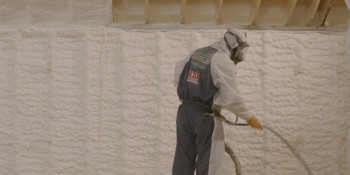
Rex and Edgar used a PMC PH-2 proportioner to process and spray the NCFI Strata-Fill Geotechnical Foam, which delivered the necessary strength, adhesion, and long-term durability for the project. Once the foam was up to temp, the crew ran their 250-ft hose and used a Fusion AP gun with a tip extension. The extension shot the foam in a steady stream, up to 15ft, and allowed the crew to safely spray the trench breakers from outside of the trench. This technique is much safer compared to using traditional sandbags and having workers down in the trench.
They first shot foam directly under the pipe to create uniform contact, then built trench breakers in multiple lifts, wrapping them snug around the pipe and into the sidewalls, extending above the crown. They did not fill the whole trench, just the specified spots, and then K&K completed the backfill. This process locked the pipe in place, stopped water from traveling the trench, and allowed backfilling to resume within minutes.

First of 200 Trench breakers installed on project.
They installed approximately 200 trench breakers, which required 12 full sets of material. “This was our first trench breaker project. To ensure everything was done correctly, we worked closely with Patrick Burchett, NCFI’s Technical Manager, who helped us verify that each installation was completed appropriately,” Rex stated.
The Strata-Fill geo foam performed exceptionally well, with each breaker being sprayed and curing in minutes. This led to significant labor and material savings for Sioux City Insulation’s client, who was pleased with the trench breakers' performance, the quicker-than-expected installation, and the protection of the surrounding environment.
The project extended over three months and went smoothly due to the teamwork and superior materials involved. Sioux City Insulation’s core philosophy is to approach every job with a focus on safety, efficiency, and quality workmanship. Not only were they able to complete the work successfully, but they also demonstrated that geotechnical foam can be an excellent solution for pipeline trench breakers.


Disqus website name not provided.