










Precision, Safety, and Yield

Spray Foam Magazine – Late Summer 2026 – The convergence is unmistakable. A trade defined for decades by the skill of the gun hand, the patience of crew leads training new sprayers, and the constant management of off-ratio passes, off-thickness substrates, and off-day weather is now facing a set of technologies — robotic application platforms, machine-vision quality control, integrated sensor and software stacks — that have already reshaped adjacent industries. The question for SPF isn’t whether the convergence happens. The question is what it looks like in the rig, in the warranty file, and in the crew schedule when it does.
What follows is a directional read drawn from documented systems, federal research, regulator guidance, and adjacent precision-spray industries. The systems exist. The data is on the record. What’s still being written is how the trade absorbs it.
The yield future: closed-loop application
Every contractor knows the gap between theoretical yield and what actually comes off the rig. Theoretical yield is built on assumptions that don’t hold on a real jobsite — ideal material temperature, clean substrate, no wind, zero waste, no trim, flawless technique. The direction of travel in spray automation is to close that gap mechanically rather than ask better sprayers to close it manually.
First-generation robotic spray platforms, several now commercially available for roofs, flat substrates, and in-plant work, market themselves on accuracy within a few mils and consistent gun-height control across a wide pass — capability no hand-applicator delivers shift after shift. Newer entrants integrate plural-component precision with detachable manual touch-up modes, pointing toward a hybrid model rather than a strict crew-replacement.
Adjacent industries point further. AI-driven quality control in industrial coating now performs real-time, high-precision, 100% inspection of coated components through computer vision and deep learning, replacing periodic manual sampling with full inline screening. Precision-spray sectors in agriculture and turfgrass have already deployed machine-vision sprayers with many more individually controlled nozzles, achieving comparable treatment outcomes with substantially less material. The closed-loop principle — measure during application, adjust on the fly — is no longer experimental. The question for SPF is when, not whether it crosses from research and adjacent industries into standard rig configurations.
Three workspaces, three robotics problems
The application surface matters. The trajectory toward automation looks different depending on whether a crew is on a commercial deck, in a wall cavity, or in an attic — and the human role shifts accordingly.
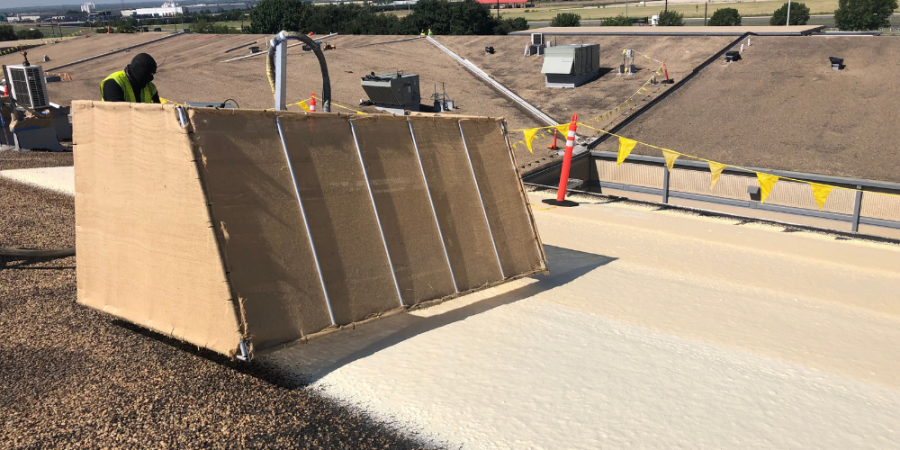
Roofs. Flat and low-slope commercial roofing is the most mature use case for SPF robotics. Geometry is largely uniform, hose and material supply from the rig is straightforward, and wide-pass platforms with adjustable gun heights can hold consistent thickness across long runs. Trade-press case studies document contractors moving to automated spray equipment specifically because hand-application across complex metal substrates — high flute, irregular profiles — produces uneven results no inspector accepts. On roofs, the human role increasingly becomes substrate prep, edge and penetration work, and equipment supervision rather than the primary spray pass.
Walls. New-construction wall cavities are the application type where machine vision and AI do the most work.
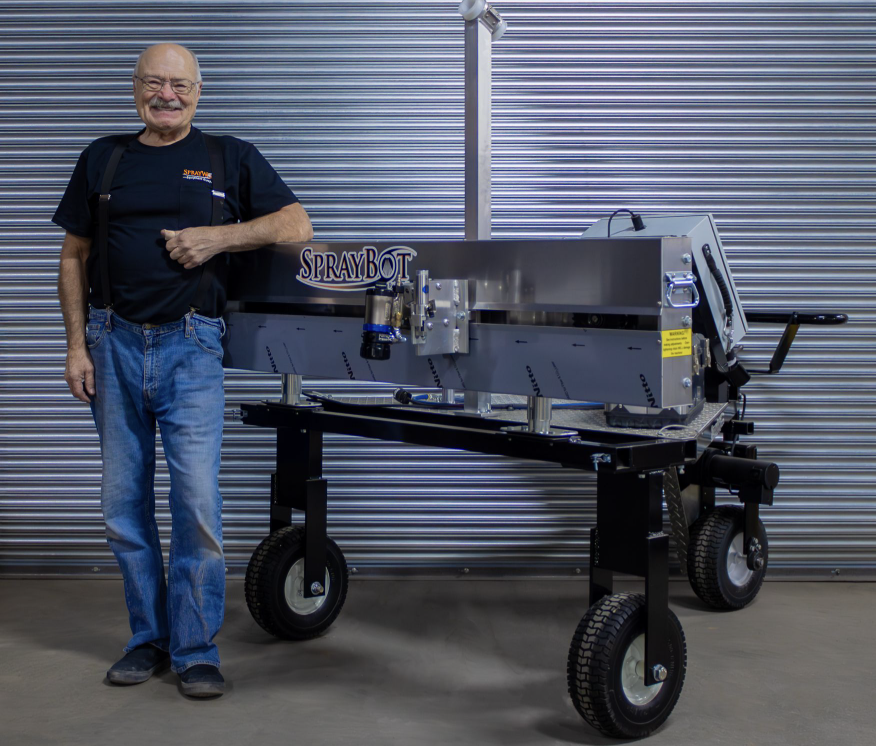
SprayBot product photo featuring the machine beside inventor of the SprayBot and founder of SprayWorks Equipment, James Davidson, showcasing the size, mobility, and professional build of the spray foam robot.
Federal patent filings describe insulation end effectors paired with vision systems and sensors that scan the cavity between exposed studs, identify geometry and penetrations, and automatically generate spray instructions before drywall closes the assembly. National-laboratory work on autonomous wall-cavity SPF describes the same architecture — scan, locate, plan, spray, manage thickness — built around the explicit objective of improved installer safety and consistent quality. The complication is that real walls are not blank cavities: fire blocking, plumbing, electrical penetrations, HVAC chases, and irregular framing introduce variability that no off-the-shelf path planner handles cleanly. The human role is identifying the cavities the robot cannot or should not handle and shooting them by hand.
Attics and confined spaces. This is the application type where robotics arguably has the most to offer and the most to overcome. Attic and underfloor work involve access through small openings, variable headroom, mechanical equipment to navigate around, and temperature extremes that punish both human applicators and electronics. Documented UK retrofit deployments have used small, tracked robots — purpose-built for void heights as low as 20 cm — equipped with onboard cameras and rangefinders that record and verify each install. The human role here shifts heavily upstream: pre-install survey of the void, hatch prep, robot deployment and retrieval, and post-install QA review of the verification footage.
The hybrid model isn’t a phase — it’s the design. Newer platforms ship with detachable manual spray modules specifically because no robotic system handles every corner, transition, and odd geometry on a real job. The human is not being replaced; the human is being repositioned — from primary applicator to surveyor, setup tech, manual finisher, and quality auditor. That is the model already visible in the documented systems, not a future state.
The safety future: operator out of the zone
The regulatory floor is not moving. OSHA’s permissible exposure limit for MDI is 0.2 mg/m³ as a ceiling. A federal occupational-health survey of installation sites measured applicator MDI exposures ranging from 7.0 to 205 µg/m³ — real-world levels that routinely approach the OSHA ceiling depending on enclosure and ventilation. Isocyanates have been reported to be a leading attributable chemical cause of workplace asthma, and federal agencies have stated there is no recognized safe level of exposure for sensitized individuals. OSHA’s National Emphasis Program on isocyanates has been in effect since June 2013.
The directional implication is structural. Patent filings and federal R&D documentation describe SPF robotic systems designed around the explicit objective of minimizing PPE requirements. Moving the operator out of the spray zone is not a side benefit but the design intent. Sensitization is permanent. Every sprayer kept out of the highest-exposure zone over a career is an applicator who can keep working — and a payroll the contractor does not have to rebuild from scratch. The math of operator-out-of-zone runs in parallel with the math of yield and labor; it is not separate.
The data future: every job becomes a file
The least-discussed shift is the quietest. A hand-application jobsite leaves a paper rig log and a depth-gauge spot check. A robotic application — by virtue of how it works — produces a full digital record: substrate scan, pass pattern, thickness map, ambient conditions, real-time sensor and control-system data. Every install becomes a file.
That shifts the conversation with code officials. It shifts the conversation with warranty programs. It shifts what an insurance carrier sees on a loss claim. For manufacturers and system houses, it creates a feedback loop on formulation performance under documented field conditions — closing a gap that has existed in spray foam since the trade’s beginning. Documented retrofit deployments verified by independent national energy bodies have already produced quantified yield, heat-loss, and energy-savings figures at meaningful scale, demonstrating the data path from rig to verification body is real, not theoretical.
The labor backdrop
None of these lands in a vacuum. U.S. industry forecasts project the construction sector needs to attract roughly 349,000 net new workers in 2026 and another 456,000 in 2027 on top of normal hiring. The gap is characterized as structural rather than cyclical — driven by an aging workforce, demographic shifts, and accelerated retirements that no single hiring cycle resolves. Specialized trades feel it hardest. For a sector with documented chemical hazards, hand-application variability, and a tight talent pipeline, that backdrop converts robotics and AI from an interesting R&D conversation into an operational one.
Where this leads
The systems exist. The third-party verification is on the record. The labor and regulatory conditions are running in the direction of automation, not against it. What the next decade of SPF likely looks like is not a question of whether contractors hold guns; it is a question of how many, where, for how long per job, and with what closed-loop data feeding back to the manufacturer, the inspector, the warranty file, and the next bid.
The trade has always been a craft. It is becoming a craft with a data layer.
SOURCES:
National-laboratory documentation on robotic SPF wall-cavity installation (Oak Ridge National Laboratory)
U.S. patent filings on automated insulation application and remote spray foam systems (USPTO patents 10870996, 12383920, 12304055)
Trade-press product documentation on commercial robotic spray platforms (multiple manufacturers)
Trade-press case-study coverage of robotic SPF deployments on commercial roofs (SBC Magazine) and in UK retrofit programs (Spray Foam Magazine)
U.S. EPA: Safer Workplace Practices for Spray Polyurethane Foam Installation; Health Concerns about Spray Polyurethane Foam
NIOSH / CDC: In-Depth Survey Report: Spray Polyurethane Foam Chemical Exposures
NASCSP: Spray Polyurethane Foam — OSHA / NIOSH exposure-limit summary
Industry analysis on AI in quality control for surface coating
USGA: Sprayers That See: Machine Vision and AI in Golf Course Spray Applications
UK Green Building Council: robotic underfloor insulation case study
Independent UK third-party verification of robotic underfloor SPF energy savings (Energy Saving Trust)
EU CORDIS project documentation on robotic underfloor insulation
Associated Builders and Contractors: 2026 Construction Workforce Shortage Analysis
Engineering News-Record: Construction’s Labor ‘Relief’ Masks Structural Risk as Demand Cools (January 2026)
Spray Foam Magazine does not take editorial positions on particular issues; individual contributions to the magazine express the opinions of discrete authors unless explicitly labeled or otherwise stated. The inclusion of a particular piece in the magazine does not mean that individual staff members or editors concur with the editorial positions represented therein.
See the Business Behind the Story:
Disqus website name not provided.