











Beating the Cold


Spray Foam Magazine – Fall 2026 – As autumn turns and the first cold drafts arrive, spray polyurethane foam contractors across North America run into a familiar problem. The swing seasons, late fall and early spring, are the most unpredictable stretches of the year for insulation work. One afternoon it’s a comfortable 65°F; the next morning it’s 35°F with damp, raw air.
For an unprepared crew, that volatility shows up fast. Cold and moisture affect chemical viscosity, the curing reaction, and how well foam bonds to a substrate. The results: sluggish expansion, collapsed cells, delamination from cold surfaces, and lower yield. In a business measured in board feet, that’s the difference between a profitable job and a callback you pay for out of pocket.
None of it is unavoidable. With sound building science, disciplined material handling, and formulations built for a wide temperature range, crews can hold productivity and quality straight through the winter.
Why Cold Weather Changes the Job
Spray foam combines two components at a 1:1 ratio by volume: an isocyanate A-side and a resin B-side containing polyols, catalysts, flame retardants, surfactants, and blowing agents.
When those components get cold, they thicken, more so on the resin side, creating two problems at once.
The first is at the pump. Thick fluid is harder to draw, and if the pumps can’t fill fast enough you get cavitation, inconsistent metering, and off-ratio material. Off-ratio foam doesn’t develop its structural properties or deliver the R-value it should and can hold a lingering chemical odor from uncured resin.
The second is at the heater. Every proportioner has a fixed limit to how much it can raise fluid temperature at a given flow rate—what most technicians call Delta T. Start the morning with cold drums and even a high-capacity rig may not close the gap to target spray temperature. Cold material at the mixing chamber slows the reaction against the substrate, and the foam runs, sags, or never fully expands.
The practical takeaway: your rig can only add so much heat. Everything upstream matters more than most crews expect.
Material Conditioning: The Job Starts in the Trailer
Cold-weather performance is largely decided before the applicator ever pulls the trigger.
Store drums indoors, dry, and within the temperature range your supplier specifies. Two things get conflated: a storage range protects shelf life; a working temperature is where material actually pumps well. The bottom of a storage range is not spray-ready. Plan for the working number.
Protect material from the cold in transit and in the trailer. Isocyanate crystallizes if it gets too cold. Crystallized material can often be recovered, but only by the manufacturer’s written procedure, controlled heating of the whole drum with proper mixing. It isn’t a field improvisation, and guessing can do more damage than the cold did.
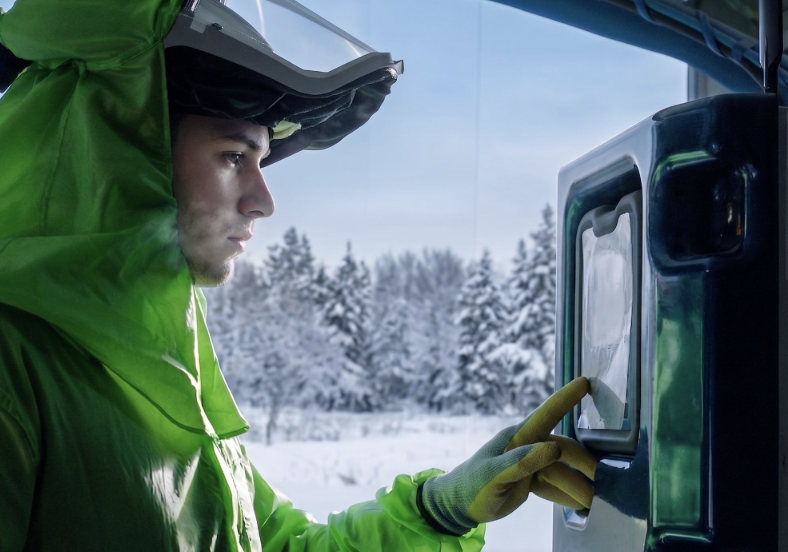
Adjusting equipment settings is vital to maintain proper performance and spray quality while working in cold- weather conditions.
The failure that genuinely can’t be undone is moisture contamination. Water reacts with isocyanate to form solids and carbon dioxide—clogged filters, pumps, and lines, and pressure inside a closed drum. Keep bungs sealed, keep condensation out, and never leave a drum open in damp air.
Before a cold-weather spray day, move from storage to active conditioning. Bring material up to target gradually and hold it long enough that the entire drum, including the core, reaches a uniform temperature. Your product’s technical data sheet and application guide specify the conditioning window; follow it rather than a rule of thumb, since it varies by formulation.
If material has cooled in transit, circulate it through the rig’s heaters to bring it up gently; mixing distributes heat and eliminates cold spots. One caution appears in nearly every manufacturer’s documentation: shut the mixer off once material reaches target—running it longer risks shearing, overheating, and working air into the chemicals.
Rig and Equipment Adjustments
Once material is conditioned, set equipment to compensate for the heat the jobsite will pull out of it. Cold air and cold substrates act as heat sinks, drawing energy from the foam as it expands.
Set pre-heaters, hose heat, and pressures to your manufacturer’s cold-weather parameters. Pre-heater and hose temperatures typically move up to offset ambient losses, while pressures stay balanced to keep the mix consistent at the gun.
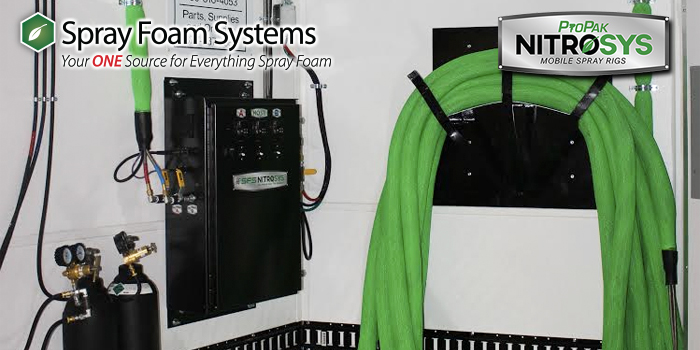
Hose heat deserves particular attention. Several hundred feet of hose on a cold slab or in the wind sheds heat fast, and material can reach the gun well below what the display says. Inspect and upgrade hose insulation, wrap fittings, and confirm your sensors read accurately. Recirculate during downtime so chemicals aren’t sitting in cold lines.
Settings vary with proportioner model, hose length and diameter, gun configuration, and local conditions. Know your equipment’s limits, and run test sprays before the main foam application.
Substrate and Humidity: The Quiet Job-Killers
Perfectly conditioned chemicals and a well-tuned rig still won’t save you from a cold, damp substrate.
When warm foam hits a cold surface, moisture in the air can condense as a thin film of water or frost. That film acts as a parting agent—the foam peels, bubbles, or cracks instead of bonding.
Humidity does chemical damage too, not just mechanical. Water reacts with isocyanate, leaving a friable surface and off-ratio behavior even when your proportioner is dialed in. Most manufacturers set a maximum ambient relative humidity, so know your limit and respect it.
A few protocols handle most of this:
Verify moisture: Check substrate moisture content with a calibrated meter and compare it against the manufacturer’s threshold. Don’t eyeball it.
Clear frost and pre-heat: Use radiant heat or warm air to dry the surface and bring substrate temperature comfortably above the dew point—a margin, not a hair’s breadth. Metal and concrete need it most.
Control the workspace: Sealing an area with temporary poly and warming it works well, but choose the heat source carefully. Direct-fired propane and kerosene units release water vapor and carbon monoxide into the space you’re drying out. Indirect-fired or electric is the better call, and open flame has no place near a spray area.
Application Technique and Scheduling
If the weather is cold, it changes how and when you spray.
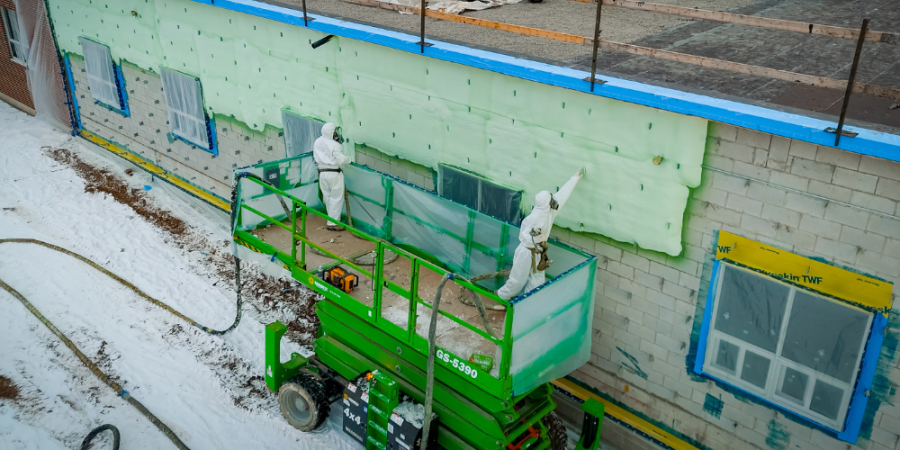
Schedule around the warmest part of the day. Midday work takes advantage of solar warming on the sheathing and reduces what you add with heaters. Watch the forecast and don’t force an installation through a storm or a sharp temperature drop.
Tighten gun distance modestly to limit how much the spray cools in transit but stay inside the manufacturer’s recommended range. Getting too close can affect pattern development, resulting in uneven thickness and ridging. It creates a different problem rather than solving the original one.
Use the exotherm to your advantage. Curing generates its own heat, and steady, consistent passes concentrate it enough to drive a more complete cure and better expansion. Stay within the maximum lift thickness for your product, or you trade cure for scorching and voids. Lift limits differ between open-cell and closed-cell formulations, with closed-cell applied in noticeably thinner passes, so work from the technical data sheet rather than a number from another product.
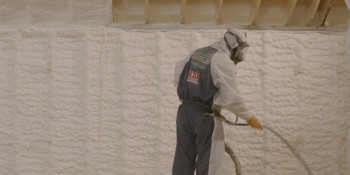
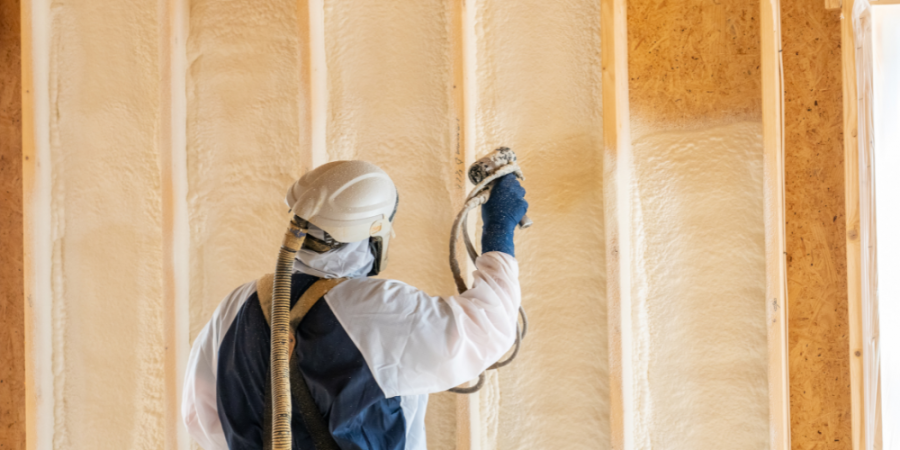
Consistent parallel passes with even overlap give the most uniform coverage across a cavity.
Safety and Re-Occupancy in Cold Weather
Winter makes ventilation harder at exactly the moment it matters most. Buildings are closed up, doors stay shut, and the natural air exchange you’d get in June disappears.
Maintain respiratory protection and PPE without exception, ventilate during and after application, and follow the manufacturer’s re-occupancy guidance before other trades come back in. If you’re running supplemental heat, make sure the heater choice supports the ventilation plan rather than working against it.
Quality Assurance and Documentation
In cold weather, a visual check simply isn’t enough.
Run density and adhesion checks through the day. Test patches on scrap sheathing confirm that the foam is expanding correctly, curing on schedule, and that it is developing a uniform, fine cell structure. Core samples verify no shrinkage, settling, or internal voiding.
Thermal imaging is valuable for spotting gaps and thin coverage before drywall goes up, with one caveat: infrared only reveals what a temperature differential across the assembly makes visible. Scan when there’s a meaningful inside-outside difference, or after conditioning the space; a mild midday scan may show very little.
Finally, keep records. Log ambient temperature, relative humidity, substrate temperature, drum temperatures, pre-heater settings, pressures, and material batch numbers, plus board feet per set—yield is what this whole discussion is about, and you can’t manage what you don’t measure. Good documentation keeps the job consistent day to day and records a professional, code-compliant installation if a question comes up later.
Elevating Winter Performance
Swing-season volatility is real, but manageable. With the right protocols and chemistry engineered to deliver reliable yields across a wide range of conditions, contractors can keep building tight, efficient, comfortable homes year-round.
The short version: respect the chemistry, prepare the substrate, calibrate your rig, and let the material do the rest.
For product specifications, technical data sheets, and cold-weather application guidance, visit the Enverge Document Library.
Spray Foam Magazine does not take editorial positions on particular issues; individual contributions to the magazine express the opinions of discrete authors unless explicitly labeled or otherwise stated. The inclusion of a particular piece in the magazine does not mean that individual staff members or editors concur with the editorial positions represented therein.
See the Business Behind the Story:
Disqus website name not provided.