













Royal Treatment
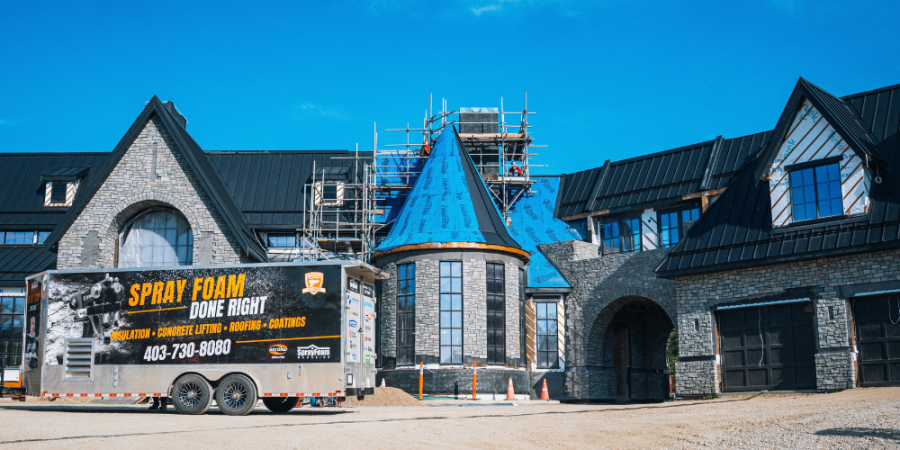

Spray Foam Magazine – Fall 2026 – A home is your own personal castle, your safe haven away from the dragons of the world. One family in Calgary, Alberta, took that seriously when designing their fit-for-royalty dream home. Right on the outskirts of the Canadian city looms a 16,675 sq. ft. almost-finished neo-fortress in the shape of a modern castle. The homeowners spared no expense on incorporating a slate of architecturally stunning features crossed with fun, whimsical additions for their children to enjoy. Spires and ball pits and spiral slides, eh! In many ways, the design feels like the result of a game of “yes, and…?”
Novelty aside, there’s nothing improvisational about this home. Every component was intentionally selected and painstakingly installed, from the imported windows to the Elastochem Insulthane Extreme closed-cell foam present on every floor. To do the installation, the homeowners enlisted Beyond Foam, the insulation division of Beyond Group, whose CEO, Curt Janzen, and CFO, Kevin Boschee, won Spray Foam Magazine’s Contractor of the Year title in 2025. Looking at their team’s precise handiwork, you don’t need a royal advisor to understand why they’re one of Calgary’s favorite trade businesses.
Beyond’s castle defense mission began when the homeowner personally got a hold of estimator Justin Hearn. The client described the job as “really big,” and invited Hearn to come check it out before drumming up a quote. Upon arriving, Hearn realized the guy wasn’t exaggerating. At 16,675 total square feet, this place is palatial.
“It’s a beautiful home, architecturally, but a pretty wild house,” said Jesse Fehr, Beyond Group’s marketing specialist, who visited the house to snap some pictures of the company’s handiwork in progress. Field supervisor Donavan Thomas concurs.
Thomas led the five-man foam team in the storming of—well, foaming of the castle. He agrees that spray foam was hands-down the best system for a house of this size, as well as the most straightforward system to install.
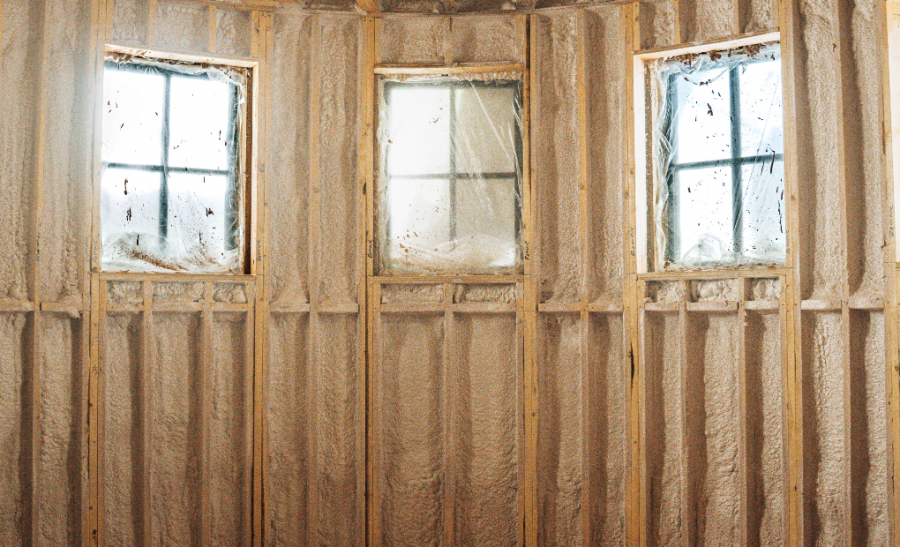
The walls received three inches of Elastochem’s Insulthane Extreme, while vaulted roof areas received six inches.
Thomas explained that although the flat spaces in the attic also received blown-in cellulose insulation, the vaulted roof deck areas were only suited for foam, or else the cellulose would just fall right out.
“The client decided on foam since many areas were hard to batt and poly. Spray foam gave those areas an air-tight seal and a better R-value around water lines,” said Thomas.
And so, it was settled. Where insulation was concerned, spray foam reigned king of this castle and would defend the home against high energy bills. In just over two weeks, Thomas and his team installed approximately 15 sets of Elastochem Insulthane Extreme’s summer version. They installed the 2LB closed-cell spray foam to the basement walls, vaulted roof deck, and in the cavities around plumbing areas, such as the kitchen, bathrooms, and laundry room.
The challenge with this home had to do with its sheer size and abundance of bespoke features to navigate around. What does this castle home have in common with an emperor penguin? Neither can fly, but they both have wings. Thomas described a foyer area as resembling a “breezeway, almost like a covered bridge area that connected what they called the ‘west wing’ with the rest of the house.”
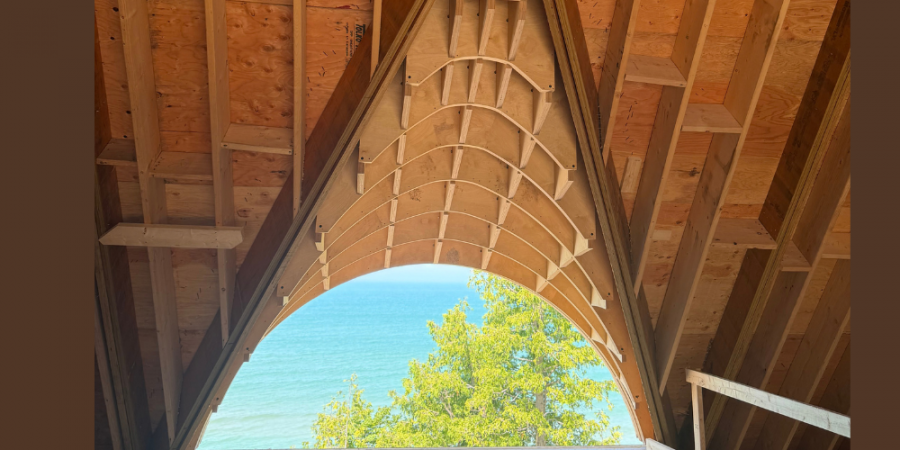
Although it’s still under construction, the home’s stately silhouette was already taking shape by the time the Beyond crew arrived to foam it. Taking it all in from the outside, its grand facade is defined by spires and arches swathed in a gray stone exterior. This castle home might lack a moat and catapults, but endless adventures await the homeowner’s children, who are sure to find themselves living in their own fairytale once construction wraps and they finally move in. The house has a swirly slide from the top floor to the basement so they can easily ascend. It’s also got a recessed ball pit built right into the house and grown-ups can level-up in the expansive home gym.
With so much ground to cover, Thomas and his five-man crew began their siege by mapping out a careful attack plan. Each day began with a daily huddle to get everyone on the same page. Thomas would define which areas they’d be focusing on, then direct the team to work in a circular rotation. In general, two helpers would work several steps ahead of the sprayers by prepping the soon-to-be foamed areas, then they’d swing back around to clean up the newly-foamed areas once the sprayers were through. Since the house was midway through construction, the prep work consisted of masking the royal number of windows with a double layer of protective plastic. Double, because these luxurious windows were imported from Europe, and Thomas was hard-pressed to allow even a single fleck of foam touch the glass.
“It sure had a lot of windows,” he said with a laugh, adding that the job was mostly straightforward, just had a lot to get done every day and required a great deal of coordination to accomplish it.
The up-front prep work was well-worth the peace of mind. Plus, working further ahead on the prep work allowed the sprayers to jump right into the next round of foam installation without much downtime. Likewise, doubling back to knock out clean-up meant they avoided making a huge mess at the end—that, and it’s just good job-site etiquette to clean as you go.
The sprayers tackled the garages first before moving to the basement down below. The basement’s below-grade concrete walls received about three inches of Insulthane Extreme, which they installed using a trusty H-40 and AP Fusion gun.

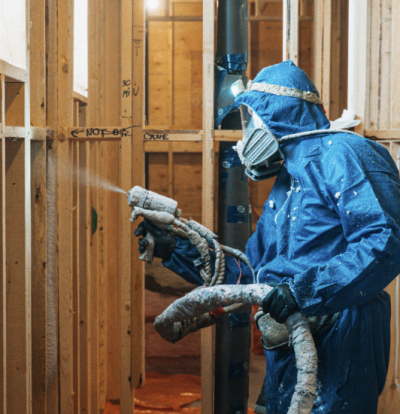
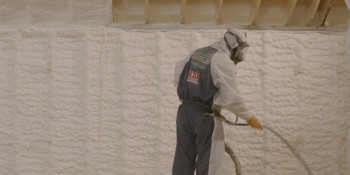
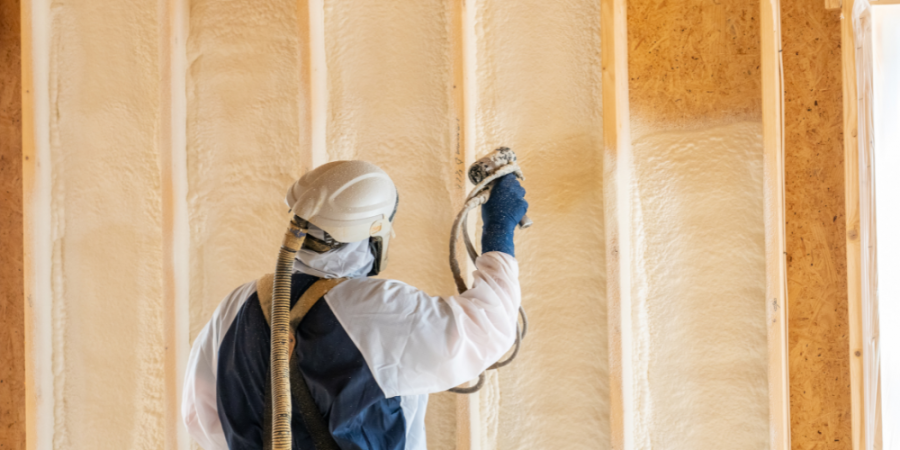
One of Beyond’s sprayers carefully installs Elastochem Insulthane Extreme to avoid getting overspray on any of the many windows.
After completing the basement, they resurfaced to add around six inches of Insulthane Extreme onto the wooden vaulted roof areas. Finally, they foamed around the water fixtures on each of the upper floor’s plumbing walls to a thickness of around three inches. Adding foam around these tight spaces stops drafts and condensation while also insulating the pipes without completely obscuring them.
Once they got into a good flow, foaming the castle was just like any other residential job…mostly. In addition to the standard safety precautions taken on every job—zip your suit up, don your gloves, secure that respirator mask, and make sure it’s pumping in fresh air—Thomas gave his team one more safety rule to follow: don’t get lost!
“Have a little AirTag on you just in case,” he half-joked. Okay, maybe he didn’t AirTag his entire crew, but navigating and keeping tabs on everyone proved a different beast to contend with.
“I’d make a round every now and again to get a head count and make sure everyone’s doing okay and no one’s gone missing,” he recalled. His reasoning was simple. “We had guys spread out, some upstairs prepping and some downstairs spraying. So, if someone has to stop and go do something elsewhere…what if they fall and get hurt while separated? The others might not know there’s an issue right away.”
A map may have helped with traversing the castle grounds, but nevertheless, Beyond Foam finished the brunt of the labor in just over two weeks.
“Call it sixteen days,” said Thomas. “We have to go back one last time to finish spraying a few areas, like above a shower that just got drywalled.”
Still, installing Elastochem closed-cell spray foam to an over 16,000 square-foot castle home in just 16 short days is a knight-worthy feat and one for the books.
Disqus website name not provided.