














Foam on Board

Spray Foam Magazine – Late Summer 2026 – In the relatively short time that Josh Martin of Georgia’s Savannah Spray Foam Insulation has worked in the insulation industry, he’s gotten plenty of calls about installing foam to a building’s roof deck. Those are the bread and butter, mundane yet reliable types of jobs they’d always relied on in their less than five years as a business. But one day he got a different sort of call. The prospective client on the other line wasn’t asking about foaming a regular building. He wanted to know about installing foam to the roof and walls on an actual boat deck. A catamaran, to be exact, and one topping sixty foot long. Now, that was a request Martin hadn’t encountered before.
The client on the phone is one Captain Derek. He runs a popular boat tour company around Savannah and Tybee Island, supplying boats for everything from dolphin tours to fishing charters. Always on the hunt for distressed boats to add to his fleet, he snagged the distressed catamaran at an auction. It was in bad shape then, but once cleaned up, it would make the perfect tour boat. He’d found Martin’s company online when researching spray foam, and he did not require any convincing.
“In this industry, most people who call already know they want the product they’re calling about,” said Martin. “From there I was able to ask him questions and build a relationship with him. We talked about the area, boating, and his business. Things grew from there.”
As he’d explained to Martin, Captain Derek was in the process of refurbishing an oversized catamaran he’d won in an auction and had towed in from the British Virgin Islands. The deck used to have fiberglass insulation, sort of, but that would no longer do. In no time, the two men reached an agreement for Martin to install two inches of Green Valley Pro 2.0 HFO closed-cell foam to the roof and walls above deck. Later, they’d return to do the same for the engine room.
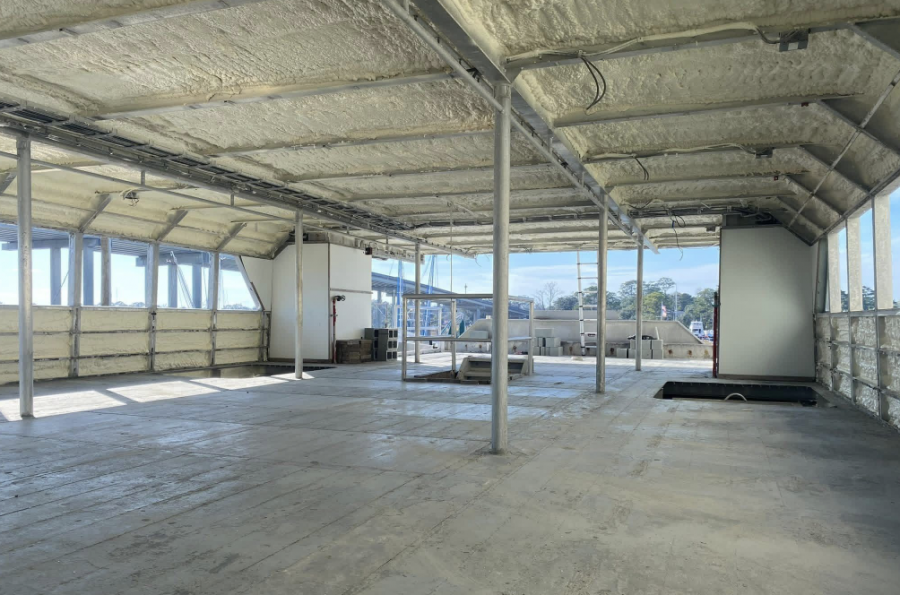
Despite living and working around the coast, spraying aboard a boat was a new experience for the Savannah Spray Foam Insulation team. Captain Derek runs a tight ship, and so does Josh Martin. Theirs is a small crew composed of General Manager Josh; his wife and Executive Office Manager, Rachel; plus an estimator, a lead sprayer, and an occasional contracted helper. For this job, Martin hired a colleague; his lead sprayer’s father, who also happens to own a spray foam company.
Coastal Georgia is warm year-round, so Savannah Spray Foam Insulation was able to foam the deck’s walls and roof in a single January day. They’d return in May to complete the engine room. When they arrived at Captain Derek’s boat shop, the catamaran was anchored ashore. It towered over their truck and rig. The captain’s team had kindly built a temporary staircase to grant the workers safe and easy access to the upper deck.
The boat’s appeal is immediate. At over 60 feet long, it’s huge and could comfortably hold a lot of eager tourists. The decks are balanced on double hulls, which means the sailing will always be smooth. Catamarans are designed in a way that does not tilt side to side the way single-hull boats do. Although the catamaran’s deck is covered, it’s not completely enclosed. Installing closed-cell spray foam will serve as a moisture barrier and insulate the area below deck. That way, riders can take in the sights and feel the wind on their face while they are still protected by a shade structure insulated by spray foam.
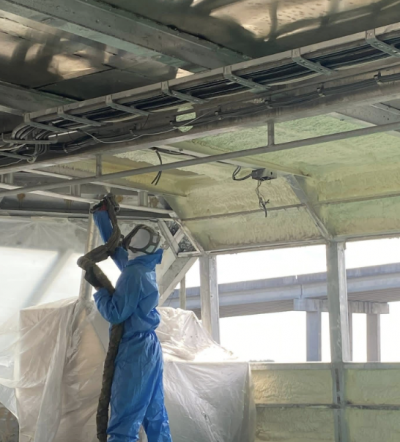
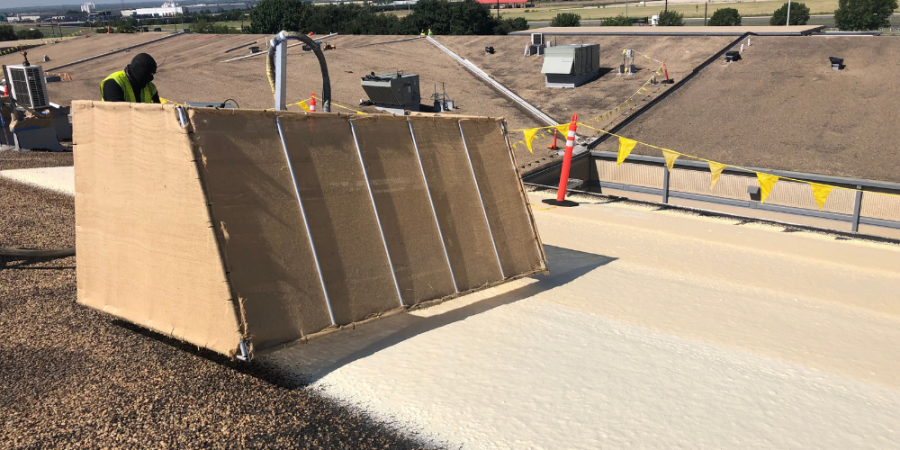
On deck, Josh Martin’s team foamed the exposed roof and walls with two inches of GVP 2.0 HFO closed-cell foam. The client later added DC315 coating himself on Martin’s advice.
Up on deck, the now-gutted interior showed zero evidence of the decrepit fiberglass batting that had once hung along the aluminum walls. It had all but disintegrated by the time Captain Derek got it. He had spent months ripping everything out and stripping it down to bare metal before taking a sandblaster to the surface of the entire boat, sans the roof, which he’d recently replaced. Replacing the roof and sandblasting the walls made the entire vessel look almost new. A big plus for the Savannah Spray Foam Insulation crew, who didn’t have much in the way of prep work thanks to their client’s meticulousness. The extent of their prep consisted of hanging plastic sheets on the windows, as dictated by the wind, to protect vehicles on the ground and the boat’s exterior from overspray.
“They did all the sandblasting down to the bare aluminum and also did the primer in the engine room. We just swung in and applied the foam, really,” said Martin. The efficiency was much appreciated and allowed them to get right down to the main event: spraying the foam.
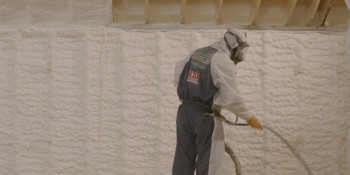
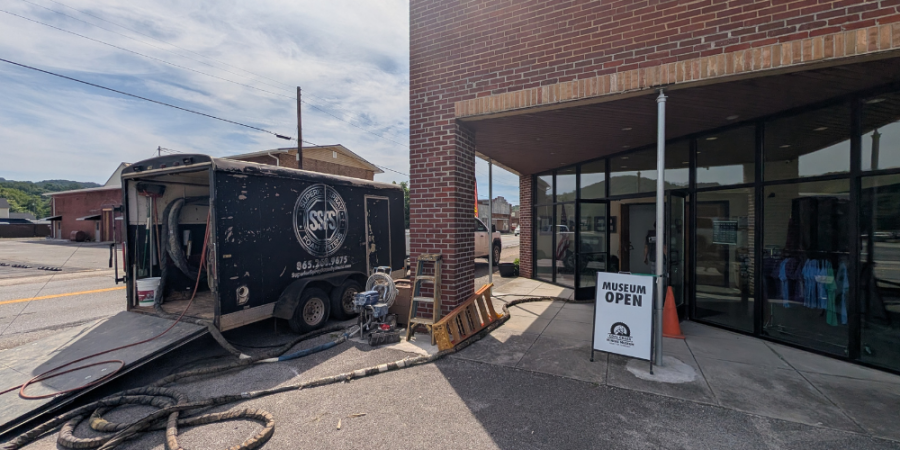
Martin’s team parked their truck and rig beside the boat and fired up the Akurate Dynamics Double Proportioner rig. Their trusty spray hose trailed up and over one side of the boat’s hull. The lead sprayer got dressed in protective coveralls and pulled on a full-face respirator mask by 3M. Over the course of a day, the team installed a two-inch layer of GVP 2.0 HFO closed-cell foam to the catamaran’s roof and walls, covering around 1,500 square feet total.
Adding closed-cell foam to the boat’s covered yet exposed deck serves as a moisture barrier with enough temperature control properties to keep occupants shaded and comfortable on sight-seeing day-trips. But, as Martin mentioned to Captain Derek, there’s a caveat.
“We don’t push upsells very often, but we did strongly recommend adding an intumescent coating,” said Martin; Captain Derek agreed with him. But there was one more thing. “I told him I’m only about three or four years in the business and don’t own a big paint sprayer yet. But he had one already and said he’d do the coating himself.”
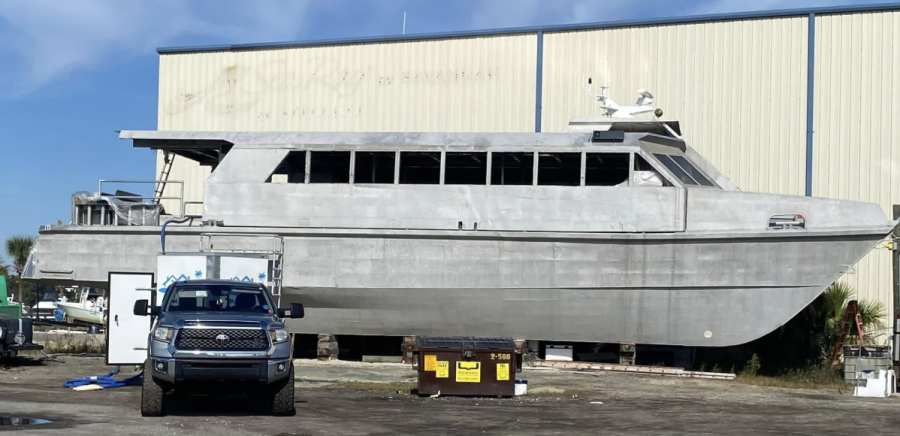
Captain Derek’s catamaran in all its sandblasted glory. Parked next to it, Savannah Spray Foam’s truck and rig looks like a tuna posing beside a tiger shark.
When they returned four months later to foam the engine room, Martin was thrilled and relieved to see that Captain Derek had made good on his promise to coat the foam. He’d painted a thick layer of black DC315 over every spot of foam on the deck, and it looked sharp. Martin appreciated that the client was willing to do the coating himself and hadn’t skipped this critical step. Intumescent coatings are recommended over top of spray foam applications as a thermal barrier. It’s too important of a step to ever skip, even if Martin wasn’t the one paid to complete it. After a mental note to invest in a paint sprayer, he moved on to the final phase: the engine room.
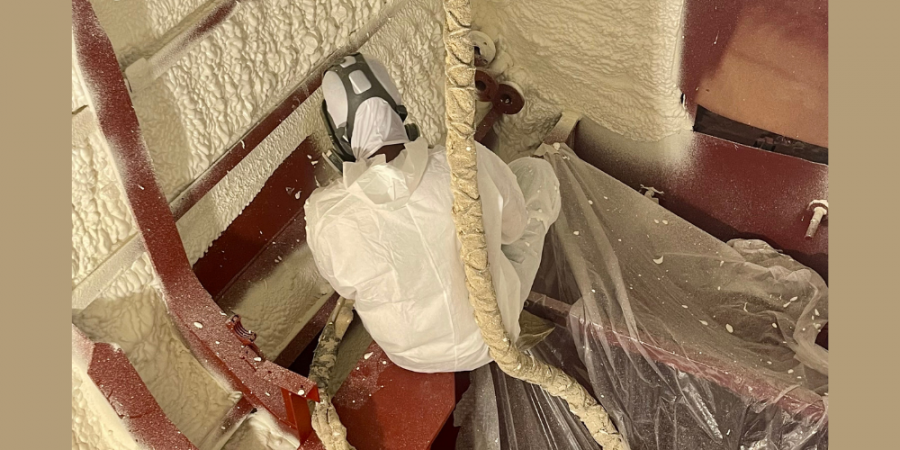
Foaming the engine room was similar to foaming the deck’s walls, only in a much smaller work area—around 200 square feet, by Martin’s estimation. Just like above deck, the engine room was empty and the captain had already sandblasted everything to perfection before Savannah Spray Foam arrived. This time around, he'd also coated the entire engine room in burgundy-colored, marine-grade primer. Once again, there was little prep work required of Martin’s team, aside from taping some plastic down over the floor indentions that would one day house the engine components. They sprayed GVP 2.0 HFO closed-cell foam in a two-inch layer, minding their feet. The terrain down there was often uneven, with tripping hazards obscured by the not-quite-clear plastic masking covering most of the floor. Maneuverability was challenging, but the sprayer continued undeterred. On the plus side, the removable hatch door meant there was little to no overhead spraying required.
As expected, the engine room phase took a single day to complete, then they were ready to call the catamaran project 100%. The team said goodbye to Captain Derek hoping it was not the last time they’d work for him. Martin thinks the odds for a reunion are good– probably. “He’s a captain with a whole bunch of money. It’s likely he’ll call back with another wild idea for us soon.”
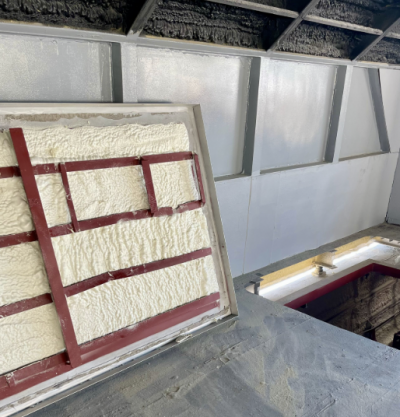
The engine room’s hatch door is removable, which means they can avoid overhead spraying this time. On Martin’s recommendation, the client coated the foam on the ceiling and elsewhere with black DC315.
Disqus website name not provided.