
















After-School Special


Spray Foam Magazine – Fall 2026 – The thought of going back to school fills many people with dread. Nevertheless, there is one contractor in Chatham, Ontario, who doesn’t find the school environment intimidating at all. This contractor compared a recent spray foam project at a school to the environment of working in the spray foam industry—every day a crash course in learning and surviving.
Getting a proper education can help set someone up for the real world, but real knowledge is earned in the trenches of working in an industry every day. It’s this determination that has made Cutting Edge Insulation & Metals Inc. top of their class, their clients happy, and builders more efficient. We caught up with this motivating contractor to find out how they used Huntsman Soya HP closed-cell foam to help a school in Canada get back in session.
Roseland Public School in Windsor, Ontario, serves students from early years to Grade 8. It first opened its doors in 1914 with just one classroom with 25 children enrolled. In 1925, a two-room school was constructed to replace the aging pre-World War I structure, and in 1928, the school expanded again with more classroom space in addition to a teacher’s room, a furnace, and male and female washrooms. Fast forward to 1988, enrollment rose to 310 students, tripling in size with classrooms, a principal’s office, and a library. Today, the school has 510 students.
The Greater Essex District School Board wanted the school’s indoor air quality and comfort levels improved year-round. The team at Cutting Edge Insulation & Metals knew that spray foam was the answer they were looking for and selected Huntsman Soya HP closed-cell foam for the exterior wall application. The SPF would seal the exterior shell, allowing students to have consistent and comfortable learning conditions during both the hot and cold seasons.
Typically, the architect on this kind of project specifies a certain approach for the build. Cutting Edge Insulation & Metals President and Co-owner Ryan Lane explains, “If foam is not specified, we have had a lot of success in getting them to accept a bid submission using it instead of full wrap membranes and rigid board stock. This approach saves them time and money and does a better job of sealing the building, so it’s a win for everyone involved. The merits of SPF on the exterior shell of a commercial building are endless, and we are seeing more of it being the designed approach by architects.”

Cutting Edge Insulation spray foam technician carefully applying materials around all brick ties. Effective angles and spray techniques to seal around these is very important for proper barrier.
Ryan Lane has a wealth of spray foam experience. He started in the industry by working for a large, family-owned spray foam business based in Woodstock, Ontario, before leaving to work for a custom home builder. Ryan spent about seven years with this company but left when the original owners retired and the company was sold to a venture capital firm.
Candise Vanderklis, the other co-owner of Cutting Edge Insulation & Metals, was originally an accountant working for firms like Deloitte, BDO and others. She started working part-time on building Cutting Edge Insulation until it became her full-time career. With hard work and grit, the sales, scheduling, and account management were handled by both Ryan and Candise, who also took care of all the important behind-the-scenes needs of the business.
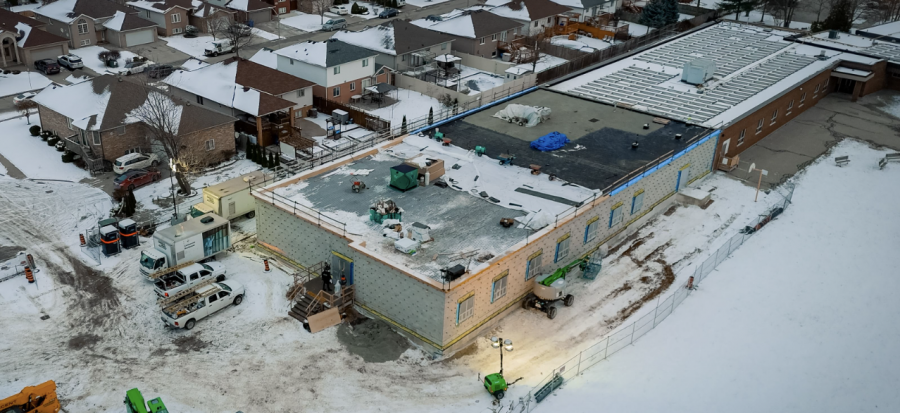
An aerial view of the addition project shows its close proximity to the surrounding neighborhood and connection to the existing school. As darkness approached within an hour of the foam application, two light towers were brought in to keep the work area illuminated.
Back at the project, it was winter and the nights came in quickly, so the crew made sure they brought in two construction light towers for visibility, as well as two lifts to access the higher portions of the walls. Safety is a top priority at Cutting Edge Insulation & Metals, and the crew always has the proper PPE, including full-face masks, fresh-air-supply respirators, gloves, a harness, lanyards, work boots, and hard hats.
Before applying the foam, the crew completed the membrane work and carefully protected surrounding areas from overspray, including the foundation walls, windows, doors, and concrete stairs. Because the project took place at an active school, the crew worked after hours to accommodate the school board’s request that no spray foam be applied while students were on the property.
The crew consisted of Greg Van Bemmel, Jeff Van Bemmel, and Nate Ouimette as the spray foam applicators, and Bryce Duley and Brodie Arnold as the SPF helpers. They started their day on-site when the kids were leaving school. They sent three rigs to the site to ensure that they could complete the spray foam application in one visit, allowing the masonry work to commence as quickly as possible.
The crew pulled their 200-ft. hose to the school’s main building and made sure all their equipment, including their E-30 machine, was running smoothly. The exterior cavity wall was just over 5,000 sq. ft.. The crew sprayed three inches of Huntsman Soya HP closed-cell foam to the concrete block.
When the crew usually does a commercial project, they typically work from the top of the wall and work their way down. However, on this project they had three crews on-site, so they did both levels at the same time.
During regular work hours, while the crew was doing the membrane, metal stops, and poly protection, there were other trades on-site. “We always work well alongside other trades. It’s what makes these sites go smoothly. Teamwork and being a part of the solution is what we strive for every time we are awarded a project no matter how big or small,” explains Ryan. Yet at night when the Huntsman foam was being installed, they were the only trade present on-site.
The crew was very mindful of the winter weather, as it was cold but thankfully still within the parameters for proper SPF application temperatures. The area recently had winter storms, including snow and ice, so the site was a little treacherous, but the substrate was in great condition to accept the Huntsman Soya HP foam application. The application went smoothly as the crew planned everything out before even arriving on-site. They ended up spraying roughly three-four sets of Huntsman Soya HP foam to complete this project.

ABOVE: Finishing touches being completed on the west elevation; BELOW: The fully finished north elevation as midnight approached.

Masonry work began immediately after the crew installed the closed-cell foam. Because the crew applied poly protection before starting the spray foam application, their cleanup afterward was very limited. “Our team was very proud of this project as winter can be difficult with snowstorms and other obstacles. So, taking what would normally be a three or four day job for one crew, we found a good weather day to make this happen all at once in under eight hours,” explains Ryan.
The crew and the entire team at Cutting Edge Insulation & Metals made this project another success. This was due to both their application techniques and their planning skills. With any challenges at this project addressed before they came to the site, things went extremely smoothly on application day.
The client was extremely happy, as the Cutting Edge crew managed to get this scope of work completed ahead of schedule and met the client’s expectations of doing the work when no students were on-site. Ryan also did a re-visit to the site before masons started to cover the foam with brick. Once that was completed, there was no need to visit the site again.
Ryan is proud of his crew and what they achieved, saying, “Having a really great team of colleagues is what made this project possible. We facilitated the client’s requests and had great people involved who were willing to work a winter night shift to help make it a reality. Our entire team is dedicated to EXCEEDING EXPECTATIONS EVERY DAY!”
Ryan also emphasized that none of these commercial bid/tender jobs would be possible without their Senior Estimator, Trevor Sutherland. “His experience and precision when reviewing specifications and drawings are an immense benefit in our successful attempts at winning bids. He has been with the company for over five years and spends most of his day reviewing projects that we price to secure future work.”
The Cutting Edge crew has completed numerous schools and other commercial buildings with spray foam applied to the exterior shell, helping create a cozy thermal blanket around the exterior envelope. At Roseland Public School, the Huntsman Soya HP closed-cell foam provided that continuous layer of protection.
“This creates the most beneficial insulation approach. It’s like the building has a forcefield around it to battle all of the intense heat in summer and extreme cold in winter. On top of comfort, this approach also helps seal the building for improved indoor air quality for the students,” concludes Ryan.
Disqus website name not provided.