













Between a Rock and a Dry Place


Spray Foam Magazine – Fall 2026 – Downtown building lots don’t come much tighter than the one on historic Gottingen Street in North Central Halifax, and this tight squeeze is now home to Urban Capital’s new Navy Lane Condominium building. The condos rise nine stories up, nestled between two existing buildings on a busy city street. Fitting a 169-unit residential building onto a constrained infill site called for maximizing every square foot within the property and municipal setbacks. These tight parameters left the architectural design team with an unusual and unforgiving foundation condition: the concrete foundation wall would need to be built directly against exposed bedrock and waterproofed. Once the concrete was poured, there would be no exterior access to that wall ever again. No digging back in for a fix. No second attempt. Whatever waterproofing assembly went in against that rock face had to work, permanently, the first time. Nova Scotia’s own Trinity Energy Group came in clutch with solid plans to install blindside waterproofing to protect the foundation wall until virtually the end of time.
A project to install 16,000 square feet of below-grade blindside waterproofing isn’t something you hand off to just anyone. Luckily, general contractor Marco Construction Group didn’t have to look far at all to find their experts. A longstanding working relationship between Marco’s Senior Vice President, Jeremy Stewart, and Trinity Energy Group’s Senior Vice President, Steve Turnbull, put Trinity in the war room from almost the beginning. Through that early collaboration, Stewart and Turnbull worked together to revise the original design away from a conventional bituminous waterproofing system and toward a blindside waterproofing solution developed by Elastochem. Their system is tailored specifically to the site’s bedrock conditions, and showcases a three-part assembly of Hygroboard drainage board, Elastochem Insulthane® HC 40 high-density structural spray polyurethane foam, and Elastochem Hygrothane spray-applied waterproofing membrane. Trinity also agreed to apply Elastochem’s Insulthane® Extreme closed-cell spray foam to around 8,000 square feet of window details throughout the building’s interior.
“The blindside waterproofing assembly was designed to create a continuous waterproof barrier between the bedrock and the concrete foundation wall,” said Kaitlyn Carvery, Construction Manager for Trinity Energy Group. “Because the foundation is constructed directly against bedrock, the completed wall cannot be accessed from the exterior once construction is complete, making the integrity of the waterproofing system critical.”
Working that assembly onto a downtown infill lot came with its own set of headaches before a single pass of foam ever went down. Limited parking and restricted access for equipment and support vehicles made staging a challenge from day one. To protect adjacent structures, vehicles, and pedestrian traffic from overspray while keeping the site controlled, crews had to erect temporary hoarding before installing either the HC 40 or the Hygrothane. Trinity kept a full-time supervisor, Bailey MacDonald, on site throughout the project, backed by Waterproofing Foreman Herman Schade and Spray Foam Foremen Nathan Berringer and Riley Singer. In total, they ran a crew of six to eight employees rotating through the application from start to finish.
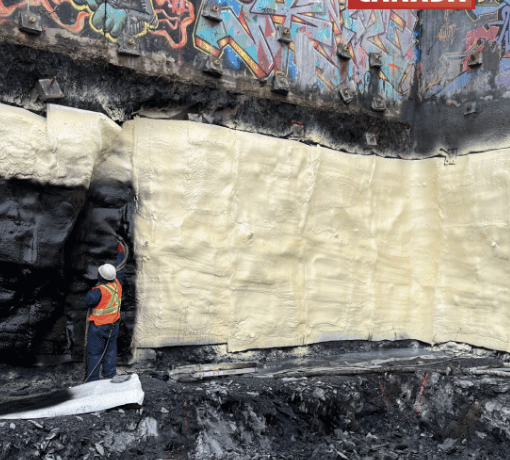
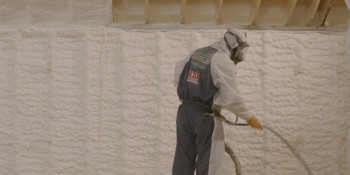
Trinity crew member sprays Elastochem Hygrothane over the Elastochem Insulthane HC 40 and drainage board.
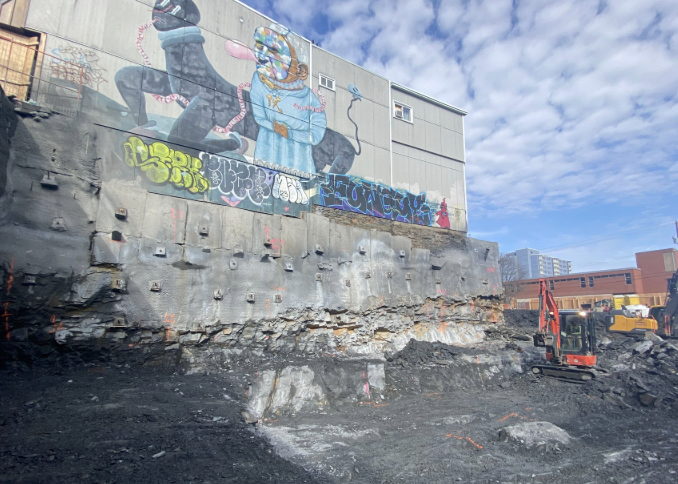
The raw, excavated bedrock face before waterproofing, showing the rows of fasteners driven into the rock to anchor the drainage board, with excavators working the pit floor below.
The assembly went in over three coordinated stages. First, Trinity sent a three to four-person crew out to affix Hygroboard drainage board directly to the bedrock using X-C fasteners, pins, and washers. This created a continuous drainage path to channel groundwater down to the perimeter drainage system and relieve hydrostatic pressure before it can build up against the wall.
Next, a two-person spray crew began applying the Elastochem Insulthane® HC 40. They sprayed the foam over the drainage board to create a smooth, uniform substrate across the highly irregular rock face. The foam’s high-compressive-strength filled voids and followed the natural contours of the bedrock, all while standing up to moisture, heavy loads, and swinging temperatures, exactly what a below-grade blindside application demands. Once the foam cured, Trinity added Elastochem’s Hygrothane spray-applied waterproofing membrane. Hygrothane is a liquid-applied system that cures seamlessly, with none of the joints or overlaps that come with sheet membranes. The membrane conformed to every irregularity left in the substrate and bridged minor movement, forming the primary barrier standing between the building and the water table for the life of the structure.
Because the work took place during the foundation phase, Trinity’s crews weren’t working alone in the excavation. Excavation crews, crane operations, formwork installers, and foundation personnel were all active in the same confined footprint at the same time. The key was to keep assembly moving without stepping on the other trades’ toes–sometimes literally.
“Executing these activities concurrently required extensive planning and coordination with the general contractor and other trades working within the excavation,” Carvery said. “Maintaining safe work zones, sequencing operations, and protecting both our employees and the completed waterproofing system were critical to the successful execution of the project.”
Of course, Nova Scotia weather didn’t make sticking to a tight schedule any easier. Over the course of the months-long project, crews endured the gamut of challenging weather, unphased by the snow, heavy rain, high winds, and extreme summer heat.
“Environmental conditions were continuously monitored to ensure compliance with the manufacturer’s application requirements,” Carvery said. “On several occasions, work was postponed due to weather conditions.”
Rather than push a spray or a coat under marginal conditions, crews held off until the assembly could go down right. A small delay in service of a wall no one would ever be able to open back up, but Carvey’s team is never known to cut corners.
On the equipment side, Trinity ran a Reactor 3 paired with an AP Fusion gun to apply the Insulthane® HC 40 and Insulthane® Extreme foams, alongside Hygrothane coating equipment for the membrane. Crews suited up in hardhats, steel-toe boots, gloves, respirators, safety glasses, fresh-air masks, N95s, Tyvek suits, and hi-vis vests throughout the application–standard protection for a below-grade site running multiple spray crews at once.
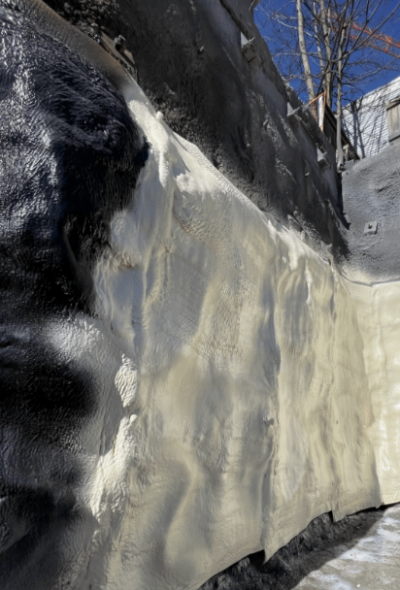
A close-up of the Insulthane HC 40 (cream-colored) meeting bare rock (gray), showing how the spray foam levels out the bedrock's natural irregularities ahead of the Hygrothane membrane (black).
In total, the exterior blindside waterproofing assembly covered approximately 16,000 square feet of bedrock and foundation wall and used 18 sets of Elastochem Insulthane® HC 40 and 15 sets of Elastochem Hygrothane. Inside the building, crews applied roughly 8,000 square feet of Elastochem Insulthane® Extreme closed-cell spray foam to window details, using six sets of material to seal out air and moisture at every opening.
Trinity completed the Navy Lane scope in July 2025, and with that closed out a project that had asked its crews to hit a moving target: coordinate around a live excavation, work through a full range of Atlantic Canadian weather, and get a three-layer waterproofing assembly properly installed against solid rock with zero chance for a do-over. This type of below-grade work is unlikely to be seen again once the concrete goes up and the building rises above it, and that’s exactly the point. For Trinity Energy Group, the proof of a job done right means signing off on a blindside waterproofing job that future Navy Lane residents will never notice or have to think about for the life of the building.
Disqus website name not provided.