














The Chemistry of Formulating & Processing Off-Ratio vs Off-Mix and It’s Not The Same…
Dudley J. Primeaux II, PCS, CCI

Spray Foam Magazine – Summer 2026 – Growing up in this industry over the past 40+ years, significant improvements have been shown, both from the standpoint of product formulation advancements as well as that with application equipment for these plural component systems. Technology, especially with electronics and Artificial Intelligence (AI) has been great, but is it used properly and not at the expense of gained knowledge and understanding the basics?
While this article may ruffle some feathers, it really is not meant to. It should get one to think, understand, and use technological advancements to enhance one’s knowledge. While equipment manufacturers may understand the mechanics of processing and fluid dynamics, very little consideration is given, or understood on the chemistry of the system.
Let’s delve very briefly into chemistry of formulating systems and compare that to processing, which will relate to the often mis-used terms of off-ratio and off-mix. Will comment on what that means, and is having 100% 1:1 ratio an absolute? But documentation is the key! Application verification is important, but one also needs to understand what exactly it is one is verifying.
The Chemistry of Formulating
For those that are involved in developing quality polyurethane foam or polyurea coating systems, we understand the challenges of making a system that is balanced from the standpoint of volume ratio as well as reactive equivalent ratio. These are not the same. The individual components of the system (A and B-side) are not pure molecules of materials in the blends. The majority of the system is based upon polymers, which can have either narrow or broad molecular weight distributions.
Another concept to understand here, the systems are made based on “parts by weight” in preparing the formulation. Ah, but then processing is based upon “parts by volume.” Lab hand mixes, or cup pours as some note, is based upon weight mixing of the two components. For this, the system formulation is based upon something called INDEX.
INDEX is the ratio of reactive equivalents of Isocyanate to reactive equivalents of reactive hydrogen species, meaning hydroxyl or amine groups in the resin blend component. Normally, we formulate these systems at an INDEX of about 1.10 or so at a 1:1 volume ratio. Meaning that there is a slight excess of Isocyanate equivalents to reactive hydrogen equivalents. This is the proper way for formulating.
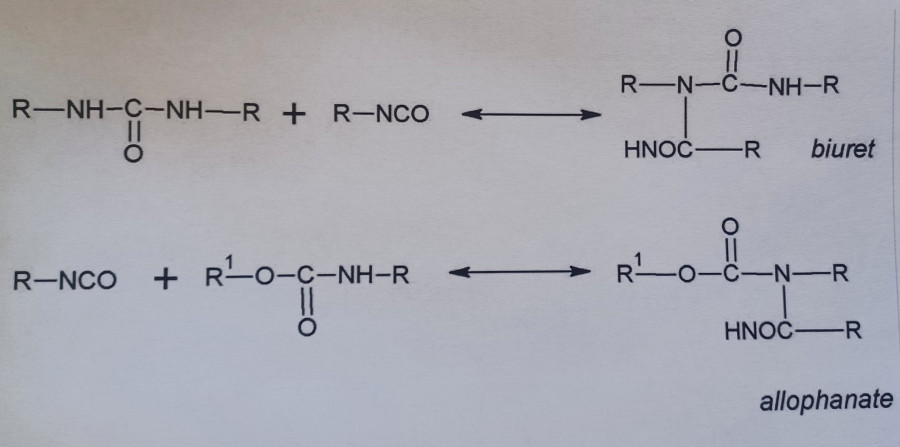
Systems are typically always prepared to have a slight excess of Isocyanate equivalents as that excess ISO can react with the formed backbone of the polymer system. Of course, there are some exceptions to this in some prepared urethane elastomer systems. Once the urethane linkage has been formed, that slight excess of ISO groups can react with amine in the linkage to form the allophanate crosslinking. For polyurea, that subsequent reaction results in the biuret crosslinking. This is shown below:
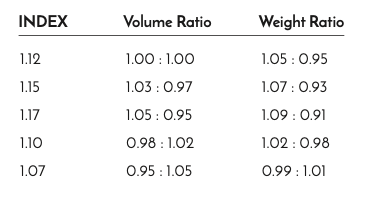
From a practical example, take the following. This is for a typical polyurea spray system, formulated at a 1:1 volume ratio, 1.05:0.95 weight ratio, for an INDEX of 1.12.
It should be noted when changing the processing volume ratio, also having good, complete mix, there was insignificant changes in tested physical properties, all within the standard deviation of the testing procedure. Good material was produced in each case.
The Processing
Back in 1992, a technical paper was published as part of Polyurethane 92, Proceedings of the SPI 34th Annual Technical / Marketing Conference, held in New Orleans, LA (October 21 – 24, 1992). This presentation was specific to the processing characteristics of the relatively new Polyurea Spray elastomer technology.
In this study, information was presented on processing at a 1:1 volume ratio, but changes were made in processing pressure / flow rate and processing temperature. What was shown is that one can be on-ratio volume-wise, material did spray and exit the spray gun and material set properly, but resulting physical properties were not the same.
This was all due to proper mix of the system not being achieved in the spray gun. Ratio was on, mix was off.
Documentation
During the recent SPFA SprayFoam Convention & Expo 2026, one breakout session discussed the importance of documentation of application work. However, it was implied that the only valid documentation is that generated from the computer of the application equipment. Handwritten reports may not be valid so to speak.
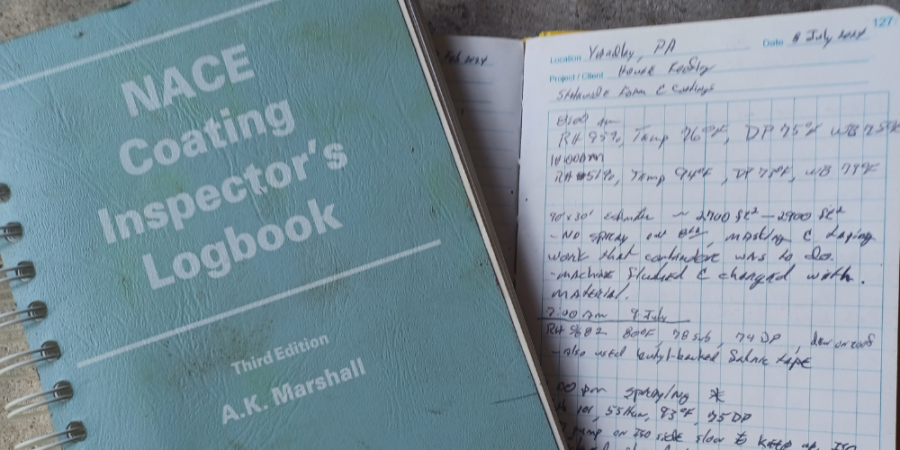
Proper documentation remains critical in coatings inspection.
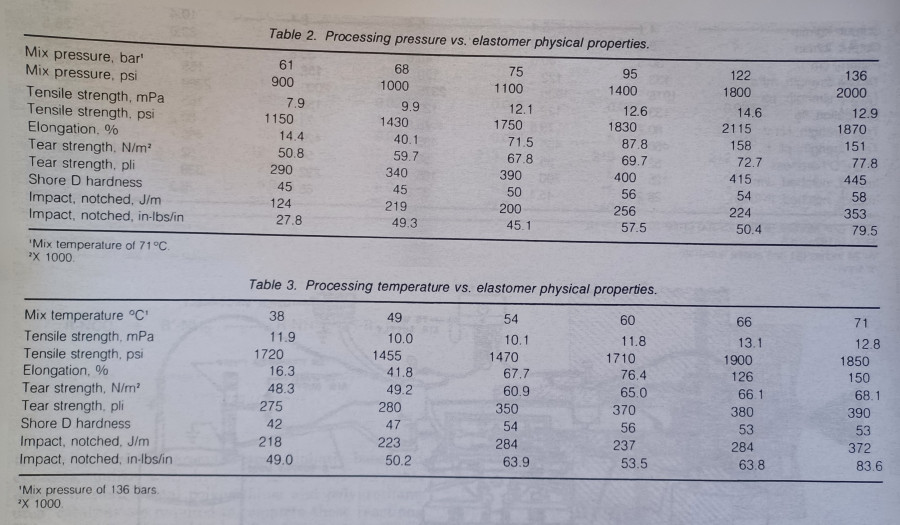
Processing variables can impact final material properties
Well as a certified coatings inspector, and one that has participated in numerous expert witness cases, that is not true.
Handwritten notations are in fact legal and admissible provided they are compiled in a bound record book. Having the convenience of computer-generated reports from the equipment is a good thing. But proper hand recorded information, especially when using proper instruments and industry procedures, is still highly acceptable and should not be discounted.
Conclusion
Does one need to be “on ratio” in order to prepare the desired foam or polyurea coating material? Absolutely!! Recording proper processing ratio on the proportioning unit is good and part of the process in achieving a proper foam or polyurea coating. But what about proper mixing? Think about it, please show us on the data acquisition feature where it also records proper and complete mixing of the components in the spray gun. That part is left to the human element.
Published by Spray Foam Magazine
SprayFoam / Spray Foam Insulation
See the Business Behind the Story:
Disqus website name not provided.