









Respect the Recoat Window
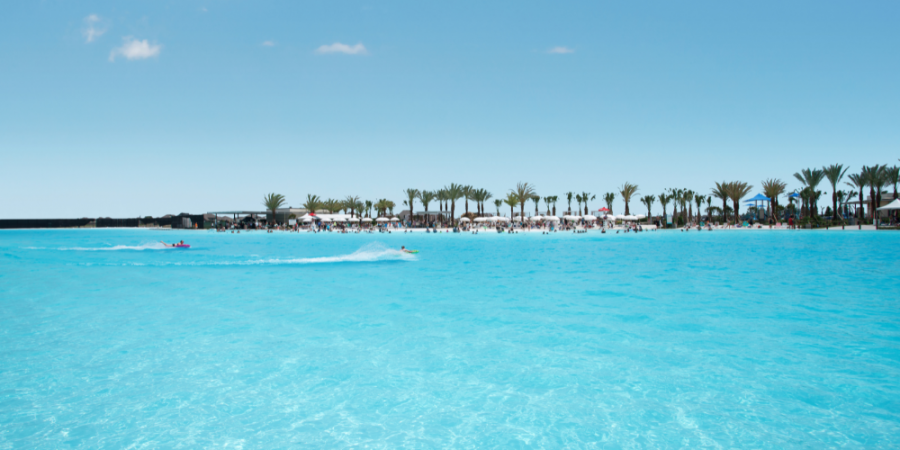
IMAGE PROVIDED BY CRYSTAL LAGOONS

Spray Foam Magazine – Fall 2026 – Just south of Houston in Texas City, Lagoonfest Texas draws crowds to the shores of Lago Mar, a 12-acre, 24-million-gallon crystal-clear lagoon. From the white-sand beaches surrounding Texas’ largest Crystal Lagoons® amenity to the well-appointed clubhouse and all it has to offer, Lago Mar offers exceptional amenities that invite you to relax and enjoy. Crystal Lagoons® is the world’s leader in water innovation and technology, which transforms any corner of the world into an idyllic beach paradise. It is an international company with offices around the world that has developed and patented a state-of-the-art technology that enables crystal-clear bodies of water of unlimited sizes to be built and maintained, offering an idyllic beach lifestyle anywhere in the world while using minimal amounts of chemicals and energy.
Since opening in 2020, the man-made lagoon has offered locals a slice of tropical paradise, complete with 6,000 square feet of artificial shoreline including sandy beaches, a boat ramp, and plenty of concrete walkways where guests transition from dry land into the water. Those high-traffic concrete areas were due for a serious refresh to the tune of a new polyurea system. What was supposed to be a straightforward polyurea recoat turned into a clean-up and rescue mission when Kevin Prychun of Houston’s ACP Coatings & Linings stepped in to save the day. Prychun used a polyurea system by Polycoat Products to refresh the lagoon’s concrete, but he had to wade through a lot of muck to get there.
The lagoon recoat project began back in March, long before Prychun was in the picture. The lagoon’s management company hired a contractor to update the concrete beach access areas with polyurea. They’d heard through the grapevine that the original coating system had a track record of failing at competitor’s water parks around the country and wanted to get ahead of the issue. After several rounds of vetting and back-and-forth, they settled on a different polyurea system and brought in a local contractor to install it. Except, things did not go as planned.
Dudley Primeaux of Primeaux Associates LLC served as the job’s technical and material consultant. At first, he provided his expertise at a distance and approved the original product. He couldn’t have predicted such a seemingly straightforward gig would turn into such a “fiasco.”
Before long, it was painfully clear that the original contractor’s crew struggled with basic application technique, not that they’d chosen a faulty product. According to Primeaux, many of the areas they’d sprayed were off-ratio and off-mix. The breaking point came when a two-part primer was applied incorrectly on one beach area. They’d rolled one component straight onto the concrete, then attempted to roll the second component right on top in an attempt to mix the two in place. The result was a sticky, unworkable mess that had to be completely removed before any real work could begin.
That’s where Kevin Prychun and his crew from ACP Coatings & Linings swooped in. Prychun was initially asked to consult for the struggling project and “help” the original contractor. He and Primeaux had both visited the site to assess the scope of the problems firsthand, and both agreed it was bad. Prychun made it clear he wasn’t interested in cleaning up a mess while the mess-maker was still hanging around. He’d either need to do it himself, or he was out. That was all it took for the lagoon’s management to turn the original contractor loose and hand the entire project over to ACP. Primeaux thinks they made the right choice, and Prychun agrees.
“When we came in there, it was an absolute mess,” Prychun said. “But I inherited it.”
They were starting from worse than ground-zero. Before ACP could even begin surface prep for the Polycoat Products system, the 22-man crew had to deal with roughly 20,000 square feet of botched primer left behind by the previous contractor. That meant bringing in high-pressure water-jetting equipment and vacuum trucks to strip the failed material and the resulting goo from the concrete. This costly detour reportedly ran up around $80,000 before the real work even started, but it had to be done.
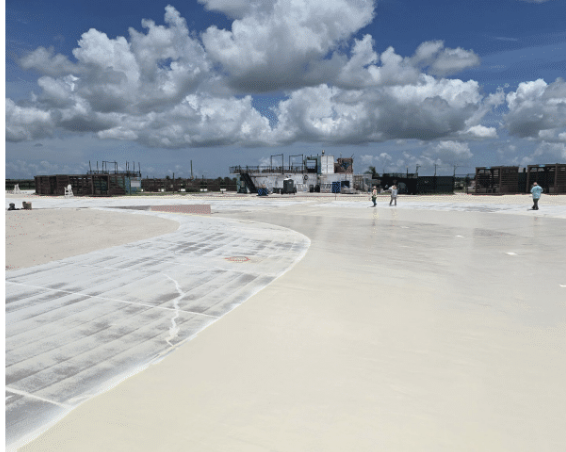
One area of the massive lagoon project completed by ACP Coatings. The concrete shown above is an area where the crew applied primer that afternoon.
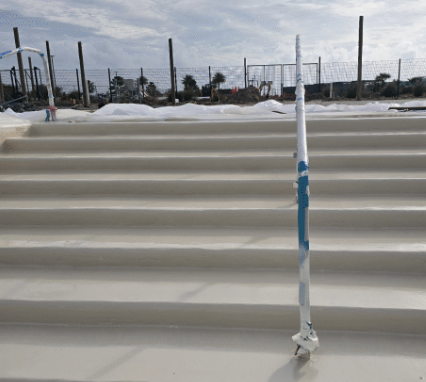
The public stair entrance to the lagoon after the coating was applied.
Once the site was clean and de-goopified, ACP’s crew got to work installing the Polycoat Products system to the lagoon’s concrete banks and beach areas. They were careful to protect the lagoon’s existing membrane PVC–anywhere the coating terminated near the lagoon’s PVC liner, they’d mask 20 to 30 feet back from the seam to keep overspray off.
Concrete surfaces were prepped to a CSP-3 profile per SSPC-SP 13 guidelines. After a good pressure washing, the crew rolled on Polycoat’s proprietary urethane primer, applied at a spread rate of roughly 160 square feet per gallon. From there, the crew sprayed a polyurea base coat (Polyeuro 5502-18PW) in two passes for an average minimum thickness of 80 mils, followed by two coats of an aliphatic polyaspartic topcoat (Staingard 7072SC). Each layer of the tan-colored topcoat was roller-applied at 10 mils each for UV and color stability. Control joints and cracks in the concrete were addressed with a cold-applied polyurea joint filler. Prychun can’t help but brag about how mercilessly his team killed it.
“Our tie-ins, our termination points, everything looked great. You could even see the clean pass lines where we’d started and stopped.” Prychun said. “The execution of our work is just beautiful compared to what it looked like before.”
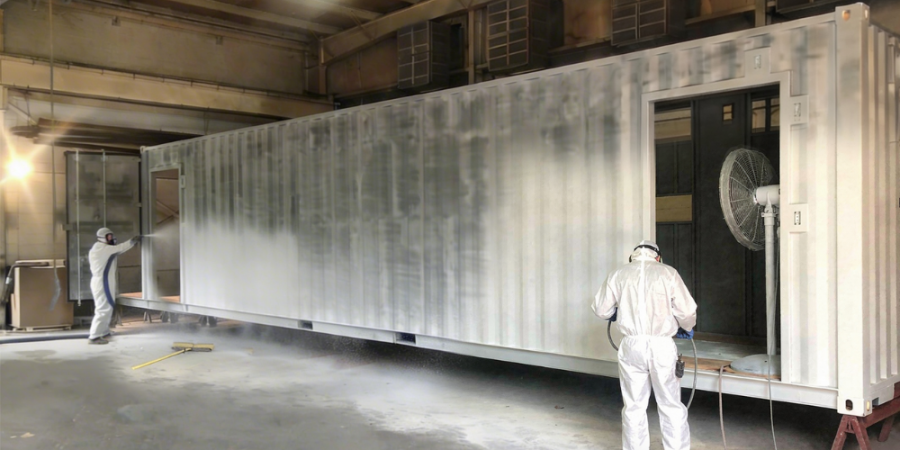
ACP ran the job assembly-line style, using two H-XP3 R2 series reactors set up in a single trailer equipped with Probler P2 spray guns. That way, the sprayers could keep working almost without pause. When one machine’s drum set ran dry, sprayers simply grabbed the second gun and kept moving while others staged fresh drums behind them. On the crew’s biggest day, they sprayed 971 gallons of material; the daily average ran closer to 700.
“We always had two or three drums of resin mixing outside continually,” Prychun explained. “The guys would drop the gun and grab the other gun...boom, they were back to spraying within minutes.”
That assembly-line pace was no accident. Prychun is adamant about one thing above all: never missing a recoat window. He stuck to his guns, even when the general contractor’s schedule caused pressures to run high.
“I had to explain that this is a strict process, and I am not going to miss my recoat windows,” Prychun said. “And we didn’t. We were right on point the entire time.” ACP finished two days ahead of the timeline Prychun had originally promised.
The grueling timelines and miscommunications between trades workers were minor annoyances compared to the real danger posed by the scorching Texas heat. The spray team had only a small window of time before the Texas sun turned into a brutal laser, with rays bouncing directly off the light-colored concrete and heating things up for hours on end. Sporadic rain showers provided some relief but really put a damper on getting work done. Primeaux remembers driving two hours toward the site one Friday morning only to get a call telling him to turn him around. Turns out the crew’s trailer access had flooded overnight, rendering the site unworkable for three or four more days while everything dried out. All told, ACP’s crew was on site for about a month, but thanks to the weather, only nine of those days were spent actively spraying.
“You may schedule a job, but then you’ve got these environmental things that come into play,” Primeaux said. “You just have to work around it.”
Despite the delays, the finished product speaks for itself. In total, ACP coated roughly 130,000 square feet of concrete across several sections of the lagoon’s beach access areas and boat ramp. Still, the coated areas are but a fraction of the property’s overall footprint, since polyurea was only ever needed where guests cross from dry land into the water. The rest of Lago Mar’s 12 acres remains protected by its original PVC liner.
For Prychun, the appeal of a job like this comes down to doing it right the first time. Despite the headaches that came before even picking up a spray gun, he promises it was just another day at the office for he and his battle-tested team. As the concrete banks of Lagoonfest Texas can attest, when a project starts underwater, the right crew can still bring it up for air.
Disqus website name not provided.