









The Polyurea Technology
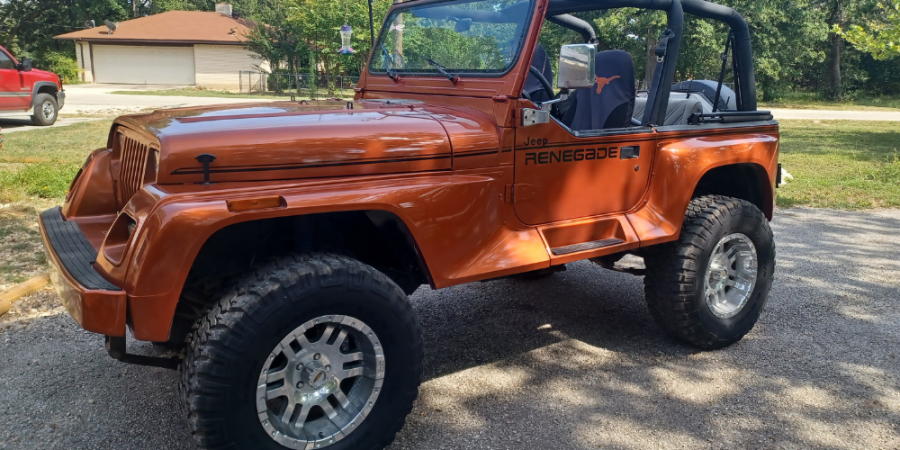
This '92 Jeep Renegade’s bumper is made of fiberglass while the full length, three-piece body flares are polyurea RIM.

Spray Foam Magazine – Late Summer 2026 – Not many may realize this, but this year represents the 40th Anniversary of the development and demonstration of the 100% solids, plural component aromatic polyurea spray elastomer technology. This was accomplished by a little company in Central Texas, Texaco Chemical Company. To complement the aromatic based technology, the 100% solids plural component aliphatic based spray technology made an appearance a few years later, same little old company.
What made this possible were the proprietary high molecular weight Polyetheramines, made from a high pressure, continuous run amination process of corresponding polyether polyols. While some of these amines were used as flexible curing agents in epoxy based systems, nylon modification work and some gas treating applications, the large commercial use from the early 1980’s was in polyurea RIM applications, mainly automotive applications.
But as we briefly delve further in this article, one thing to keep in mind is that Polyurea is a description of a technology, and it is not necessarily a product or coating and lining system. Most all the articles here in The Coating Zone related to the polyurea technology have been related to applied coating systems. A little history on the road traveled through the years.
Polyurea RIM
RIM, meaning Reaction Injection Molding, has been an initial key material and process for producing a variety of automotive body panel parts. This specific technology, an improvement over the previous hybrid polyurethane / polyurea RIM technology, was a co-development by both Texaco Chemical Company (U.S.) and Bayer (Germany) in the very early 1980s. The advantage of course with the polyurea RIM systems was faster cycle times in part molding, improved thermal stability as it relates to the high temperature paint processes, and better Distinction of Image (DOI) in parts produced. This DOI characteristic also relates to those that may spray polyurea into molds to make various objects.
Another advantage of the polyurea RIM system relates to mold release of the manufactured parts. A unique characteristic of the polyetheramines is that solid zinc stearate is very soluble in the liquid, but insoluble in the formed polymer, migrating to the surface, thus allowing for easy part removal with limited external mold release being applied.
This concept has also been applied to spray polyurea systems to create a protective mask on various parts during shipment and installation, but yet easily peeled from the part substrate. This is a common practice in the vanity industry; i.e. bathtub, shower stall, sink manufacturing and shipment. Of course, the resulting system has little to no re-coat window, which can be very important in commercial coating applications.
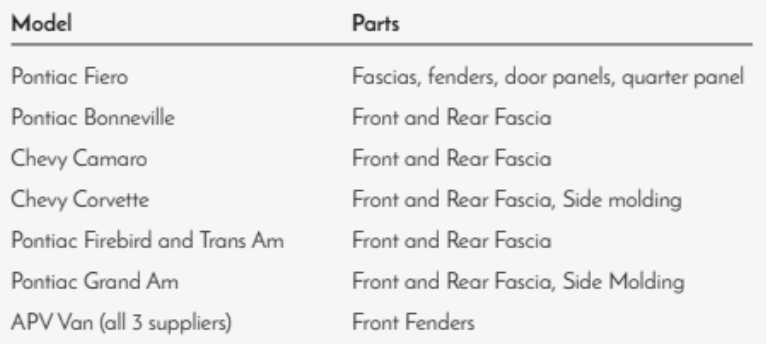
A few of the part types made with polyurea RIM are shown below in Table 1:
An example here is my next-door neighbor’s '92 Jeep Renegade recently acquired. The bumper is made of fiberglass while the full length, three-piece body flares are polyurea RIM. Supplied to Chrysler by the old Autostyle company in Grand Rapids, MI, these were made from 1990-1994, 40 lbs. per vehicle. Not bad for being out there for over 30 years.
Some non-automotive polyurea RIM work also includes the manufacture of some high-end golf balls. Yes, the thermoplastic ionomer or Surlyn-based cover has been replaced with an aliphatic based polyurea RIM type material. Touted as having better control, more spin and cut resistance, they will cost more than the typical Surlyn-based covers. Not a golfer here so not able to attest to this use experience!
So, the 100% solids polyurea spray technology was an evolution of this polyurea RIM technology as a manageable spray coating application. But food for thought here, most spray applicators are running in that 1–2 gal/min output range (~9 – 18 lbs/min or ~4 – 8 liters/min), and some may feel they need to boost that to 3+ gal/min with bigger equipment to increase “production” rates. Caution here as problems can happen much faster when applying with a “fire hose” so to speak. For polyurea RIM processing, using a large mix head like that of a mechanical purge spray gun, a typical output of 12–30 lbs./sec (not minutes)!!!!! How would you like to hold on to that head? Size matters…
Polyurea Joint Sealants / Joint Fillers
The polyurea Joint Sealant/Joint Filler (JS/JF) systems have been a slowed version of the fast set aromatic polyurea spray systems. These are typically 1:1 by volume, processed either through a dual cartridge dispense, or a low-pressure gear pump system, fitted with the proper static mix tube for mixing. Mainly used for horizontal joints, due to a somewhat slow gel and the leveling effect, not much work for vertical joints. Unless of course a type of form is used to hold in place. The initial 1:1 JS/JF systems were in fact all polyurea based.
Today however, most all of the 1:1 JS/JF systems are actually a formulated hybrid polyurea/polyurethane based system. This is mainly due to the fact that a specific high molecular weight polyetheramine used in the initial version was functionally “improved” for use in nylon modification work, and when employed in JS/JF systems, reaction gelling significantly increased that made too difficult to properly process.
For JS systems, these are in the Shore A Hardness range of 45–60 Shore A and can be used in both in-door and out-door applications for crack and control joint work. The JF systems, typically in the range of 75–90 Shore A Hardness, are primarily for in-door applications, or out-door use prior to using a polyurea spray system. These Polyurea JS/JF systems should never be used in expansion joint application, other materials are proper here due to the 3-dimensional movement that occurs. Most of these are aromatic based, so while possessing some UV-stability, they are not UV color stable. There are a couple of special aliphatic based systems though.
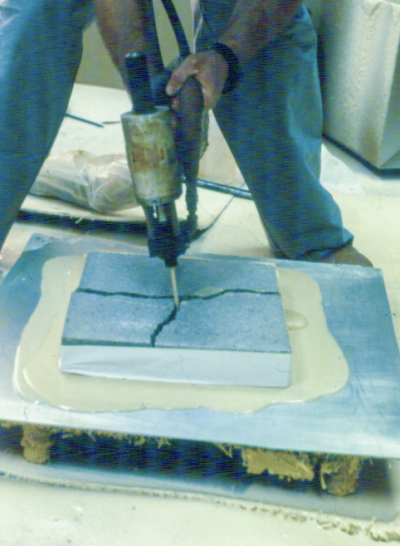
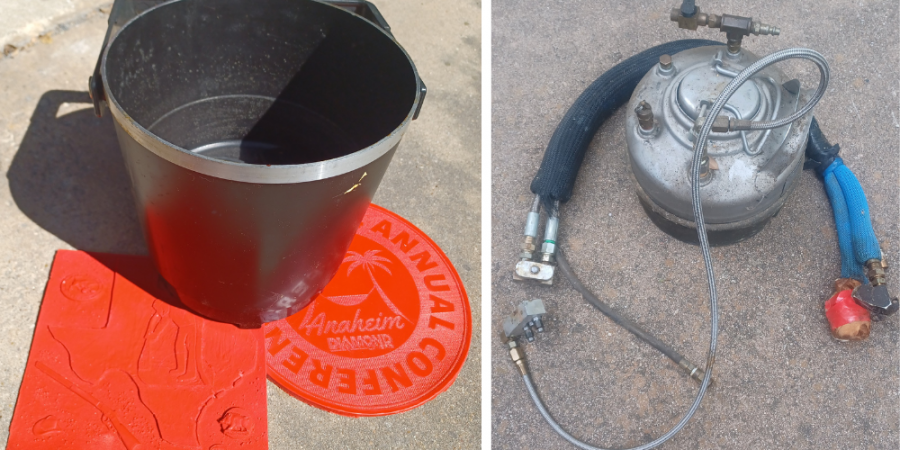
First demo of polyurea joint filler system from 1987 using a special pour gun.
Polyurea Grease
Grease, really? What does that have to do with polyurea one might ask? Polyurea thickeners were first introduced in the 1950’s as an additive for light oil to then make a grease. This was to replace the original Barium based thickeners due to health and safety issues. Used in continuous castors at mills, automotive wheel bearings and CV joints, as well as electrical instrumentation due to high thermal stability and a hydrophobic nature.
One process uses the method of injecting the ISO and Resin side into light oil under agitation to form the polyurea thickener or dispersing solid polyurea particles under heat and agitation into the respective oil. And yes, one can buy drums of solid, white powered polyurea.
Conclusion
Just keep in mind, when one posts a request on social media about the need for a “drum set” of polyurea, don’t be surprised if someone may offer you a drum set of Polyurea Grease. For most, when requesting a “polyurea” system the natural assumption is that a fast set spray system is what is required. Ah…but that is not a good assumption! Keep in mind also, a supplier does not “sell” polyurea, they are provided a formulated polyurea system, where the actual polyurea polymer is being manufactured by the person holding the spray gun or static mix wand.
See the Business Behind the Story:
Disqus website name not provided.