



One Mile Below Earth

Spray Foam Magazine – Late Summer 2026 – This project sounds more like a plot from a sci-fi movie, yet it is happening right here in the U.S. There are few who will ever see it, and that’s because it’s buried a mile underground and consists of at least 370 miles of tunnels. The Department of Energy’s Fermi National Accelerator Laboratory is home to a cutting-edge neutrino experiment including three massive caverns. The underground space will house massive detectors and a comprehensive laboratory system dedicated to neutrino research. Spray Foam Magazine spoke to one coating company to find out why and how their services were needed in such a pioneering project.
Located in Lead, South Dakota, DUNE (Deep Underground Neutrino Experiment) represents one of the most ambitious scientific collaborations in the world. There, scientists study particles such as neutrinos and dark matter. A mile of rock shields the experiments from cosmic radiation that constantly bombards Earth, helping researchers search for answers to the mysteries of the universe.
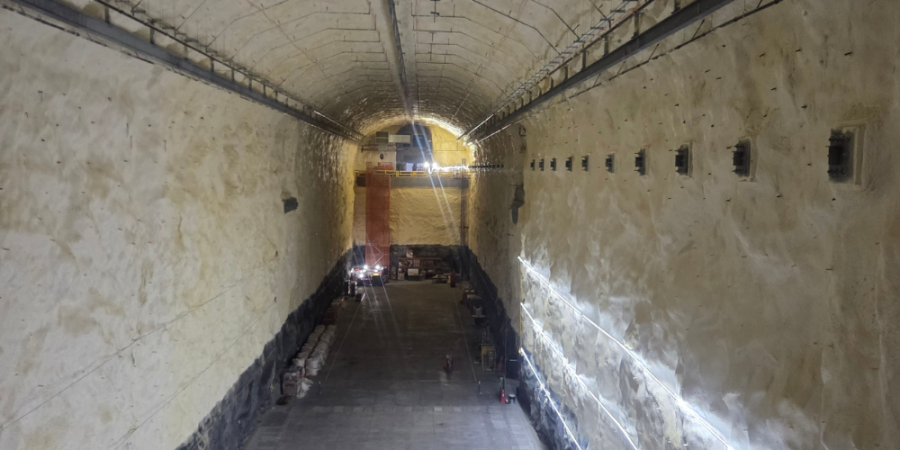
The caverns are truly a marvel of geotechnical engineering. With two enormous caverns, each measuring 65-feet wide, 92-feet tall, and 495-feet long (20 meters x 28 meters x 150 meters), and one slightly smaller one. Together, the three underground caverns are about the size of eight soccer fields. Once the caverns had been constructed, Fermilab needed a coating company to protect people and experiments from potential falling shotcrete if the rocks shifted or cracked in the walls and ceilings, which soar more than 90 feet overhead.
The specified work was put out to bid. These contractors that submitted bids were also invited to the “job walk” before the final proposals were made. Hartman Walsh Painting Company was awarded the contract. Hartman Walsh has been up and running since 1950 and is a trusted provider of industrial painting, coating, and lining services to both public and private entities. With over 75 years of experience, they have built a reputation for delivering high-quality workmanship and advanced technical expertise.
They worked with Ultimate Linings on specifying the appropriate materials for the project. Since 1989, this manufacturer has produced polyurea and polyaspartic coating systems, as well as polyurea spray-on bedliner materials. Today, Ultimate Linings operates from a 302,000 square foot facility in Lebanon, Tennessee. This advanced complex houses their corporate offices, innovation center, technical laboratories, and manufacturing operations.
For this project, Ultimate Linings used its extensive expertise to help ensure long-term safety and structural integrity within the massive underground caverns, Ultimate Linings used its extensive expertise to determine that the walls and ceilings of the caverns should be coated with its FR-263 polyurea system. This includes their epoxy primer system and 5mm application of Ultimate Linings FR-263 fire-retardant polyurea. This coating system was selected based on two critical factors:
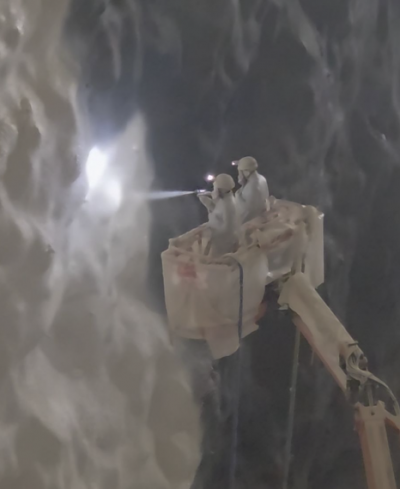
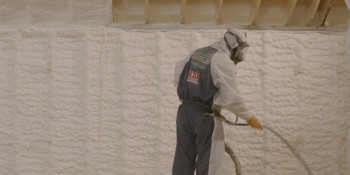
Application of Ultimate Linings FR-263 Fire- Retardant Polyurea, spray-applied using a Graco Reactor H-XP3.
As a dedicated FR-polyurea formulation, FR-263 meets stringent fire performance requirements while maintaining the toughness, elongation, and impact resistance inherent to polyurea chemistry.
According to Ultimate Linings, their facility possesses unmatched production capability.
For the DUNE project, Ultimate Linings significantly increased its FR-263 manufacturing capacity to meet the demanding project schedule. Hartman Walsh Painting Company was hired to apply coating to a 250,000 square foot area. All the crew’s equipment had to go down an elevator or was suspended from the bottom of an elevator car and lowered 4,860 feet to the project level. The boom lifts and equipment that would not fit in the elevator in one piece had to be reassembled. The spray machines and the product were brought down during the night shift by mine personnel.
The equipment included two Reactor H-XP3s with 410 feet of hose for the polyurea, and a King E-Max XT was used to apply the epoxy primer. The product needed to be fire-rated for personnel safety, and Fermilab wanted to use a white coating to improve the cavern's brightness. In an area of this scale, enhanced brightness improves personnel visibility and supports safer working conditions.
Any of Harman Walsh’s crew or workers who went into the caverns had to go through safety classes from Fermilab. The crew wore full-face respirators, Tyvek spray suits, hard hats, and harnesses while spraying. When they were not spraying, they needed a high vis vest, a hard hat with a light, long sleeves, and a self-rescuer breathing apparatus. The entire floor, as well as any equipment such as elevators or platforms, had to be masked off before spraying began.
Working closely with project organizers and Hartman Walsh, Ultimate Linings coordinated production schedules to ensure a consistent, uninterrupted supply, helping maintain project momentum and supporting the timely completion of milestones. The crew varied between four to twelve people working the second shift from 4pm to 2am, six days a week.
After ensuring the area was both clean, safe, and masked off, they first applied 3,000 gallons of primer to the rock face substrate. Once this was dry, 25,000 gallons of polyurea were applied over the primer. The completion of the FR-263 coating system, with its high-build elastomeric membrane, encapsulated and safeguarded the existing substrate for years to come.
The logistics of this project, from scheduling and receiving product to preventing it from sitting out in the cold weather and storing it correctly in a small, open warehouse area at the top of the mine, required planning and communication. Both Ultimate Lining and Hartman Walsh used their communication skills to make sure everything ran smoothly.
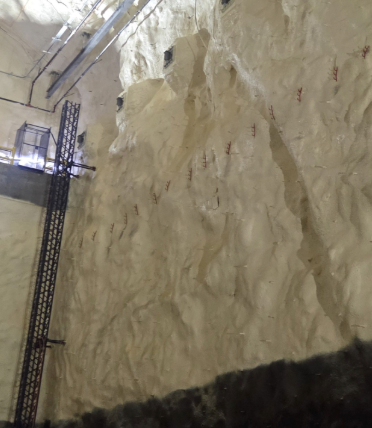
Completed application of Ultimate Linings FR-263 Fire-Retardant Polyurea, sprayed to a 5 mm thickness. The polyurea membrane encapsulates and secures the existing substrate, helping mitigate the risk of falling debris.
Once everything was completed and inspected, the crew cleaned up. This was just a matter of removing all the masking, then bringing all the trash and empty totes up to the surface.
Jess Chism, Project Manager at Hartman Walsh reflected on the project saying, “Working underground was great. No weather impacts and consistent conditions every day. Fermi was super happy with the performance of the material and received the side benefit of increased lighting which was also a major safety improvement.”
The DUNE project is the largest neutrino collaboration in history, comprising more than 1,500 scientists and engineers from over 35 countries, all in these caverns to help unlock the deeper questions of the universe. Questions like, “Why does an exploding star create a black hole?” and “Are neutrinos connected to dark matter?” For both Hartman Walsh and Ultimate Linings, their solid and professional work may not answer these universal questions. However, their advanced coating system and professional application will help protect the people who can, and that is a matter of fact!
Disqus website name not provided.