





Boiled Crawfish or Slow Smoked Brisket?
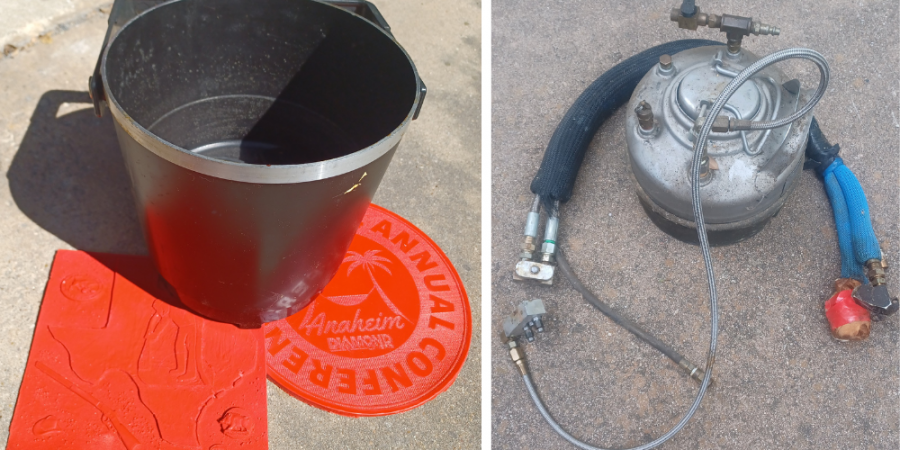
When used correctly, a Fry Daddy (left) and a flush pot (right) can safely clean your spray gun parts.

Spray Foam Magazine – February 2025 – Numerous posts of late on social media have been about what to use and how to “boil” spray gun parts and equipment to remove solidified ISO, overspray, etc. Of course, true to form here, there are many opinions as to what to use and how, without considering potential damage and safety related issues.
What does boiling mean?
Boiling is the application of heat to a material where it reaches or causes to reach a temperature at which the material bubbles and turns to vapor. I’m not sure I want these vapors floating around in a confined area of a trailer or shop that could pose a health safety risk or even a fire, depending upon what the subsequent vapors are.
I have seen posts where a gas burner is used under a pot with “some liquid” just boiling away, and while the poster felt this was a good idea, I just shook my head and thought.
HISTORICAL REFERENCE
Back in the day, this all started by using ethylene glycol (antifreeze) and heat to clean solidified ISO, foam, or coating from parts. This was the alternative to soaking in Methylene Chloride, (which did a fantastic job by the way, but is not so easy to come by, and is banned). This was a process used on metal/steel gun parts, not aluminum based parts. Aluminum and methylene chloride are not compatible as a dissolution reaction will occur. The parts were first flushed of any liquid residue before immersion in the bath.
For this process, a Fry Daddy was used, in a well-ventilated area. Why? Because temperature was limited to 375°F (190°C), and ethylene glycol boils at ~385°F (196°C), and one DOES NOT want it “boiling” from a chemistry perspective, and potential part damage. This would soften/gel and “remove” the solid via a process called glycolysis, which typically required about one to two hours, have patience here. You do not want to breathe those heated vapors, as this can be very harmful to soft body tissue in the nasal cavities, as well as your eyes.
This has now unfortunately progressed (bad info being spread) to use of things like CU-6, Dzolv, or other “solvents” containing NMP – N-Methyl-2-Pyrrolidone for example, and elevated temperatures and boiling, because it is “faster.” But this in fact can cause damage to some metal gun parts, because these types of materials contain amines, and can lead to some stress cracking of those metal parts. Not to mention a health and safety issue and what it does to any plastic parts or rubber O-rings.
Now with many of the gun parts being aluminum, one needs to take care with the type of commercial antifreeze being used. Why? Because different antifreeze products contain different anti-corrosion packages, which can be detrimental to aluminum parts. Commercial antifreeze being used now should be suitable for aluminum block/head engines or use pure ethylene glycol.
THE SCIENCE BEHIND IT
It is well known that the application of heat when cleaning things does make for a better job. Well, except for washing white and colored clothes together (Just ask my wife and daughters. I am banned from washing clothes!) The heat, of course, “excites” the molecules and makes all more fluid, for example. Care must be taken here as too much heat may in fact lead to unwanted results.
For these other solvents that may be used, those containing NMP is one to use the utmost care with. NMP is used in a variety of paint stripper systems. NMP is what is referred to as a heterocyclic organic compound, I did quite a bit of work with these types back in my college days. And while NMP has a boiling point of 395°F (204°C), the flash point is only 196°F (91°C).
NMP is considered a reproductive toxicant and skin and respiratory irritant in its liquid form. We have all seen pictures of exposed skin effects when someone handles this liquid without use of proper PPE—nitrile gloves, for example. Heating that material to exceed its flash point and then boiling will result in the molecules being vaporized and thus more readily entering the body via inhalation and skin absorption.
Work by the U.S. Navy at Tinker Air Force Base over 20 years ago showed that the use of NMP, at temperatures of 120 – 160°F (49 – 71°C) provided effective cleaning of certain metal parts. However, the parts had to then be washed to remove the residual NMP that remained on the surface. Immersion cleaning at temperatures above that did show metal stress cracking and warping issues with certain metal parts.
One shop that I have been working with had a related issue with boiling parts in NMP, and they knew better. The crock pot on the workbench corner area was set on high, the NMP vaporized and then ignited.
While no significant damage was done, the corner wall was scorched, but they caught it in time and averted a major issue here. Unfortunately, no picture evidence is available, but I did observe this in person.
Conclusion
Everyone seems to be in a hurry these days and taking unnecessary short cuts. While one can do some things, it comes down to whether one should do certain things.
First off, please don’t boil your parts and equipment. You can use a warm setting and have patience—take it slow. Second, use the proper chemical material, and follow proper safety practices. And third and most importantly, if you are going to do this, make sure it is done in a well-ventilated area. Just because you see someone post about what they may use and do, does not necessarily make it right. Take care of your equipment, that is your “money maker!”
See the Business Behind the Story:
Disqus website name not provided.