











Unsinkable By Design

Spray Foam Magazine – Late Summer 2026 – In Sarnia, Ontario, Canada, on the shores of Lake Huron, Gordon’s Shoreline Marine is hard at work carrying on a 50-year family legacy as experts in all things marine construction and repair. Seawalls, marinas, docks—if it’s submerged or it floats, Gordon knows what to do to keep it in tip-top shape. At their shop, co-owners and cousins Taylor and Curtis Gordon often use closed-cell spray foam in their services. Most often, they reach for a specially-formulated marine foam manufactured by Empire Foam Solutions (EFS): 2.2 LB density (2.2 pcf). It is a USCG approved Bio-Renew Flotation Foam and safe for using in marine environments.
The marina’s primary purpose is to float in water and give people a place to dock their watercraft. It should be built well enough to withstand some boat-bumps and rough waters, and for people to walk on without accidentally toppling into the water. What a marina is not supposed to do is slowly fill with water like a rectangular wooden water balloon. It should never be sinking, sagging, or submerged. If a marina owner notices any of their floating docks sinking, sagging, or submerged, they should address any of these issues as soon as possible. But it’s not always that simple.
Waterlogged, sagging docks are common enough problems for aging or well-loved marinas. Completely replacing the entire structure, or even just sections of it can be a pricey endeavor most owners prefer to avoid. The Bridgeview-Guildwood Marina on the Sarnia Harbour found themselves in this situation. Significant portions of their marina had degraded over the years and some sections had taken on a lot of water. The waterlogged docks were beginning to dip too far down into the water, and were approaching the level of a safety hazard. The marina owners got a hold of Gordon’s Shoreline Marine to explore the options for restoring the marina without demolishing the entire thing and starting over.
Fortunately for the sinking marina, closed-cell foam and marine applications are a match made in heaven. SPF has a long resume as an excellent void-filler. Injected underground, it makes fast work of leveling out foundations and stopping concrete slabs from cracking. So, if it can fill the gaps in soil and seal a building’s envelope from air and moisture, it makes sense that it could be used to fill the void inside of a floating dock. Properly installed inside the dock, the EFS marine foam resists water and can potentially keep the dock floating for decades.
Armed with this knowledge, Taylor and Curtis came up with a multi-phase plan for the marina. Their client was completely on board and was already well-versed in the gospels of marine foam.
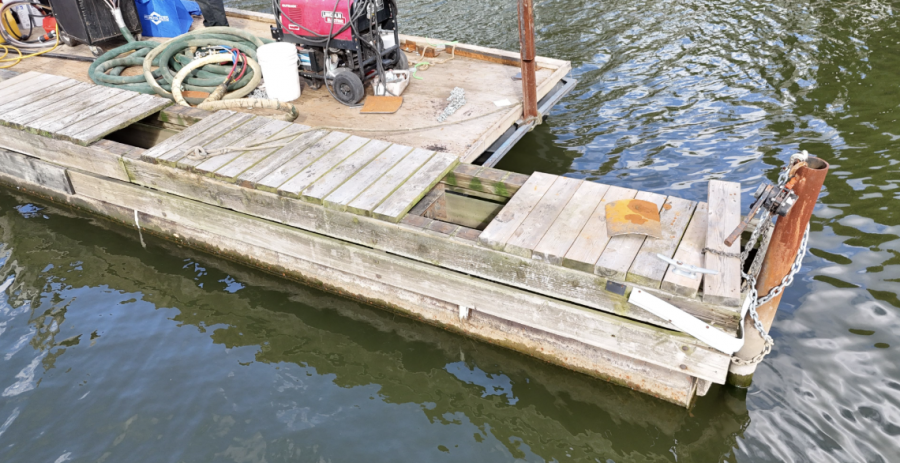
Gordon’s removed several deck boards to expose the flotation chamber. They’ll fill this internal void with closed-cell marine foam by Empire Foam Solutions. Their barge workstation is in the background serving as a makeshift rig.
“The client selected foam restoration because it allowed the marina to rehabilitate existing infrastructure while avoiding the significant cost and downtime associated with full dock replacement,” said Taylor.
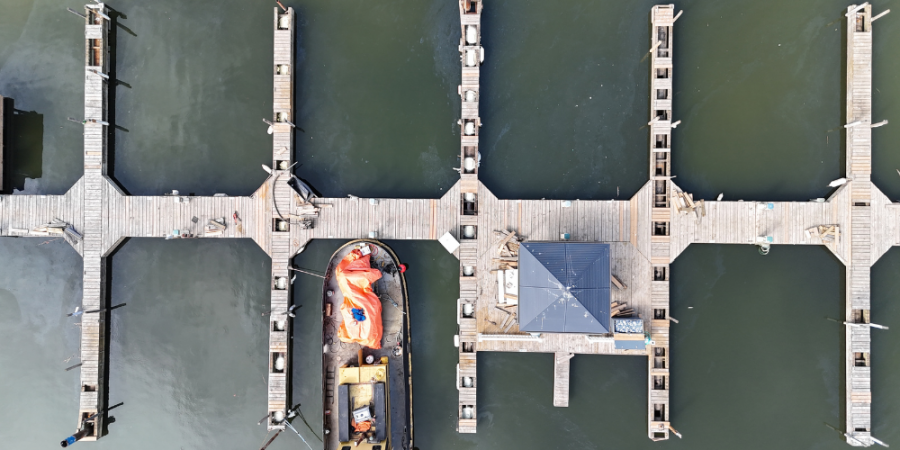
The docks at Bridgeview-Guildwood consist of wooden decking built around steel pontoons, like long rectangular boxes floating on top of the water. Often, the docks have an outer shell around the pontoon connected to the wood. The steel pontoons are responsible for most of the deck’s buoyancy. If water intrudes through the wood and into the void space around the pontoons, it will drag the dock sections into the water. This can happen if something ruptures the dock’s outer shell, or if water seeps in through gaps in the wood. Too much water inside the dock makes the deck uneven and difficult, even dangerous, to walk on. If the docks continue filling up with water, they will sink further and further over time. By injecting the marine foam, the dock could maintain buoyancy for decades to come. The foam will still exclude water and keep the dock floating even if the outer shell fails. No sinking, no leaking, no stress.
In May 2026, Gordon’s Shoreline Marine started working on the marina. Getting to and from the jobsite couldn’t have been easier, since Gordon’s and the marina are actual neighbors.
Given the watery nature of this job, it’s not as if they could pull up a truck or trailer right into the harbor. Even their 100-foot-long hose would need an assist. They had three to four humans working on this job, but they also relied on a trusty barge to serve as their roving marine workstation. They split their workstations between the barge and working directly off the thin dock. The flat barge kept all their equipment organized as they serviced the docks.
“The use of the barge was especially valuable, as it allowed us improved access to hard-to-reach areas and better positioning over the water for safe and efficient application,” said Curtis. Luckily for the crew, everyone has well-developed sea legs. It’s the nature of the job, after all.
When the crew first arrived at the marina, they assessed each of the dock’s condition to decide where to begin. They’d decided to eat the proverbial frog and start with the sections that were most waterlogged.
Working out in the middle of the water meant there wasn’t a lot of prep work for them to do. They sprayed through slots directly into the enclosed dock structure. Most of the time, there were no boats or structures close enough to be in overspray range.
The Empire Foam Solutions foam is bio-renewable. Even if one day the dock breaks down and exposes the foam directly to the water, it won’t harm the water or the marine flora and fauna. It’s Coast Guard approved, remember?
Not having a lot of prep work to do meant they could sail right into the dock restoration part. However, they still took precautions to follow safe marina operations. While actively spraying, they were meticulous about wearing PPE. Al, from Apex Abrasives & Coatings, and Shawn, a Gordon's Shoreline Marine employee, suited up in protective coveralls, chemical-resistant gloves, and half-face respirator masks equipped with organic vapor cartridges before beginning the spray foam application.
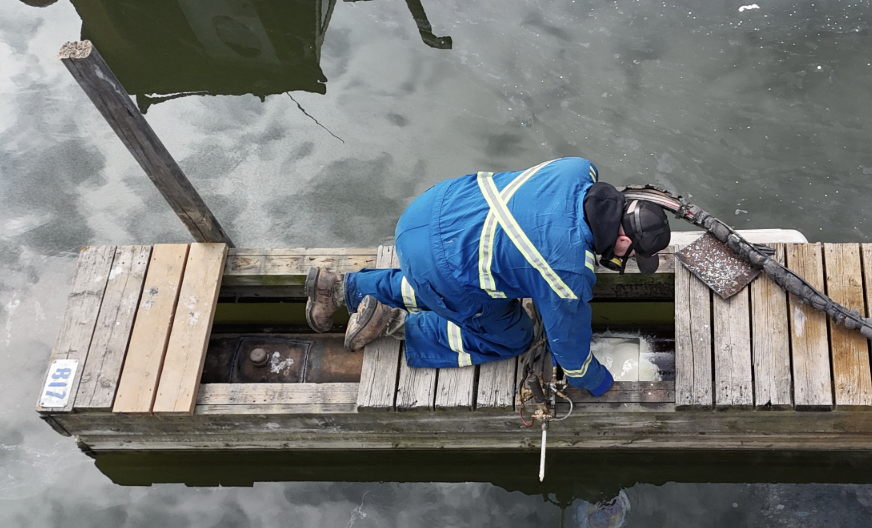
Al sprays Coast Guard- approved closed-cell marine foam into the deck voids while Shawn assists with the application process.
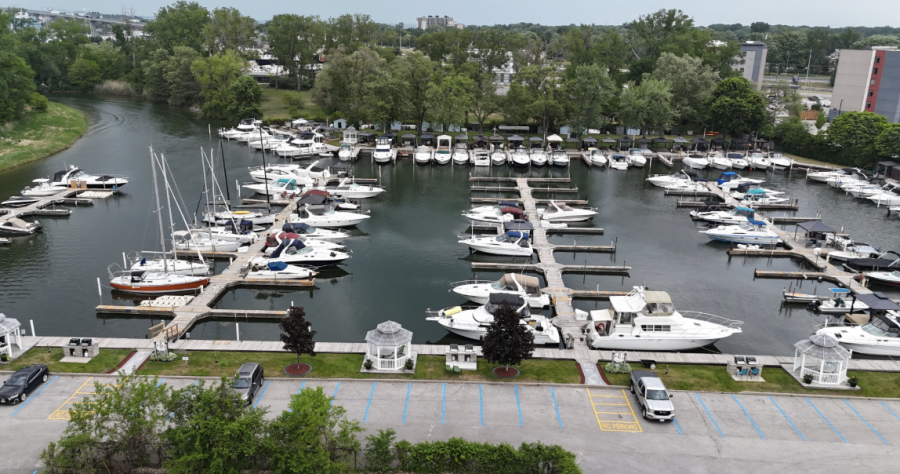
The marina is full of boats now, with all its docks free of water and floating evenly.
Locking onto their first soggy target, they started by removing a piece or two of decking board to access the dock’s internal flotation chambers. For badly waterlogged sections, they used a come-along pulley tool to lift and drain the trapped water back to its natural habitat—the harbor.
After mostly emptying the dock’s flotation chamber of water, they readied their equipment, an M-Power Spray Foam System, also manufactured by Empire Foam Solutions. They used this powerful machine to inject the EFS 2.2 LB density (2.2 pcf) closed-cell marine flotation foam into the dock system’s internal void spaces. The foam pushed out any water left inside, then sealed the void to prevent the water from ever returning. There was no need to spray to any particular nominal thickness. They injected as much foam as it took to expand and fill the void, exclude water, restore the dock’s flotation, and smooth out uneven dock elevations.
“The foam was injected into the full interior volume of each pontoon section until the cavity was sufficiently filled to restore flotation and structural support,” said Taylor.
Working on the marina had its share of expected challenges. Moving their equipment and workstations from deck to barge was a pain, but their M-Power Spray Foam System made the brunt of the spraying painless. For one, the machine’s ultra-portable design makes it easy to use wherever they need it—even, or perhaps especially, on a narrow dock floating in the middle of a harbor. It’s got a built-in gun that self-cleans with pressurized acetone, so the team could avoid wasting daylight with downtime and gun jams. The machine is designed to use the EFS marine foam, after all.
They went through multiple sets of the EFS closed-cell marine foam on the entire marina. Expanded, each set yields around 400 cubic feet. After each injection, the crew assessed the finished sections’ buoyancy, adjusting the pontoons. Once each section’s buoyancy had been tested and greenlighted, they’d replace the decking boards and move on to the next section.
After three or four weeks of hard work out on the water, Gordon’s Shoreline Marine got the Bridgeview-Guildwood Marina fully floating again, just in time for the rush of summer. Thanks to the closed-cell marine foam filling up its core, the dock’s structural integrity and flotation is restored. The marina can float on with no sagging or sinking in its future.
Disqus website name not provided.