








Tractor Time with Tim

Spray Foam Magazine – Summer 2026 – When homeowners and builders plan a new project—whether it is a residential home or a massive “dream shop”—the insulation conversation almost always centers on a single metric: R-value. We are taught that R-value, the measure of a material’s resistance to heat flow, is the ultimate yardstick of efficiency. The logic seems simple: if R-20 is good, R-60 must be three times better.
However, as Tim Marks, host of the popular YouTube channel Tractor Time with Tim, discovered during the construction of his expansive new machine shop, chasing a high R-value can be a tremendously expensive mistake. By focusing on the wrong numbers, builders often spend tens of thousands of dollars on “diminishing returns” while ignoring the most critical factor in climate control: air sealing.
Tim’s project wasn’t just a simple shed; it was a massive 96 ft x 56 ft structure with 18-ft-high walls. Designed to house multiple layers of tractor attachments and a dedicated wash bay for winter maintenance, the building needed to function like a fully conditioned home.
Tim’s goal was ambitious: maintain a consistent temperature of 67–68°F in the winter and 72°F in the summer using a geothermal forced-air system. To achieve this without astronomical energy bills, he had to look beyond standard insulation and investigate the science of the building envelope.
The Law of Diminishing Returns
The most significant misconception in the insulation industry is that energy savings scale linearly with R-value. In reality, insulation follows a sharp curve of diminishing returns. Moving from an uninsulated tin wall (R-0) to a basic layer of insulation (R-10) provides a massive, 90% reduction in heat loss. However, as you continue to add thickness, the benefit drops off precipitously. Increasing from R-30 to R-60—a move that effectively doubles material and labor costs—might only offer a marginal 1% to 2% increase in actual thermal efficiency. For Tim’s shop, following traditional “thick insulation” quotes would have cost upwards of $60,000, much of which would have been wasted on these tiny incremental gains.
The fatal flaw of traditional insulation, like fiberglass batts or blown-in cellulose, is that it is “air permeable.” You can have a two-foot-thick wall of fiberglass with a massive R-value, but if the wind is blowing against the building, that cold air will move right through the material. This is known as “wind washing.” Tim noted that traditional vapor barriers, like thin plastic or house wraps, are incredibly fragile. “If I take a screw accidentally... or I intentionally cut a hole for an outlet, I’ve broken my whole air seal,” Tim explained. Air can then migrate freely through the permeable insulation. In contrast, a building with a lower R-value that is perfectly sealed will always be more comfortable and cheaper to heat than a drafty building with a high R-value.
The Solution: Enverge OnePass Closed-Cell Spray Foam
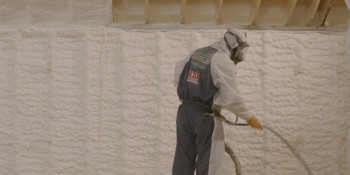
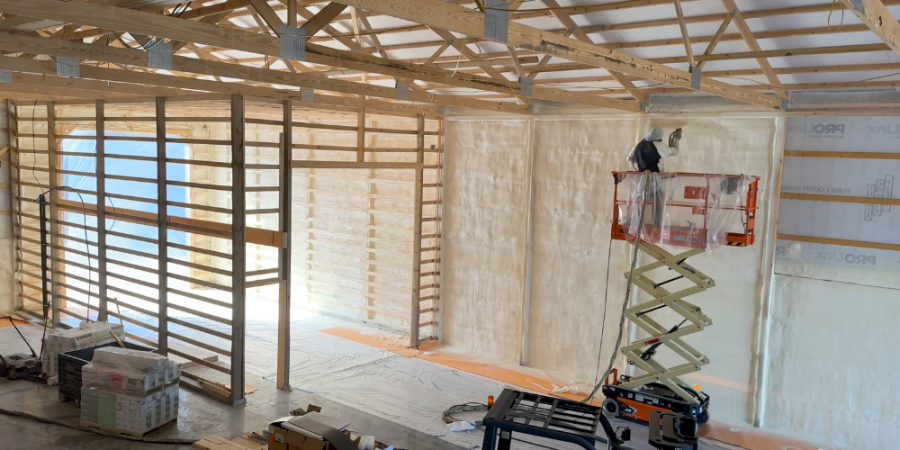
To achieve a truly high-performance building envelope, Tim turned to a high-tech solution: Enverge OnePass closed-cell spray foam, installed by the experts at The Insulation Guys. OnePass closed-cell spray foam is a gamechanger because it addresses two critical needs simultaneously: thermal resistance and a total air seal.
Traditional spray foams often have to be applied in thin “lifts” of two inches or less to prevent the material from overheating or failing to cure properly. This makes installing thick layers a slow, multi-day process. The Enverge OnePass technology allows installers to spray up to four inches in a single pass. This speeds up the construction timeline and creates a more uniform, monolithic seal against the building’s substrate.
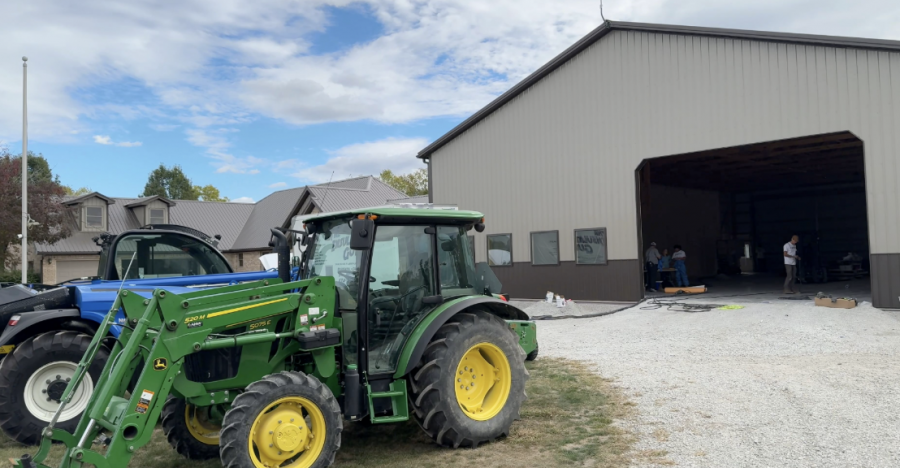
For Tim, this metal building isn’t just storage—it’s a dependable home for the equipment that keeps his operation running.
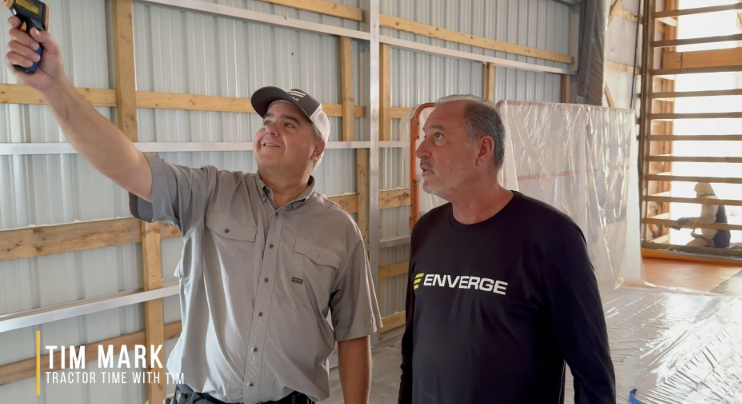
DIGITAL EXCLUSIVE // Watch the full shop install with Tim Marks on our Enverge Youtube Channel . Make sure to subscribe to get the first look at future projects, tech tips, and more!
By using Enverge OnePass, Tim achieved a building envelope that defies conventional expectations. In harsh northern climates, a shop sealed with roughly three inches of closed-cell foam (providing approximately R-21 to R-22) will often outperform a building with R-40 fiberglass. The foam expands into every nook and cranny, eliminating the “micro-drafts” that plague metal buildings and pole barns. Tim pointed out that “an average job of applying this spray foam is going to be a lot better air seal than a perfect job of applying fiberglass” because the material itself is the seal.
Beyond climate control, OnePass closed-cell foam adds significant structural rigidity to the building, effectively “gluing” the structure together. While Tim’s builder insisted on using a house wrap to maintain the steel warranty, the foam still provides these structural advantages. Tim also highlighted the importance of choosing closed-cell over open-cell foam for specific environments. While he initially considered open-cell to save money, the experts at Enverge advised against it for his wash bay and crawl space due to humidity concerns. Closed-cell foam’s resistance to moisture made it the only viable choice for a building where equipment would be washed throughout the winter.
The Importance of Professional Installation
One of Tim’s biggest takeaways was the necessity of hiring professionals like The Insulation Guys. Though Tim is a dedicated DIYer, he realized that spray foam application is a complex chemical process. The equipment is finicky and requires constant adjustment based on humidity and substrate temperature. An inexperienced operator might not recognize when the foam isn’t curing properly or expanding at the correct rate. “There is just no way that I could have done this from a DIY standpoint,” Tim admitted.
The lesson from the Tim Marks build is clear: Stop chasing a number on a bag and start focusing on the seal of the building. While the upfront cost of Enverge OnePass may be higher than fiberglass, the reduction in labor and the lifetime energy savings make it the more economical choice.
By combining this superior insulation with a geothermal HVAC system and solar panels, Tim expects to heat and cool his massive facility for virtually nothing. As energy costs continue to rise, investing in a high-quality air seal is a one-time expense that protects the property owner from future price hikes. Focus on the seal, and the efficiency will follow.
Contact Enverge If you have any questions about any of Enverge’s spray foam products or services: 713-239-0252 // EnvergeSprayFoam.com
Spray Foam Magazine does not take editorial positions on particular issues; individual contributions to the magazine express the opinions of discrete authors unless explicitly labeled or otherwise stated. The inclusion of a particular piece in the magazine does not mean that individual staff members or editors concur with the editorial positions represented therein.
See the Business Behind the Story:
Disqus website name not provided.