












Scholarly Spraying
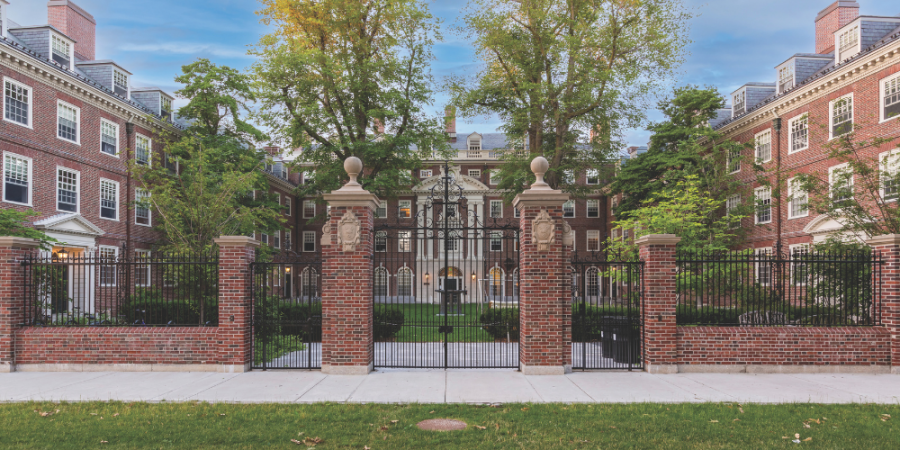

Spray Foam Magazine – Late Summer 2026 – North East Foam Solutions (NEFS) operates out of Dedham, Massachusetts and is proud to be one of the biggest union contractors in New England. Owner Doug Sharpe and Fred Palladino, Field Operations General Superintendent, have been in the insulation industry for 18 years, completing a wide range of high-profile projects. Universities are one of their most common clients, be it public colleges to Ivy League private schools. Past gigs include a blow-in job for Dartmouth and insulating a laboratory for Bridgewater State University, as well as a study pharmacy for Brown University. They were beyond confident they could “WOW” Harvard with their work. There was just one problem—their foam brand of choice, NCFI, was not on Harvard’s Sustainable Building Standards list.
Given the rigorous academic standards the schools in this area hold, it’s not surprising they also maintain high standards for the building materials allowed on their campuses. When NEFS was first contracted for a job at Harvard Business School, they thought they would have to choose between supplier loyalty and their client’s specifications. Instead, Doug and Fred opted to do things the hard, yet noble, way by getting NCFI InsulBloc approved by Harvard.
Doug submitted a winning bid after hearing about the job from Suffolk Construction, the general contractor (GC). Several of Harvard Business School’s dormitory buildings were undergoing a major overhaul, and retrofitting the attics with modern insulation was high on the docket. The large dorms they’d be working in are called Chase and McCulloch Halls, and the smaller building is named Dillon House. Each of the attic’s roof decks called for nine inches of closed-cell foam, and four inches on the walls. Harvard’s preapproved list of sustainable building products did not include NCFI, North East Foam’s ride or die supplier.
Other contractors may have conceded to sourcing approved foam just for this job, but Doug and Fred didn’t want to abandon their friends at NCFI, especially not for a job of this magnitude (95 sets). They’d rather jump through a million hoops to see NCFI approved. For them, it was a matter of professional principle.
NEFS hadn’t always used NCFI. But everything changed once COVID hit. The pandemic rocked the supply chain and forced their usual distributors to ration the number of sets allocated to each customer. Doug and Fred could only get their hands on a measly 32 sets per month, barely a fraction of their usual business volume. The situation got desperate in a hurry.
“I’m over here doing a truckload of foam every two weeks, but only getting 32 sets a month,” recalled Fred. “At that rate, we would have had to shut our doors in no time.” They sent out a distress signal and NCFI was one supplier quick to answer. And boy, did they deliver.
“NCFI came riding in on their white horses and promised to deliver material every month, but really, they brought me a truckload every two weeks. We’ve been loyal to NCFI ever since.”
With the supply crisis averted and their business still intact, NEFS vowed to show their gratitude to NCFI by offering unshakeable loyalty. All went well until they snagged the Harvard job, but Doug and Fred refused to give up on NCFI without a fight, mountains of paperwork be damned.
To convince Harvard’s Sustainability Department to add NCFI to their approved list, they’d need to take an academic approach. The department needed to see that NCFI’s foam was comparable to current approved foams, which means they’d need to submit studies and product tests for review. Fred and Doug’s verbal endorsement wasn’t enough. The onus was on them to prove NCFI was a high-quality product worthy of gracing Harvard’s hallowed halls. It would be a long process, and approval wasn’t even guaranteed. But they knew if they were successful, it would all be worth it.
They enlisted the help of their NCFI representatives at Tucker & Mulhern Associates, based in Pennsylvania. One of the reps, Drew Mulhern, was confident he could convince Harvard to give NCFI a chance. In addition to getting the NCFI foam approved, they also sought approval to use their preferred thermal barrier coating, Flame Control 60-60A.
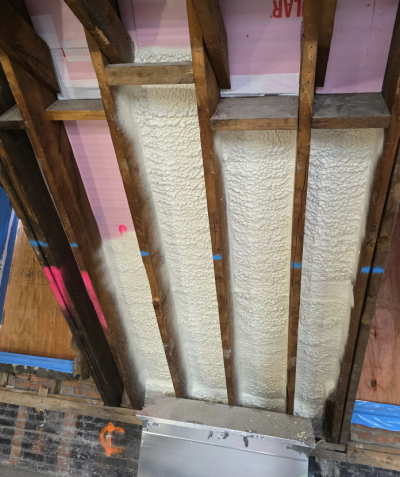
The architect requested a polystyrene residing board between the NCFI InsulBloc spray foam and roof deck. Doug’s team flash coated the board before spraying so it wouldn’t melt.
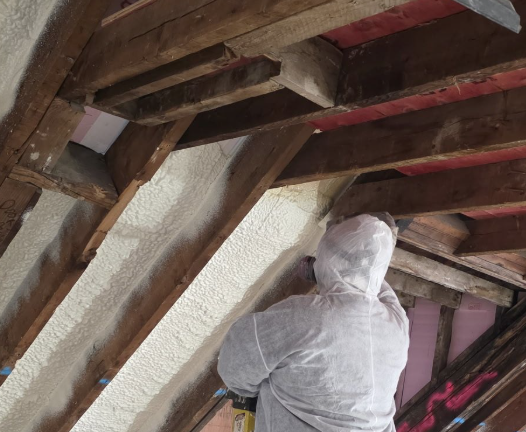
North East Foam Solutions installed nine inches of NCFI InsulBloc closed- cell spray foam between the attic rafters.
After six months of paperwork and endless back-and-forth, the Harvard Sustainability Department announced their decision to approve both products.
“Our NCFI reps at Tucker & Mulhern went to bat for us to get NCFI on spec,” Fred recalled. “Drew Mulhern did 80 percent of the legwork to get NCFI on Harvard’s sustainability list.”
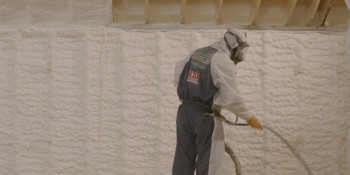
The approval came at just the right time, as the GC was now ready for the spray foam portion of the project. NEFS got to work spraying the historical dorm buildings, working in teams of three to retrofit the roof with nine inches of NCFI closed-cell foam and the walls with four inches. In all, they covered 60,000 square feet of walls and 22,000 square feet of roof with 95 sets of NCFI InsulBloc closed-cell foam.
While working on the Harvard campus, they ran three crews with three rigs. The exact time they reported for duty depended on the building they were working in. For instance, the Dillon house gets less foot traffic during the day, so the crews could get in and out early. But the McCulloch and Chase buildings are more crowded and harder to navigate during the day, so the crew would typically work later on the second shift.
The GC, Suffolk, handled a lot of the prep work for them so they could focus most of their efforts on the foam. Before they even arrived, the GC’s labor force ensured the work area was accessible and clean. The GC’s crews hung plastic masking as needed for any overspray containment, and made sure to mask the windows. They also took care to brush down the surface of the walls and roof to get rid of any loose debris that could affect the foam’s adherence, such as dirt, and dust. The GC’s conscientiousness saved the foam team a lot of time and effort. Even so, Fred double checked the surface to make sure it’s condition before giving his crews the go-ahead.
“We are only as good as our substrate, so I don’t pull the trigger until after I’ve inspected everything,” said Fred.
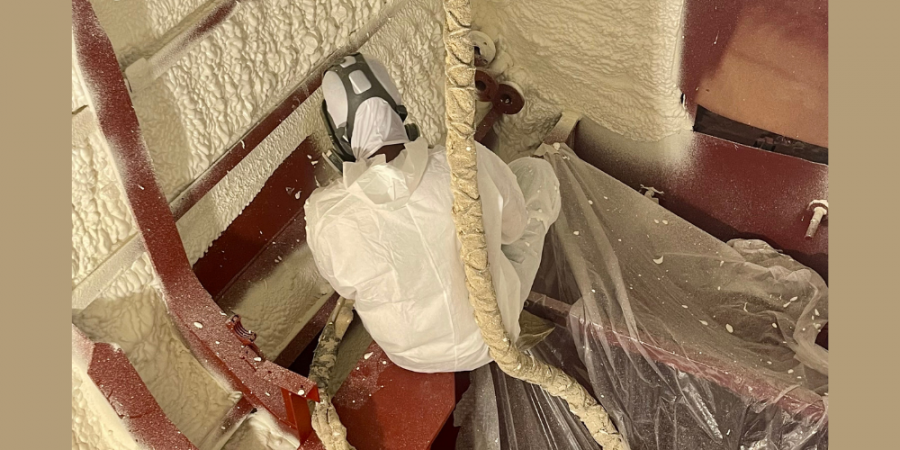
Working in the confined attic area meant they need to keep the air fresh and circulating. They set up air mover fans to bring in fresh air from outside and exhaust it through a heavy-duty HEPA filter. The applicator’s PPE included a universal flow respirator, protective coveralls, and gloves.
They installed the nine inches of NCFI InsulBloc closed-cell foam right between the roof deck’s wooden rafters in each building’s fourth-floor attic. They applied another four inches of NCFI foam to the attic’s brick walls. All foam was installed using a Reactor 2 and three E-30s with Probler P2 spray guns.
Although it seemed like a straightforward job on paper, the NEFS crew had a few challenging surprises waiting for them. Plumbing fixtures snaked along the attic walls and were difficult to avoid. The team needed to somehow insulate the walls behind the plumbing without covering the pipes with foam. This was for maintenance reasons, but also out of concern that the foam could damage the pipes if it made contact. No one wanted to risk messing up or blocking the plumbing, but both the architect and GC were out of ideas. Fortunately, Fred had encountered this type of thing before and knew exactly what to do.
On wall sections with too many pipes to safely foam, they installed a fluid-applied air and vapor barrier (AVB) membrane. They also installed three to six inches of Thermax polyiso board to the walls behind the pipes. The AVB and Thermax combo allowed them to skip the foam on the heavily plumbed areas while guaranteeing continuous insulation and a moisture barrier throughout the attic. When spraying other sections, they could easily tie the foam into the board to create a monolithic layer.
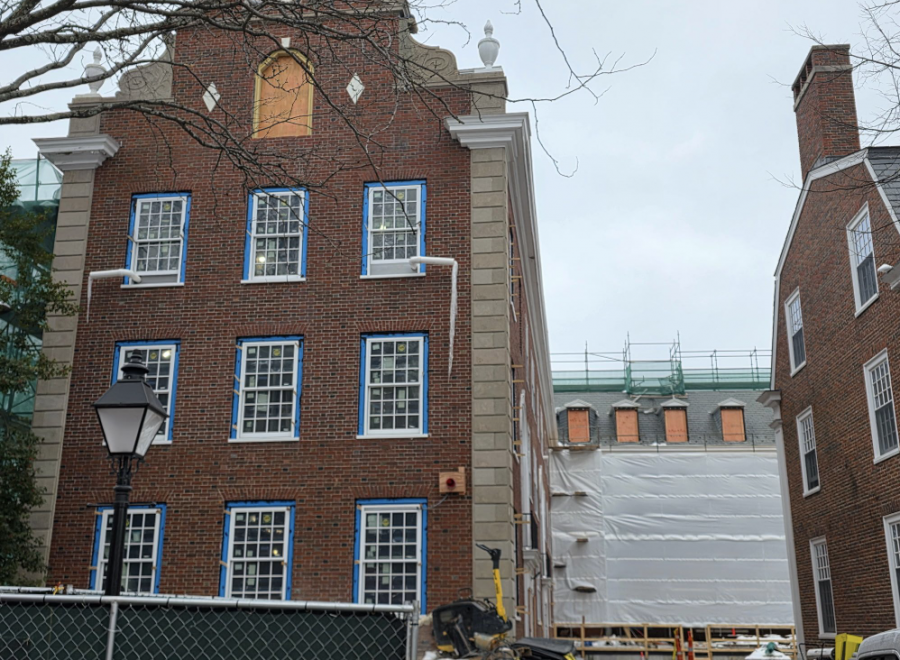
An exterior shot of the McCulloch Hall, featuring a containment barrier, masking over the attic windows, and exhaust venting out of the third story.

From left to right: Doug Sharpe, Fred Palladino, Luke Mulhern, Drew Mulhern, Dillan Mallory, and middle Jamie Spears.
NEFS had a few tricks up their sleeves for sticky situations, but sometimes they had to default to what the client wants. The architect was worried that installing the foam directly to the roof deck would result in damaged foam if roof sections ever needed to be repaired or replaced. The architect requested that Doug’s team install a quarter-inch foam board to the underside of the roof sheathing before spraying any foam. The extra foam board layer required them to add a one-inch flash coat across the entire roof before spraying, or else the foam would melt through the foam board. Fred wasn’t crazy about this detail, but his customer’s peace of mind was his top priority, so he obliged.
Once the foam cured, they added a Flame Control 60-60A coating. They lightly scraped the studs on a few sections where the foam had gone on a bit too thick, then cleaned up their equipment and called it a day.
After spending the last year installing 95 sets of NCFI InsulBloc onto brick walls and between rafters, they are just about finished with the Harvard dormitory project. Although Doug and his team are close to wrapping things up at Harvard, they know it won’t be their last foray into scholarly spaces. And if they’re called back to the prestigious university, they’ll be ready to hit the ground running with the knowledge that their preferred NCFI foam is already approved.
Disqus website name not provided.