












From Snow Drifts to Spray Foam

Spray Foam Magazine – Late Summer 2026 – The idea began with a question: if snow protects plants from freezing, could George Klat, founder of Frosco, develop a foam with similar benefits? He aimed to create an on-demand, scalable, and environmentally safe foam for the agricultural industry. Collaborating with researchers from Imperial College London, George developed a foam platform that not only insulates but also shields plants from heat, acts as a pest barrier, retains moisture, and supports soil health.
Many spray foam insulation manufacturers are adopting climate-friendly blowing agents with lower global warming potential and incorporating bio-based materials like castor oil and soy to reduce environmental impact. Spray Foam Magazine is committed to exploring bio-based foams across industries. So, we spoke with George Klat to learn how his agricultural foam company, Frosco, was founded.
In the summer of 1992, George Klat worked on an organic mixed farm in the United Kingdom. While he admired the farm’s goals, he encountered the challenge of fly strike in sheep, a serious condition caused by blowflies. This experience may have influenced his later focus on plant protection.
During the 1990s, growers typically addressed crop and weather challenges independently due to limited available solutions. After a period away from farming, George managed an organic market garden for several years before establishing a vineyard in the Thames Valley, west of London. Recognizing the value of vineyards, he began seeking effective risk mitigation strategies.
For ground-level crops, insulation materials like fleece or straw can slow heat loss, leveraging the soil’s thermal mass. However, vine buds on thin canes above ground lack this protection and require additional energy input. Common solutions include electric cables, gas heaters, wind machines, or, most frequently in vineyards and orchards, paraffin candles. All of which are expensive, and the outcome not guaranteed.
George investigated researchers in the 1960s who explored foam as a frost protection method. Early foams provided insulation by reducing heat loss from plant surfaces, but issues with stability and application limited their adoption. Today, advancements in materials and a renewed focus on sustainable agriculture, along with Frosco’s biodegradable, plant-safe ingredients, are renewing interest in foam for agricultural applications.
According to George, Frosco foam works differently. It uses the latent heat naturally stored in water as it freezes and melts. Rather than simply acting as a blanket, the foam is designed from the molecular level upward to both release heat and slow heat loss. Nature offers good examples of this principle: feathers create ultra-low-density insulation, while adipose tissue stores and releases latent heat, as seen in camel humps and whale blubber. Frosco combines both ideas: insulation and controlled thermal energy release. George describes it as a thermal shock absorber.
When water freezes, it releases heat; thus, crystallization is an exothermic process. By structuring the water inside the foam using hydrophobic and hydrophilic regions, the Frosco foam can control how that heat is released and maintain a steady temperature around 0°C. Plant cells contain dissolved salts, which lower their internal freezing point to around -2°C. So, if Frosco can keep the plant’s surface at 0°C, they prevent freeze damage inside the cells. “This principle is already used in sprinkler frost protection systems, where ice forms continuously around plants. That method works well, but it requires enormous amounts of water, creates heavy ice loads that can break stems, and leaves the ground heavily waterlogged. Frosco delivers the same latent heat effect with a fraction of the water and without the disadvantages of ice buildup,” explains George.
In the spray foam industry, we have specialized high-pressure equipment. However, applying Frosco foam was initially an enormous challenge. For example, in a vineyard, the target is often a thin cane only about one centimeter in diameter. To apply enough foam at a practical speed, there needs to be a very high foam volume but with a very low exit velocity so that the foam can adhere to the target without being blasted off. Frosco therefore developed a prototype tractor-mounted foamer that achieves this. It is a compressed air foam system that uses manifolds to distribute air evenly through multiple hoses and can be mounted on standard agricultural tractors, thus cutting back on any extra expenditure for the grower.
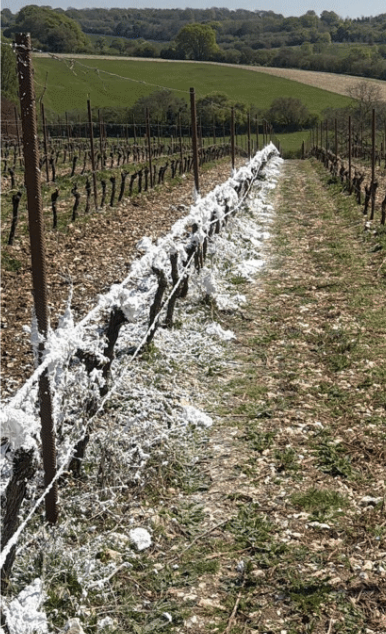
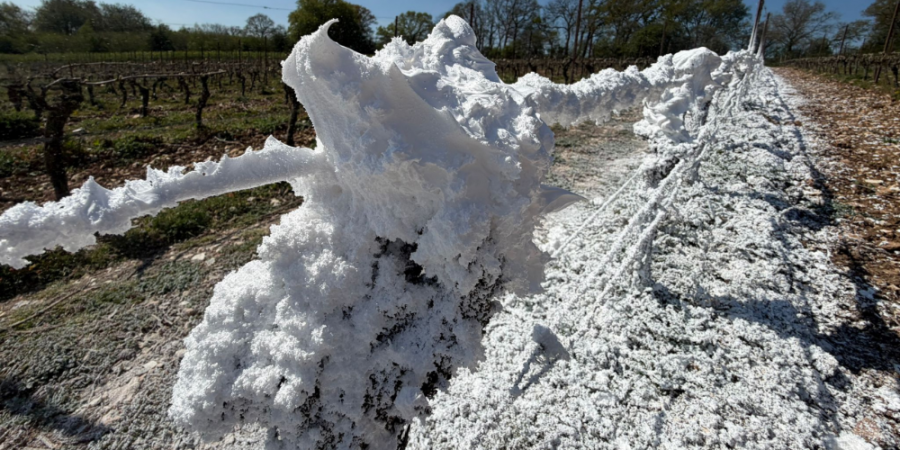
Vineyard in Surrey where Frosco conducted a small field trial, applying the foam prior to a frost event.
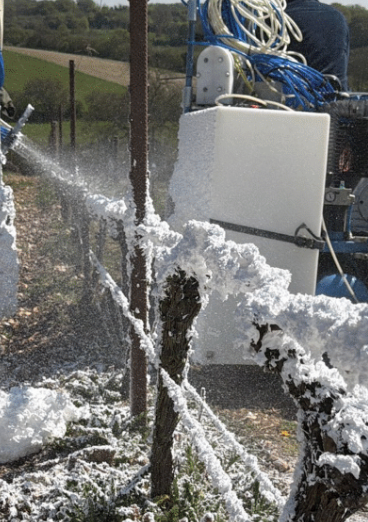
Prototype tractor- mounted compressed air foam system developed for applying foam to thin vine canes just after bud burst, when they are vulnerable to frost.
Preventing the evaporation of the water fraction is crucial, especially during the first two nights of a prolonged frost event. The Frosco foam can be rehydrated in situ using a fog nozzle if needed. In dry conditions, it can dehydrate while still maintaining its structure and overall volume. In effect, it becomes an aerogel (a lightweight, porous material) with exceptional insulation properties.
In advective frosts, periods when strong, cold winds from polar regions bring freezing air, most traditional protection methods struggle. “Frosco performs differently. It can form a frozen shell over the foam itself, creating a protective cocoon around the bud and keeping the wind out. This principle is also being tested successfully in Sweden on large sugar beet clamps, which are large piles of harvested beets, where freezing winds can penetrate storage piles and cause major losses,” says George.
Current frost protection systems are extremely expensive. Lighting paraffin candles, for example, can cost around $2,700 per hour per hectare per night, plus significant labor. Some large vineyards keep dozens of workers on standby for weeks just to be ready to light candles at short notice. Some even hire helicopters to hover over vineyards overnight to mix warmer air from above. “Frosco is designed to cost around $677–$1,355 per hectare. It can remain effective for several nights, until the plant grows through it, or until rain washes it away. It also works in windy advective frosts, where wind machines and many other systems fail,” confirms George.
Frosco foam consists of approximately 90% air and 9.9% water, leaving virtually no waste. It is biodegradable, safe for animals, and made from ingredients already used in agriculture. The foam can remain on buds for several days without causing damage. Its soluble liquid form allows it to deliver bio-stimulants, foliar feeds, and plant signaling molecules, helping to protect against frost and prime plants for future stress. Prolonged contact is important, as plant immune responses require sustained exposure.
Most construction foams are polyurethane-based, with an increased focus on the bio-based foams. Frosco is plant-based and biodegradable, drawing inspiration from nature. For example, spittlebug larvae create protective foam from plant sap and urine, shielding themselves from UV radiation and predators. Some frogs also build foam nests that adhere to leaves and withstand wind and rain. These examples demonstrate that foam can also be lightweight, durable, protective, and biodegradable. Frosco applies these principles using plant-derived ingredients.
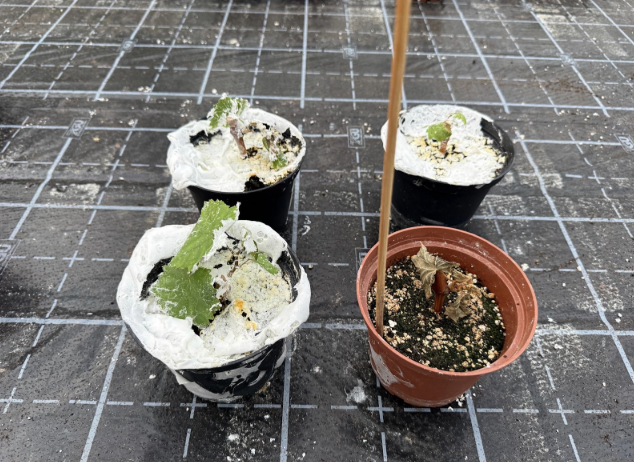
Frost protection trials at VWO Weinsberg, Germany. Four vine cuttings were exposed to several nights of frost: three protected with Frosco foam and one left untreated. After the foam was removed, all protected vines survived, while the unprotected vine was lost to frost damage.
Frosco ensures its formulation is harmless to plant tissue and soil after it breaks down. The foam is mainly air and water. The rest is made from natural plant-derived acids and food-grade counter ions. “In many ways, it becomes a partially digested buffet for microorganisms and soil life. Rather than creating waste, it contributes back to the biological system,” says George.
As the spray foam insulation industry expands and develops bio-based foams, the question arises: could it transfer some of Frosco’s technology into spray foam insulation? George responds enthusiastically: “Yes, absolutely. Phase change materials are already used in several industries. However, using water as a phase change material is still quite unusual, even though it is the most powerful and accessible. Combining ultra-light insulation with controlled latent heat release has applications far beyond agriculture. I would welcome collaboration with companies interested in adapting the technology to construction or other sectors.”
Frosco is completing its second year of field trials. George’s immediate goal is to launch the frost protection foam in the southern hemisphere before the late spring frost season. Production capacity is also being increased to ship intermediate bulk containers (IBCs) of concentrated solution internationally. Frosco is also seeking regional production and distribution partners to support local manufacturing and adaptation.
In the UK, Frosco is represented by its distributor, Vine Care, owned by Paul Woodrow-Hill, who has been involved in the English wine industry for several decades. As Frosco is still gathering field data, the foam is currently being applied to a few rows of vines at a time rather than full commercial blocks. Research is also being conducted by Martin Fujishin at Walla Walla Community College in Washington State, USA, as well as across Europe with Chambre d’Agriculture Loire in France and Weinsberg LVWO in Germany. It is also being tested on orchard fruits, where it has proven safe even on fragile blossoms.
During Frosco’s recent vineyard visits in England, growers had previously been lighting paraffin candles several nights in a row. One vineyard has already lost more than half of its buds on the lower slopes. George has first witnessed growers increasingly concerned about destructive frost events occurring between bud burst and the final spring frosts. “This risk is becoming worse as bud burst happens earlier each year, a phenomenon often linked to climate change and known as false spring. That is exactly the problem Frosco is designed to solve, but what we have developed can be used for much more.”
Spray Foam Magazine is eager to see Frosco’s eco-friendly foam advance in the agricultural sector. It is important for the spray foam insulation industry to stay informed about innovations across disciplines, as these bio-based foams set new standards for performance and sustainability.
Disqus website name not provided.