






A Relaxing Environment, or so You Thought

Spray Foam Magazine – Show 2026 – Well, the winter blast, Winter Storm Fern, has been upon us! Hope all stayed warm and safe, and all are looking forward to warmer weather.
For those who follow the social media groups, such as Polyurea World and even Spray Foam World Wide, there have been quite a few posts on the subject of using “polyurea” to re-line swimming pools. Fantastic idea and opportunity, right? Numerous “pros and cons” discussions have occurred, and some postings referencing the workings.
While there may be a few polyurea suppliers that note their system for swimming pool applications, most of these refer to the concrete decking area, not the pool lining itself. Just note that a pool deck (splash and spill) is not the same as in continuous, chemical immersion lining situations.
This article does not aim to express an opinion on the subject.
The following is a brief insight into what to consider, is polyurea, or polyurea / polyurethane hybrids, the right choice?
Chemistry and Performance
There are two basic types of polyurea systems, aromatic and aliphatic based. While aromatic systems have been referred to as the “workhorse” materials, they are prone to surface oxidation. Whereas properly formulated aliphatic systems are resistant to surface oxidation. This was discussed in the Fall 2023 issue of Spray Foam Magazine.
Sunlight is a strong oxidizing agent. Personally, we have all experienced this when in the sun and having the not so fun sunburn. Aromatic based system will also experience the same, as noted in surface color change as well as possible surface chalking in some systems.
Ah - but so is chlorine, like that found in swimming pool applications. This is a chemical oxidation process which also affects the aromatic based systems. This is chemistry at work. Reports over the years have shown that when some pools are lined with a blue pigmented aromatic polyurea system, people exit the pool and their skin has been stained blue. Yes, that is true and was most likely due to a combination of the aromatic system used, and an improper blue based additive for color.
And then one has the difference between a managed chlorine treatment, such as institutional pools, and the local homeowner that “shocks” the pool with chlorine or bromate tablets. Excessive amounts of the oxidizing substance sets at or near the bottom and can wreak havoc on the lining material.
Very important, the polyurea system shall have a very low moisture vapor transmission (MVT) rate, as per ASTM E 96 Standard Test Methods for Water Vapor Transmission of Materials. And while most systems may have a reported MVT that would classify the system as a Class II (low permeability) moisture vapor barrier, this is good for general protective coating work. A Class II is rated at greater than 0.1 perms and less than or equal to 1.0 perms.
For long-term immersion work, a Class I (Very Low Permeability): Rated at 0.1 perms or less, should be used. This is specifically addressed in the performance standard from AMPP (Association for Materials Protection and Performance), SSPC-Paint 45: Two-Component, Thick-Film Polyurea and Polyurea/Polyurethane Hybrid Coatings, Performance-Based.
Keep in mind that many bedliner systems, which work great in bedliner application work, are typically Class II to Class III (greater than 1.0 perms) vapor barrier materials. These systems are not suitable for immersion work like swimming pool linings.
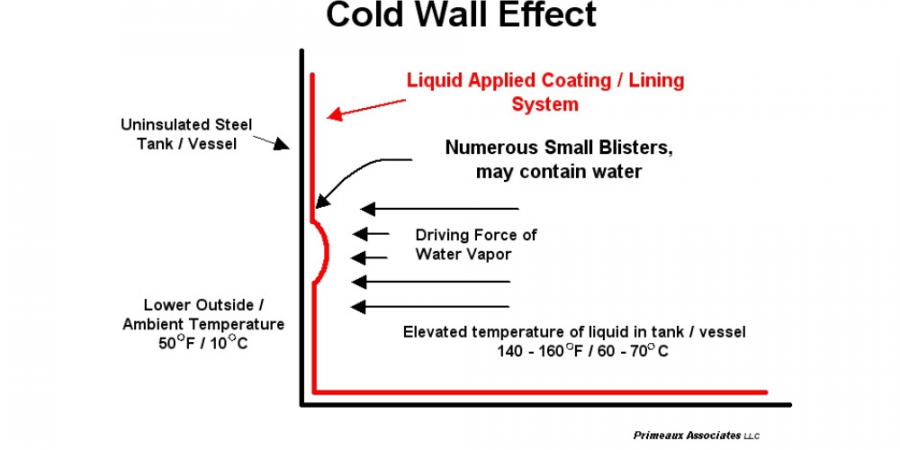
Couple these various MVT ratings and a heated pool application, then one can experience blistering of the lining system. This can occur both below the liquid level and above the vapor space if the pool is covered. This is referred to as the Cold-Wall Effect, where there is thermal gradient where the heated liquid vapor ingresses through the lining to the cold substrate faster than it egresses.
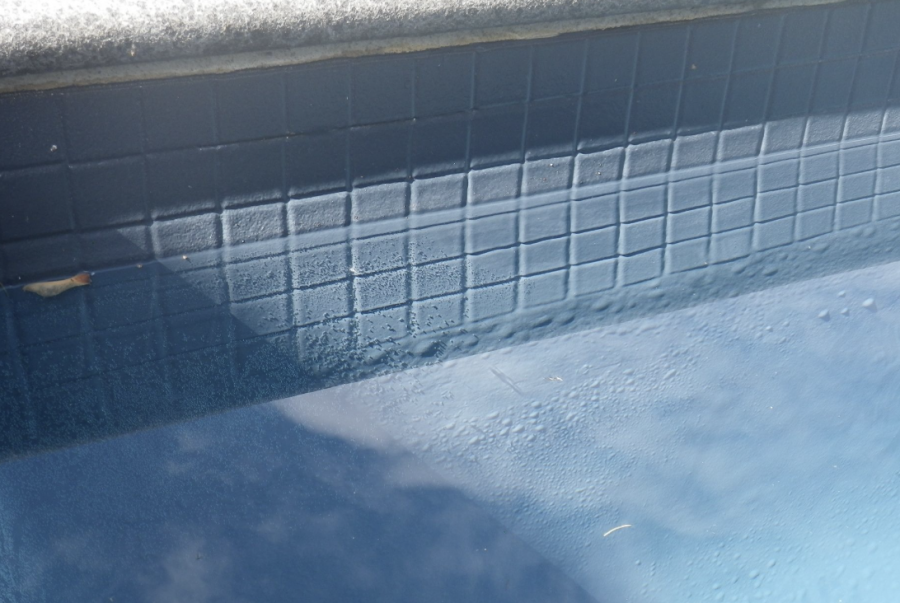
Blistering in pool.
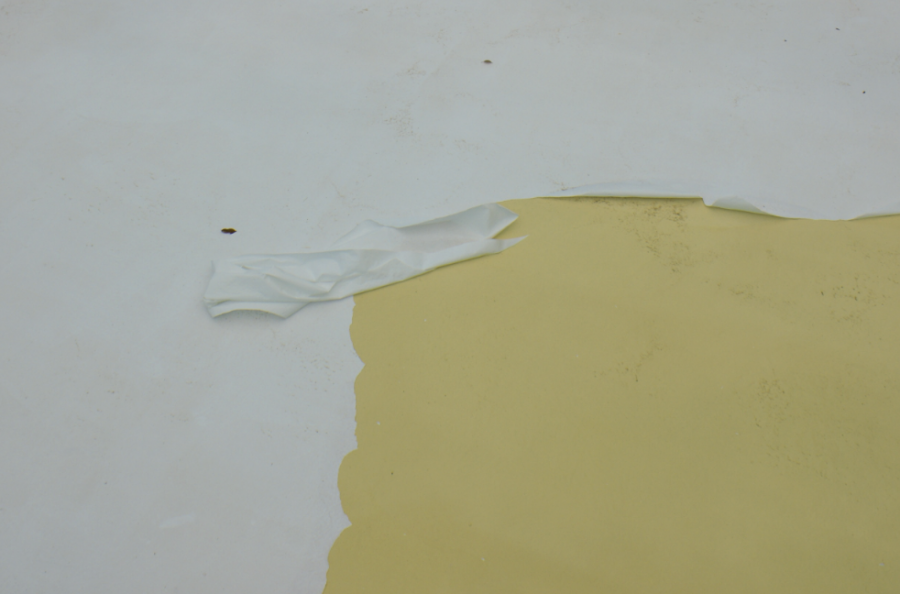
Peeling topcoat in a swimming pool in Denmark.
Surface Preparation
As with any liquid immersion application, substrate evaluation and subsequent surface preparation is crucial to successful application work. This lack of understanding of evaluation and proper preparation has led to many issues in the field. This was highlighted in the Late Summer 2023 issue of Spray Foam Magazine.
A few years ago, when evaluating a massive series of swimming pool lining failures, the contractor used Muriatic Acid (HCl) to clean the cementitious based pools before the lining work. The problem, the acid does not “clean” the substrate per say but attacks the concrete paste. When not properly and completely rinsed, additional chloride ions will be present within the matrix of the substrate. Check the pH of the concrete after rinsing to ensure the pH of the concrete is at least 8 – 9. If not, continue rinsing, lots of clean water here. Use caution with Gunite pools, compared to solid concrete.
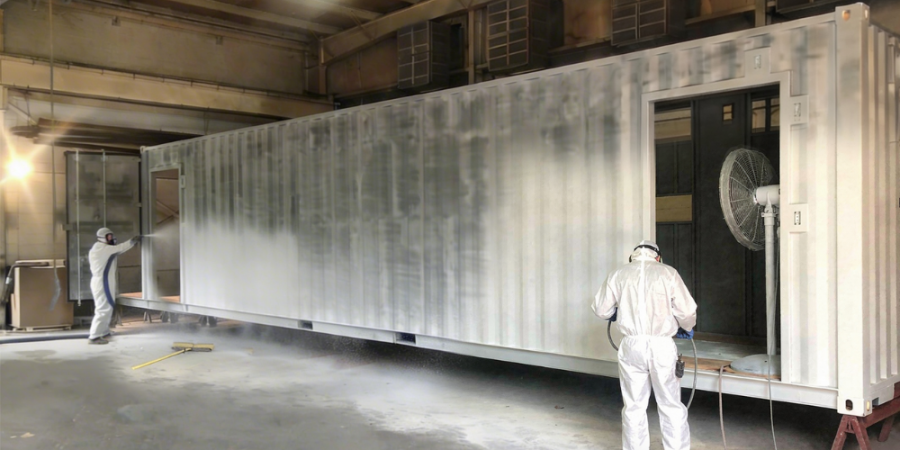
For steel substrates, such as the converted container pools, the proper surface preparation will require abrasive blasting to achieve a White-Metal Blast cleaning with a minimum 3-mil (76 µm) profile. This is achieved by utilizing SSPC-SP 5, SSPC-SP 5 WAB, NACE No. 1, NACE WAB-1 or ISO 8501-1 Sa 3. Failure to perform the proper surface preparation will lead to blistering and disbonding of the lining system.
Fiberglass lined pools can also be a consideration here for relining. Understanding why that has failed and what the expectations are of the pool owner shall be considered.
Proper Topcoat
For performance, a properly suited and compatible topcoat will be required. These can be the typical “pool paint” systems, including acrylic-modified aliphatic urethanes, proper epoxies, fluoropolymer-based coatings, or even chlorinated rubber pool paints. In some cases, a well formulated polyaspartic ester system may be applicable.
Given that many polyurea systems have re-coat windows of less than 12 hours, some even note a recoat of 1 hour, topcoat material requires immediate application. If the topcoat is applied outside the recoat window on the base coat material, disbonding of the topcoat will occur.
When using the proper silicone-based sealants around penetrations, etc, this shall be applied after the lining system has been applied. Reasoning here is that the sealant will bond to the lining material, but the lining material will not bond to the silicone sealant.
CONCLUSION
Should one choose to pursue this specific application area, make sure all the proper steps are followed. Work with a material supplier that promotes and stands by a complete system for this application work! Evaluate the conditions of exposure and substrate before taking on a project of this type. This is a performance immersion application, exposure with the general public, and not like a standard secondary containment project. Also consider the expectations of the pool owner, specifically aesthetics. It is not just polyurea, but a well assembled system of primer, basecoat and proper topcoat.
Disqus website name not provided.